
Mastering photography, like astrophotography, means learning about technical details that affect image quality. One key aspect is backfocus. It’s the distance between your camera’s sensor and the telescope’s rear.
Getting this distance right is essential for the best results. That’s where spacers help. They let you adjust the backfocus to fit your equipment perfectly. Learning to use spacers well can greatly improve your astrophotography.
As you dive into photography, knowing about backfocus and spacers will boost your skills. It’s a step towards better photography.
What is Backfocus?
Understanding backfocus is key to taking sharp photos. Backfocus is a vital part of photography that greatly affects your image quality. It’s the distance from the camera sensor to the back of the telescope or lens.
Definition of Backfocus
Backfocus is the distance from the camera’s sensor to the lens or telescope’s rear. This distance is crucial because it impacts how images are captured. When backfocus is right, your photos will be sharper and clearer.
Importance in Camera Systems
In camera systems, backfocus is very important for the best image quality. It ensures the camera is aligned with the lens or telescope. Correct backfocus improves camera performance, leading to more detailed images.
How It Affects Image Quality
The backfocus setting greatly impacts your image quality. If it’s off, your photos might be blurry or out of focus. But, with the right backfocus, your images will be sharp and detailed. Knowing how to adjust backfocus is essential for better photography.
Learning about backfocus and its role in camera systems helps you set up your gear for the best results. This knowledge will improve your photography skills and enhance your overall experience.
The Concept of Spacers
Spacers are key to getting the best images in photography. They adjust the space between your camera and the telescope or lens. This ensures your images are sharp and clear.
What Are Spacers?
Definition and Purpose
Spacers are rings or tubes that change the camera’s distance to the telescope or lens. Their main job is to get the right backfocus distance. This is essential for high-quality images.
Types of Spacers
There are many spacer types, each for different needs and gear.
- Standard spacers: These are the most common type and are used for general adjustments.
- Threaded spacers: These have internal threads that allow for the attachment of other components.
- Adjustable spacers: Some spacers are designed to be adjustable, allowing for fine-tuning of the backfocus distance.
Applications of Spacers in Photography
Spacers are vital in photography, like in astrophotography and with telescopes or lenses needing precise adjustments.
| Application | Description | Benefit |
|---|---|---|
| Astrophotography | Adjusting backfocus for telescopes | Sharp, clear images of celestial objects |
| Macro Photography | Fine-tuning lens distance | Highly detailed close-up images |
| General Photography | Ensuring optimal camera sensor distance | Better overall image quality |
By using spacers well, photographers can greatly improve their image quality. Whether it’s the night sky or close-up shots, spacers are crucial for the best results.
The Relationship Between Backfocus and Spacers
Understanding backfocus and spacers is key for great photos. Backfocus is the distance from the camera sensor to the telescope’s rear. Spacers help adjust this distance for the best image quality.
Backfocus and spacers work together to align your camera for sharper images. With the right backfocus using spacers, your camera sensor is at the perfect spot. This leads to precise focusing and less distortion.
How They Work Together
Spacers adjust the backfocus distance to the length recommended by the maker. They help fine-tune the backfocus for the best image quality. This is very important in astrophotography, where focus must be exact.
To get the best backfocus, you need to know how spacers affect your system. The spacer goes between the camera and the telescope or lens. It changes the distance to the right length. This ensures the camera sensor is at the best spot for sharper images.
Correcting Backfocus with Spacers
Fixing backfocus with spacers means adjusting the spacer to the right distance. This needs patience and careful attention. Small changes can make a big difference in image quality.
- First, check your manufacturer’s guidelines for the right backfocus distance.
- Then, use spacers to adjust the backfocus to that length.
- Lastly, test your camera system to make sure the backfocus is correct.
By following these steps and using spacers to fix backfocus, you can get the best image quality. This will greatly improve your photography experience.
Signs of Backfocus Issues
Spotting backfocus problems is key to fixing them and bettering your photos. Backfocus issues can show up in many ways, impacting your photo’s quality.
Symptoms to Look For
Backfocus troubles might make your photos blurry or soft, mainly with certain lenses or conditions. Common signs include:
- Images that are blurry or out of focus, even when the camera is set right.
- Inconsistent image quality, with some shots sharp and others not.
- Hard time getting sharp focus with some lenses or camera settings.
For more detailed guidance on setting the correct backfocus, check out this article on adjusting backfocus settings.
How to Diagnose Backfocus Problems
Diagnosing backfocus problems needs a careful method. Begin by testing your camera and lenses in controlled settings to spot any image quality issues. Take multiple shots of the same subject, tweaking the focus a bit between each one.
Looking at these images can show if backfocus is a problem and how big it is. It’s also crucial to check your camera’s calibration and make sure your lenses are aligned right.
Measuring Backfocus in Your Camera
Learning how to measure backfocus is key for top-notch photos. Backfocus is the distance from the camera’s sensor to the lens’s rear when it’s in focus. Getting this right is vital for your camera’s best performance.
Tools You Need
To measure backfocus, you’ll need a few tools. You’ll need a backfocus adjustment tool, a lens alignment tool, and a high-quality test chart. The test chart should have a clear pattern for checking image sharpness.
You might also need a computer with image analysis software. Some cameras come with tools for this. Check your camera’s manual or the manufacturer’s website for details.
Step-by-Step Measurement Process
Measuring backfocus involves several steps. First, set up your camera and test chart as instructed. Make sure the camera is aligned with the chart and the lighting is good for clear images.
Then, take pictures with different focus settings. It’s important to do this methodically for reliable data. After taking the images, use your software to check their sharpness and find the backfocus.
By following these steps and using the right tools, you can accurately measure backfocus. This will help you adjust your camera for better performance. For more on adjusting backfocus, see the next sections of this guide.
Adjusting Backfocus
To get the best images, knowing how to adjust backfocus is key. Backfocus adjustment makes sure your camera’s sensor lines up with the lens’s image plane. This is vital for clear images.
Methods for Adjustment
There are a few ways to adjust backfocus. You can use spacers, move the camera’s sensor, or mix both. Spacers are a popular choice because they let you control the distance between the lens and sensor precisely.
- Using spacers to adjust the lens-to-sensor distance.
- Adjusting the camera’s sensor position.
- Combining spacers with sensor adjustments for fine-tuning.
Choosing the right spacer thickness is important. The spacer’s thickness depends on your camera and lens.
| Spacer Thickness (mm) | Backfocus Adjustment |
|---|---|
| 0.1 | Minimal adjustment for fine-tuning. |
| 0.5 | Moderate adjustment for most lens configurations. |
| 1.0 | Significant adjustment for lenses with larger backfocus issues. |
When to Make Adjustments
Make backfocus adjustments when your images start to blur or when you switch lenses. Regular checks are advisable to keep your camera in sync with your lenses.
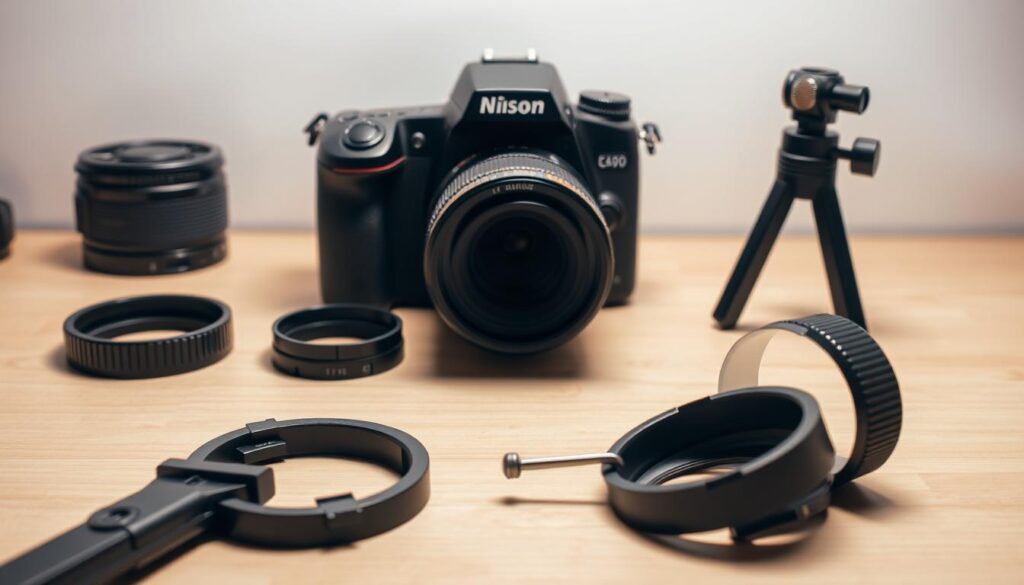
Knowing when and how to adjust backfocus helps keep your camera system sharp. This ensures your images stay high-quality.
Importance of Calibration
To get the best image quality, knowing how important calibration is key. Calibration makes sure your camera works right. This is crucial for taking clear pictures.
Why Calibration Matters
Calibration is important because it affects your photo’s quality. When your camera is calibrated right, your photos will be sharper and colors will be more accurate. This is very important for professional photographers who need precise images.
Proper calibration can greatly improve your photos. This is true, even with complex setups involving backfocus and spacers.
| Calibration Aspect | Importance | Impact on Photography |
|---|---|---|
| Backfocus Adjustment | High | Ensures sharp images by adjusting the camera’s sensor position. |
| Spacer Alignment | Medium | Affects the overall optical setup, influencing image quality. |
| Sensor Cleaning | High | Prevents dust and smudges from affecting image quality. |
How Often Should You Calibrate?
How often you should calibrate depends on how much you use your camera and the conditions. Professional photographers should calibrate at least once a year or after big changes or upgrades.
If your photos start looking worse or if your camera has been in tough conditions, you might need to calibrate more often.
Common Misconceptions About Backfocus
It’s important to know the truth about backfocus in photography. Many photographers face backfocus problems because of misunderstandings. These misunderstandings can make it hard to fix the issue.
Myth vs. Reality
Many think backfocus is always a camera or lens problem. But, it can be caused by many things. This includes the camera’s setup, the lens, and how the photographer works.
Understanding the causes is key to solving backfocus problems. For example, using the right spacer can greatly improve your photos. It makes sure the lens is in the right spot for the camera’s sensor.
Understanding the Facts
To handle backfocus well, knowing the facts is crucial. Here are some important points:
- Backfocus isn’t just a camera or lens problem. It can be affected by many things.
- Getting your camera calibrated right is very important for backfocus.
- Spacers can fix backfocus by changing the lens’s position relative to the camera’s sensor.
Now, let’s look at how different methods compare for fixing backfocus:
| Method | Description | Effectiveness |
|---|---|---|
| Spacer Adjustment | Using spacers to adjust the lens’s position | High |
| Camera Calibration | Calibrating the camera for accurate backfocus | High |
| Lens Replacement | Replacing the lens to resolve backfocus issues | Variable |
By knowing the truth and clearing up myths, photographers can better solve backfocus problems. This leads to sharper photos and better photography results.
Maintaining Your Equipment
Keeping your camera gear in top shape is key for great photos. This means taking care of the camera itself, lenses, spacers, and more. They all help make your photos look amazing.
Best Practices for Camera Care
To keep your camera in great shape, follow some simple steps. Always handle your gear with clean, dry hands to avoid smudges and damage. Clean your lenses and camera body often to keep dust and dirt away from your photos.
Storage is also very important for your camera’s health. Store your camera and lenses in a cool, dry spot, away from sunlight. Use protective cases or bags to keep them safe from dust and damage.
Protecting Your Spacer and Backfocus System
The spacer and backfocus system need extra care. Make sure your spacers are clean and free of debris. Any blockage can mess up the backfocus adjustment. Handle the backfocus system gently to avoid breaking it.
- Check your spacer and backfocus system often for wear or damage.
- Use a soft brush or air blower to clean out dust or debris from the spacer and backfocus area.
- When adjusting the backfocus, follow the manufacturer’s instructions to avoid damage.
By following these backfocus and spacer tips, your camera’s backfocus system will work better. This means sharper images. Adding these backfocus and spacer techniques to your routine will improve your photography.
Troubleshooting Backfocus Problems
Getting your camera’s backfocus right is key for top-notch photos. Troubleshooting is a big part of this. If your camera’s backfocus is off, it can mess up your photos. Knowing how to spot and fix these issues is vital for photographers.
Common Issues and Their Solutions
There are a few common problems that can cause backfocus issues. These include:
- Misaligned camera sensors: Make sure your camera’s sensor is lined up with the lens.
- Incorrect spacer usage: The wrong spacers can cause problems; always use the right ones for your camera and lens.
- Lens and camera body compatibility: Check that your lens fits your camera body, as the wrong one can cause backfocus problems.
To fix backfocus issues, follow these steps:
- Look in your camera’s manual for how to adjust backfocus.
- Use a backfocus chart or tool to measure and adjust your camera’s backfocus.
- If you’re not sure, ask a professional for help.
When to Seek Professional Help
If you’ve tried to fix backfocus problems and still have issues, it’s time to get help from a pro. Experts have the right tools and know-how to solve tough backfocus problems. Also, if you’re using special or high-end gear, it’s safer to let a pro make adjustments to avoid damage.
By knowing common backfocus problems and when to ask for help, you can make sure your camera works its best. This way, you’ll get the quality photos you want.
Advanced Techniques for Experienced Photographers
Exploring advanced backfocus and spacer techniques can change your photography game. It brings unmatched image quality. As you get better, knowing how to use backfocus and spacers well is key.
Fine-Tuning Backfocus
Fine-tuning backfocus means making small changes to your camera to get sharp images. It’s detailed work that needs patience and a good grasp of your gear.
Key steps in fine-tuning backfocus include:
- Using special tools to measure backfocus accurately
- Making tiny adjustments to the camera’s sensor position
- Checking the results with test shots
By carefully fine-tuning backfocus, you can make your images sharper and clearer. This is very important for macro or landscape photos.
Custom Spacer Solutions
Custom spacers let photographers adjust their camera setups as needed. By choosing spacers that fit your photography style, you can get the best results.
Benefits of custom spacer solutions include:
- Better image quality by controlling the lens to sensor distance
- Works better with special or non-standard gear
- Allows you to adjust your camera for different photo styles
Using custom spacer solutions and fine-tuning backfocus lets pros get amazing results. They can do things with their cameras that impress both technically and creatively.
Conclusion: Mastering Backfocus and Spacers
Understanding backfocus and spacers is key to great photos. Knowing how they work helps you improve your photography. This knowledge takes your photos to a new level.
Key Takeaways
Backfocus problems can ruin your photos. But, spacers help fix these issues. By adjusting your camera, you can get the best results.
Continuing Your Learning Journey
Keep learning to get better at photography. Focus on advanced backfocus techniques and custom spacers. With practice, you’ll handle tough photography projects with ease.