
Capturing the beauty of the night sky can be tough, thanks to light pollution. The right astrophotography filters can greatly improve your deep sky images.
Deep sky filters are key when shooting in urban areas. They help reduce light pollution’s impact and enhance image quality. This guide will cover different filters like light pollution, narrowband, and broadband filters.
Knowing how to pick the best filter for your needs is crucial. It lets you capture amazing deep sky images.
Understanding Deep Sky Astrophotography
Deep sky astrophotography lets you capture the beauty of distant stars and galaxies. It’s not just about pointing a camera at the sky. You need to know your equipment, techniques, and the objects you’re photographing.
What Is Deep Sky Astrophotography?
Deep sky astrophotography focuses on capturing images of distant galaxies, nebulae, and star clusters. It requires patience, technical skill, and the right equipment to get high-quality images. Using the right filters can make these objects look more vivid and detailed.
Why Use Filters?
Filters are key in deep sky astrophotography. They help reduce light pollution, which can ruin images, even in urban areas. Filters also enhance specific wavelengths of light from celestial objects. This makes images more detailed and colorful.
Types of Deep Sky Objects
Deep sky objects include galaxies, nebulae, and star clusters. Each has its own unique features. You need specific techniques and filters to capture their beauty.
| Object Type | Description | Recommended Filters |
|---|---|---|
| Galaxies | Massive, gravitationally bound systems consisting of stars, stellar remnants, interstellar gas, dust, and dark matter. | LRGB Filters |
| Nebulae | Interstellar clouds of dust, hydrogen, helium, and other ionized gases. | Narrowband Filters (Ha, OIII, SII) |
| Star Clusters | Groups of stars that are gravitationally bound together. | LRGB Filters |
Knowing about different deep sky objects and using the right filters can greatly improve your astrophotography.
Benefits of Using Filters
Using the right filters in deep sky astrophotography can greatly improve your images. Filters enhance your photography by improving image quality and reducing light pollution effects.
Enhancing Image Quality
Filters are key in deep sky astrophotography for enhancing image quality. They improve contrast and reduce unwanted light, showing the fine details of deep sky objects. This way, you can see the intricate structures of nebulae, galaxies, and more.
Reducing Light Pollution
Light pollution is a big challenge for astrophotographers, mainly in urban areas. Filters block certain wavelengths of light pollution, helping you get clearer images of deep sky objects. This makes it easier to see the beauty of the night sky.
Selecting Specific Wavelengths
Filters also let you choose specific wavelengths of light. This is great for capturing unique features of deep sky objects, like the red glow of hydrogen-alpha emissions. By picking certain wavelengths, your images can become more detailed and complex.
Different Types of Filters
To capture the beauty of deep sky objects, you need to know about different filters. Filters are key in deep sky astrophotography. They improve image quality and reduce light pollution. The right filter can reveal the unique features of celestial objects, like nebulae and galaxies.
Narrowband Filters
Narrowband filters capture specific wavelengths of light. They are great for imaging nebulae and other objects that light up at certain wavelengths. These filters are perfect for capturing the H-alpha and O-III lines, common in many deep sky objects.
Broodband Filters
Broodband filters capture a wider range of wavelengths. They are good for imaging galaxies, star clusters, and other objects that light up in a broader spectrum. These filters help capture the natural colors of deep sky objects.
LRGB Filters
LRGB filters capture the luminance, red, green, and blue channels of an image. They provide high detail and color accuracy. These filters are great for capturing high-resolution images of deep sky objects.
Knowing about the different types of filters helps you choose the right one for your deep sky astrophotography. This way, you can capture stunning images of celestial objects.
Narrowband Filters Explained
Narrowband filters have changed deep sky astrophotography. They let photographers focus on certain light wavelengths. This makes it easier to capture details of nebulae and other deep sky objects.
Hydrogen-Alpha (Ha) Filters
Hydrogen-alpha filters catch the 656.3 nm wavelength. This is from ionized hydrogen. It’s great for seeing nebulae because it shows hydrogen gas. Ha filters are perfect for showing nebulae’s fine details, loved by many astrophotographers.
Oxygen III (OIII) Filters
Oxygen III filters grab the 500.7 nm wavelength, from ionized oxygen. They’re key for spotting nebulae’s faint parts. OIII filters boost image contrast, showing nebulae’s structure better.
Sulfur II (SII) Filters
Sulfur II filters catch the 672.4 nm wavelength, from ionized sulfur. Like Ha and OIII, SII filters help image nebulae and other deep sky objects. Using Ha, OIII, and SII together can make composite images that show nebulae’s complex structures.
It’s key to know what wavelengths narrowband filters capture. This knowledge helps improve your deep sky images. By mixing data from different filters, you can make detailed and informative images of deep sky objects.
- Narrowband filters allow for the capture of specific wavelengths, enhancing image quality.
- Ha, OIII, and SII filters are the most commonly used narrowband filters in deep sky astrophotography.
- These filters are very useful for imaging nebulae and showing their detailed structures.
Broadband Filters Explained
Broadband filters capture a wide range of wavelengths. They are perfect for imaging galaxies and star clusters. These filters are key for deep sky astrophotography, helping you get detailed images without losing much data.
Using broadband filters lets you see a broader spectrum of light. This is great for capturing the fine details of many celestial objects. It’s very useful for objects that light up across many wavelengths.
Light Pollution Reduction Filters
Dealing with light pollution is a big challenge in astrophotography. Light pollution reduction filters help by blocking light from streetlights and urban sources. These filters make your images sharper and clearer.
UV/IR Cut Filters
UV/IR cut filters are another important type. They block ultraviolet (UV) and infrared (IR) radiation. This prevents your images from looking blurry or distorted. These filters ensure your images are clear and sharp.
Choosing the right broadband filters is crucial. Think about what you need and what you’re imaging. The right filters can make your astrophotography better and help you capture amazing night sky images.
Choosing the Right Filter for Your Telescope
Getting great deep sky astrophotography starts with picking the right filter for your telescope. There are many filters out there. It’s key to think about a few things to pick the best one.
Consider Your Equipment
First, think about what kind of telescope you have. Different telescopes work in different ways. This can change how well a filter works.
Refractors need filters that handle their special designs. Reflectors might need filters that fix their unique issues.
Matching Filters with Your Camera
Your camera is also very important. The filter you pick must fit your camera’s needs. For example, full-frame cameras might need different filters than cropped sensors.
Also, some cameras need specific filter thickness and mounting types. Make sure the filter you pick fits your camera right.
Filter Size and Compatibility
Filter size is key for a good fit and performance. A filter that’s too small won’t cover the whole sensor. One that’s too big won’t fit in your telescope’s filter wheel.
Check your telescope’s filter thread size. Make sure the filter you choose fits. Common sizes are 1.25 inches, 2 inches, and 36mm.
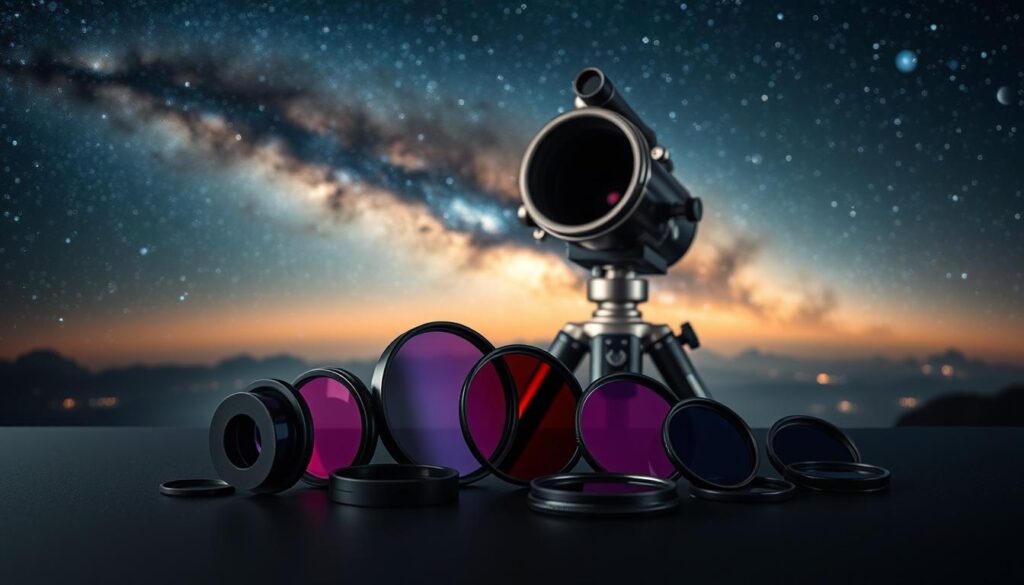
| Telescope Type | Recommended Filter Type | Filter Size |
|---|---|---|
| Refractor | Narrowband or LRGB | 1.25 inches or 2 inches |
| Reflector | Broadband or Narrowband | 2 inches or 36mm |
| Schmidt-Cassegrain | Light Pollution Reduction | 1.25 inches or 2 inches |
Think about your equipment, camera, and filter size to choose the best filter. This will help you take amazing deep sky photos and improve your astrophotography.
Filter Coatings and Quality
Filter coatings and quality are key to a great deep sky astrophotography experience. The coatings on your filters greatly affect their performance.
Importance of Optical Coatings
Optical coatings are thin layers on your filters to boost their performance. They reduce reflections and improve transmission, leading to better images. Anti-reflective coatings help by cutting down light loss and increasing light to your camera sensor.
Different filter brands have varying optical coatings. Some use advanced technologies for better performance, while others might use simpler coatings that can lower image quality.
Comparing Quality Brands
Choosing the right filter for deep sky astrophotography means comparing quality brands. Brands like Baader Planetarium and Astronomik are known for their high-quality filters with advanced coatings.
When comparing brands, consider these factors:
- The type and quality of optical coatings used
- The materials and construction of the filters
- The manufacturer’s reputation and customer reviews
- The price and value for money
By looking at these factors, you can pick a filter that fits your needs and budget. This ensures the best results for your deep sky astrophotography.
Recommended Brand Filters for Beginners
Starting with deep sky astrophotography can feel overwhelming. There are so many filters to choose from. It’s key to know the top brands and what they offer.
Overview of Top Brands
Several brands are known for their quality. Optolong, Astronomik, and IDAS are leaders. They have filters perfect for beginners. These brands offer great value and performance.
For more info on astrophotography filters, check out this guide.
Budget-Friendly Options
Looking for affordable filters is smart. Here are some budget-friendly picks from top brands:
| Brand | Filter Model | Price Range | Key Features |
|---|---|---|---|
| Optolong | L-Pro Filter | $150-$200 | Light pollution reduction, suitable for color cameras |
| Astronomik | CLS Filter | $100-$150 | City light suppression, enhances contrast |
| IDAS | LP-2 Filter | $200-$250 | Light pollution reduction, high transmission |
These filters are affordable and work well for deep sky astrophotography. Choosing the right filter from a trusted brand can improve your photos. It lets you enjoy the hobby without spending too much.
Filters for Advanced Astrophotographers
Advanced astrophotographers need filters that perform well and have special features. These filters help capture the details of deep sky objects. The right filters can make your images better and show details you couldn’t see before.
High-End Filter Choices
High-end filters from top brands are best for advanced users. These filters have advanced coatings and precise wavelength control. Brands like Astronomik and Baader Planetarium are known for their quality.
Think about what you need for your project when choosing a filter. Whether it’s for narrowband imaging or a broad spectrum, there’s a filter for you. These filters not only improve image quality but also let you capture a wide range of deep sky objects.
Specialized Filter Options
There are specialized filter options for specific tasks. Narrowband filters, like Hydrogen-Alpha (Ha), Oxygen III (OIII), and Sulfur II (SII), are great for nebulae and other deep sky objects. They help isolate specific wavelengths, making your images clearer and more detailed.
Hydrogen-Alpha filters are great for nebulae, while Oxygen III filters are perfect for planetary nebulas. Choosing the right specialized filter can greatly improve your astrophotography.
In conclusion, the filters you choose can greatly affect your deep sky imaging projects. High-end and specialized filters can lead to better image quality and reveal the universe’s intricate details.
Tips for Using Filters
Filters can greatly improve your deep sky astrophotography images. They help reduce light pollution and enhance certain wavelengths. To get the most out of them, learn how to install, set up, and adjust your exposure settings.
Installation and Setup
Getting your filters right is key to great images. Make sure your filter fits your telescope and camera. Securely attach the filter to your camera or filter wheel to avoid any movement. Always follow the manufacturer’s instructions for installation and handling.
Here are some steps to set up your filter:
- Check if the filter fits your equipment.
- Clean the filter before use to avoid dust or debris.
- Handle filters by the edges to avoid touching the optical surface.
Adjusting Your Exposure Settings
Filters change how much light your camera gets, so you might need to adjust your exposure. For example, narrowband filters let less light through, so you’ll need longer exposures. It’s important to adjust your exposure compensation to get the best detail in your images.
Here’s a guide for adjusting exposure with different filters:
| Filter Type | Exposure Adjustment | Notes |
|---|---|---|
| Narrowband Filters | Increase exposure time | Captures specific wavelengths, ideal for nebulae |
| Light Pollution Reduction Filters | Moderate increase in exposure | Reduces light pollution, enhances contrast |
| UV/IR Cut Filters | Minimal adjustment needed | Blocks unwanted UV and IR light, improves image sharpness |
By learning how to install, set up, and adjust your exposure settings with filters, you can greatly improve your deep sky astrophotography images.
Common Mistakes to Avoid
Starting deep sky astrophotography can be tricky. Two big mistakes can mess up your photos: using filters wrong and ignoring light pollution.
Misuse of Filters
Choosing the wrong filter or not knowing how to use it can ruin your photos. For example, using a narrowband filter without knowing its use can make your images lack detail. Always read the manual and know what the filter does before you use it.
- Make sure you’re using the right filter for your camera and telescope.
- Know what wavelengths your filter captures.
- Practice with your filters to get better.
Ignoring Local Light Pollution
Light pollution can ruin your photos by adding noise and reducing contrast. Not considering local light pollution can make your photos look bad, even with great gear. To fix this, use light pollution reduction filters or shoot in darker places.
- Check local light pollution maps to know your area’s conditions.
- Use filters that block light pollution, like those for streetlights.
- Shoot when the moon is down for the best views.
Knowing these mistakes and how to avoid them can make your deep sky astrophotography better. Remember, practice and patience are key to amazing photos.
Conclusion: Your Next Steps in Deep Sky Astrophotography
Choosing the right filter is key to capturing amazing night sky images. Knowing about different filters like narrowband, broadband, and LRGB can boost your astrophotography. The best astrophotography filters can greatly improve your photos.
Researching the Right Filter
Before buying a filter, research the top filters for deep sky imaging. Think about your gear, the objects you want to shoot, and local light pollution. An astrophotography filter guide can guide your choice.
Experimenting with Filters
After picking a filter, try out different settings and methods. You might need to tweak your exposure or mix filters. This way, you’ll get stunning photos that highlight the night sky’s beauty.