
Capturing the breathtaking beauty of Saturn is a thrilling experience for any astrophotographer. As the sixth planet from the Sun, Saturn boasts a spectacular ring system. This has captivated astronomers and photographers alike.
To take your astrophotography skills to the next level, it’s essential to understand Saturn’s unique features. This includes its composition, moons, and orbital period. For more detailed tips on capturing stunning images of Saturn’s rings, explore the resources available to enhance your photography techniques.
By grasping the characteristics of this stunning planet, you’ll be well on your way. You’ll be able to capture Saturn photography tips that will leave your audience in awe.
Understanding Saturn: An Overview
Before you start taking pictures of Saturn, it’s key to know about its makeup and past. Saturn, famous for its amazing ring system, is a gas giant that has amazed astronomers and photographers for ages. Its unique ring system is made of ice and rock particles, from tiny dust to huge boulders.
The Beauty of Saturn
Saturn’s beauty isn’t just in its rings. It also has a complex composition and many moons. The planet’s atmosphere is mostly hydrogen and helium. It has at least 62 moons, with Titan being the biggest. Knowing about the planet’s makeup and moons is important for taking great photos.
The rings of Saturn are very thin, just about 30 feet (10 meters) thick in some spots. Yet, they stretch for hundreds of thousands of miles. This stunning visual effect makes Saturn a top choice for astrophotographers.
A Brief History of Saturn Exploration
The study of Saturn began in the 17th century with Galileo Galilei’s first look at the planet. Since then, many spacecraft have visited Saturn. The Voyager missions and the Cassini-Huygens mission have given us lots of info about Saturn’s rings, moons, and atmosphere.
Knowing Saturn’s exploration history helps you appreciate its complexity and photographic potential. By learning how spacecraft have captured Saturn, you can get tips for taking its beauty.
Essential Equipment for Astrophotography
To capture Saturn’s rings, you need the right tools. This includes telescopes, cameras, and mounts. These tools must handle the challenges of astrophotography.
Telescopes: Your Primary Tool
A telescope is key for astrophotography. Look for a telescope with a large aperture. This is because a bigger aperture gathers more light and shows more detail.
For Saturn, a telescope with at least an 8-inch aperture is best. It helps reveal the planet’s rings in great detail.
| Telescope Type | Aperture | Best for |
|---|---|---|
| Refractor | 60-80 mm | Beginners, Lunar Observation |
| Reflector | 8-10 inches | Planetary Observation, Deep Space |
| Compound | 8-14 inches | Planetary Observation, Astrophotography |
Cameras for Capturing the Cosmos
The camera is vital for quality Saturn images. DSLR cameras are favored for their manual controls and RAW format capture. Look for a camera that excels in low light and can handle long exposures.
Mounts and Tripods: Stability Matters
A stable mount and tripod are crucial for clear astrophotography. A good mount tracks celestial objects smoothly over time. For Saturn’s rings, you need a mount that can handle high payloads and track precisely.
Investing in the right equipment and learning how to use it is key. Remember, practice is essential. Don’t get discouraged by early results. Keep trying and learning.
Choosing the Right Location
To get amazing photos of Saturn, you need more than just the right camera. You also need a spot with little light pollution. The sky’s clarity is crucial for capturing celestial bodies.
Light Pollution and Its Effects
Light pollution is a big problem for astrophotographers. It makes stars and planets harder to see and reduces image contrast. The light from cities scatters in the atmosphere, making night sky shots blurry.
To avoid this, find places far from cities and towns. Dark-sky preserves and national parks are great choices because they have less artificial light.
Best Locations in the U.S. for Viewing Saturn
The U.S. has many great spots for stargazing and Saturn photos. Some top places are:
- Death Valley National Park, California – Known for its dark skies and unique landscapes.
- Big Bend National Park, Texas – Offers incredibly dark skies and a remote location.
- Great Basin National Park, Nevada – Features ancient bristlecone pine trees and clear skies.
| Location | State | Dark Sky Rating |
|---|---|---|
| Death Valley National Park | California | Gold Tier |
| Big Bend National Park | Texas | Gold Tier |
| Great Basin National Park | Nevada | Silver Tier |
Choosing the right location can greatly improve your Saturn photos. Remember, great astrophotography combines the right gear, timing, and a dark, clear sky.
Timing Your Photoshoots
Timing is key when photographing Saturn and its rings. The success of your photos depends on when you take them. You need to think about the season and the time of night.
Optimal Seasons for Observing Saturn
Saturn is in the sky for half the year. The best times to see it change based on where you are and the planet’s position. The best season to observe Saturn is when it is at opposition, opposite the Sun. This happens once a year, giving you months to observe.
In the Northern Hemisphere, Saturn is best seen in late summer or early fall. For those in the Southern Hemisphere, it’s more visible in late summer or early fall too.
What Time of Night is Best?
The best time to take Saturn photos is when it’s highest in the sky, around midnight. This is when the sky is darkest and the air is calm. Avoid times when the planet is near the horizon, as the atmosphere can distort the image.
Also, consider the Moon’s phase. A new moon phase means darker skies, making Saturn and its rings easier to see.
To get the best photos, plan your shoot when Saturn is high and the weather is clear. Use astronomical apps or software to find the best times.
By planning your photoshoots well, you can get high-quality Saturn photos. You’ll capture the planet’s details and its stunning rings.
Setting Up Your Equipment
To capture Saturn’s beauty, you need to align your telescope and balance your camera. A well-aligned telescope ensures you’re capturing the right object. A balanced camera setup helps avoid blurry images by reducing camera shake.
Aligning Your Telescope
Aligning your telescope is key in astrophotography. It means adjusting it to point at the object you want to capture. For Saturn, use a star chart or planetarium software to find the planet. Precise alignment is essential for clear images.
- Use a star chart or planetarium software to locate Saturn.
- Adjust your telescope’s mount to point at Saturn.
- Verify the alignment by checking the planet’s position in your camera’s viewfinder.
Balancing Your Camera Setup
A balanced camera setup is crucial for smooth tracking and sharp images. It involves adjusting the weight of your camera and telescope for stability. Proper balancing is important, even for long exposure shots.
To balance your setup, start with the counterweights on your telescope mount. Then, adjust the camera’s position for the best balance. It might take some trial and error, but it’s worth it.
Focusing Techniques
Getting sharp focus is key to capturing Saturn’s rings’ beauty. In astrophotography, the right focus can make or break your photo. A blurry photo can ruin the shot, while sharp focus reveals the planet’s details.
To get the best shots, knowing focusing techniques is crucial. We’ll look at methods for sharp focus and why live view helps.
How to Achieve Sharp Focus
Sharp focus comes from the right equipment and technique. First, align your telescope and attach your camera securely. Use live view to zoom in on a bright star or Saturn to fine-tune your focus.
- Use the camera’s live view to zoom in on a bright object.
- Adjust the focus until the object appears sharp and clear.
- Take a test shot to verify that the focus is accurate.
Manual focus is best for astrophotography. It lets you control focus precisely. This ensures your image is sharp and clear.
Using Live View for Better Focus
Live view on your camera boosts focusing accuracy. Zooming in on a bright object lets you fine-tune focus. This is great for Saturn’s rings or bright moons.
Live view shows a real-time preview. This lets you adjust before taking the photo. It’s vital in astrophotography, where small errors can blur your image.
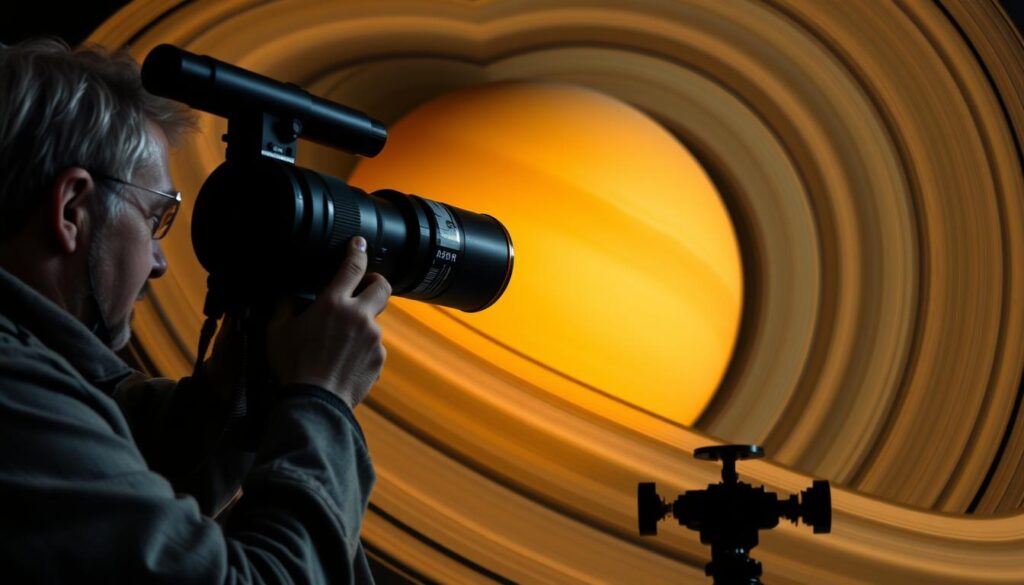
With the right focus techniques and live view, you can get amazing Saturn shots. Take your time and adjust as needed for the sharpest focus.
Camera Settings for Astrophotography
Getting the right camera settings is key to capturing Saturn’s beauty. You need to know how to adjust your camera settings to see Saturn’s details clearly.
Adjusting your camera settings is crucial for astrophotography. You must master ISO, shutter speed, and aperture. Each setting is important for capturing Saturn’s stunning images.
ISO: Finding the Sweet Spot
ISO settings control how sensitive your camera’s sensor is. A lower ISO catches less light, while a higher ISO catches more. For Saturn, finding the right ISO balance is important.
- Low ISO (100-400): Best for bright objects and reducing noise.
- Medium ISO (800-1600): Suitable for general astrophotography, offering a balance between light capture and noise.
- High ISO (3200 and above): Ideal for faint objects, but be cautious of increased noise.
Shutter Speed: Capturing the Moment
Shutter speed controls how long your camera’s sensor is exposed to light. Faster speeds are for bright objects, slower for faint ones.
- Fast Shutter Speed (1/1000th of a second or faster): Useful for capturing bright planets like Saturn when using a telescope.
- Slow Shutter Speed (1 second to 30 seconds): Ideal for capturing deep-space objects or when using a wide-angle lens.
Aperture: Letting in Light
Aperture is the lens opening that lets light in. A wider aperture lets in more light, a narrower lets in less.
- Wide Aperture (f/2.8 or wider): Excellent for capturing more light and creating a shallow depth of field.
- Narrow Aperture (f/8 or narrower): Better for capturing detailed images with a deeper depth of field.
Mastering these camera settings will improve your astrophotography skills. You’ll capture stunning images of Saturn and its rings.
Try different ISO, shutter speed, and aperture combinations. This will help you find the best settings for your equipment and the shoot conditions.
Capturing Saturn and Its Rings
To take your Saturn photography to the next level, you need to master the art of framing your shot and capturing detailed images. This involves understanding the techniques and equipment necessary for capturing the stunning beauty of Saturn and its rings.
Framing Your Shot
Framing your shot is crucial in astrophotography, as it helps you compose the image and ensure that Saturn is the focal point. Use a wide-angle lens or a telescope with a camera adapter to capture the planet and its surroundings. Consider the background and try to include interesting elements, such as trees or landscapes, to add context to your image.
Techniques for Detailed Images
Capturing detailed images of Saturn requires a combination of the right equipment and techniques. Use a high-quality telescope and camera to capture the planet’s intricate details. You can also use image processing software to enhance the image and bring out the details.
| Technique | Description | Benefits |
|---|---|---|
| Using a high-quality telescope | Capture detailed images of Saturn | Improved image quality |
| Image processing software | Enhance and edit images | Better control over image details |
| Framing your shot | Compose the image and add context | More visually appealing images |
By mastering these techniques and using the right equipment, you can capture stunning images of Saturn and its rings that will leave your audience in awe.
Using Software for Image Processing
Capturing Saturn’s image is just the start. The real work comes in processing it with special software. This step is key to bringing out the details and enhancing the quality of your photos.
Once you’ve taken a picture of Saturn and its rings, you’ll need to tweak it. Adjustments like brightness, contrast, and color balance are essential. They help show off Saturn’s rings and its atmosphere in all their glory.
Recommended Software for Astrophotography
There are many software options for processing astrophotography images. Here are some of the most popular:
- Adobe Photoshop: A powerful tool with a wide range of features for editing and enhancing images.
- StarStax: Ideal for stacking images to improve the quality and reduce noise.
- Autostakkert: Another excellent tool for stacking images and aligning frames.
- RegiStax: Useful for aligning and stacking images, as well as performing wavelet processing.
Basic Editing Techniques for Astronomical Images
When editing your Saturn images, keep these techniques in mind:
- Adjusting Exposure and Contrast: Enhance the details in both the bright and dark areas of the image.
- Color Correction: Ensure that the colors in your image accurately represent the real colors of Saturn and its rings.
- Noise Reduction: Use software features to minimize grain and digital noise, making the image smoother.
- Sharpening: Apply sharpening techniques to accentuate the details of Saturn’s rings and surface.
By learning these software tools and techniques, you can greatly enhance your Saturn photos. This makes them more stunning and shows off the beauty of this celestial wonder.
Troubleshooting Common Issues
Capturing stunning images of Saturn requires overcoming common issues. Whether you’re a seasoned astronomer or just starting out, understanding how to troubleshoot these problems is crucial. This is key for getting the best shots.
Dealing with Blurriness
Blurriness is a common issue in astrophotography. It can be caused by atmospheric distortion, equipment instability, or incorrect focusing. To minimize blurriness, ensure that your telescope is properly aligned and your camera is securely attached.
- Use a sturdy tripod to stabilize your equipment.
- Adjust your telescope’s focus regularly to compensate for temperature changes.
- Use image processing software to sharpen your images.
Addressing Overexposure
Overexposure can be a problem when photographing bright objects like Saturn. To avoid overexposure, adjust your camera settings. Here are some tips:
| Camera Setting | Recommended Value | Effect |
|---|---|---|
| ISO | 100-400 | Lower ISO reduces noise and overexposure. |
| Shutter Speed | 1/100s – 1/200s | Faster shutter speed can help prevent overexposure. |
| Aperture | f/8 – f/11 | A smaller aperture can reduce the amount of light entering the camera. |
By adjusting these settings, you can capture a well-exposed image of Saturn. Remember to check your camera’s histogram to ensure that your image is not overexposed.
Troubleshooting common issues is essential in astrophotography. By understanding how to deal with blurriness and overexposure, you can improve your images. This way, you can capture stunning photos of Saturn.
Safety Tips for Night Photography
When you’re ready to take pictures of Saturn, think about safety first. Night photography is exciting, but it has its own risks.
Staying Safe While Stargazing
Your safety is the most important thing when you’re out. Here’s what to do:
- Let someone know where you are and when you’ll be back.
- Carry a fully charged phone and a portable charger.
- Bring a first-aid kit and a flashlight.
- Watch out for dangers like wildlife or uneven ground.
Protecting Your Equipment
Keeping your gear safe is just as important as your safety. Here are some tips:
- Use a strong tripod to keep your camera steady.
- Keep your equipment covered when not in use to avoid moisture.
- Use a camera cover or housing to protect from extreme weather.
- Think about getting a lock or alarm to keep your gear safe.
By following these tips, you can have a great time taking pictures of the stars.
Continuing Your Astrophotography Journey
As you keep exploring the night sky, you’ll want to improve your astrophotography skills. Joining local astronomy clubs is a great way to do this. You’ll meet others who love the stars, learn from experts, and get access to new tools and methods.
Joining Local Astronomy Clubs
Local astronomy clubs are full of knowledge and resources for you. By joining, you’ll get hands-on experience, feedback on your photos, and updates on the latest astrophotography news. This includes tips on capturing the Saturnian system.
Resources for Further Learning
To boost your skills, check out online tutorials, workshops, and books on astrophotography. Online forums and YouTube channels focused on Saturn photography are also great. They offer new techniques and inspiration to keep you going.