
Capturing the beauty of the universe is thrilling. You’re about to explore deep sky astrophotography. Galaxies, nebulae, and star-forming regions are waiting for your lens.
Framing your target is key in astrophotography. It needs technical skills and creative vision. This guide will cover the basics of deep sky astrophotography.
You’ll learn about the equipment and techniques for stunning images. By the end, you’ll know how to create visually appealing and technically sound deep sky images. Let’s start our journey into astrophotography and see what it offers.
Understanding Deep Sky Targets
To capture the beauty of deep sky objects, you first need to understand what makes them unique. You also need to know how to frame them effectively. Deep sky targets include galaxies, nebulae, and star-forming regions. Each offers distinct photographic opportunities.
What are Deep Sky Targets?
Deep sky targets are celestial objects beyond our solar system. They include galaxies, nebulae, and star clusters. These objects are often faint and require careful framing to capture their intricate details.
For example, galaxies like the Andromeda Galaxy offer a wealth of detail. They have central bulges and spiral arms. Nebulae, on the other hand, can display vibrant colors and complex structures. They are fascinating subjects for astrophotography.
Understanding the characteristics of these objects is key to capturing their essence. You can learn more about the techniques involved in deep sky astrophotography by visiting this resource.
Importance of Framing in Astrophotography
Framing is a critical aspect of astrophotography. It can make or break the composition of your image. Effective framing involves considering the rule of thirds, leading lines, and the overall context of the celestial object.
By applying the rule of thirds, you can create more balanced and visually appealing images. Leading lines, whether they are formed by natural landscape features or the tendrils of a nebula, can guide the viewer’s eye. This enhances the depth and engagement of the image.
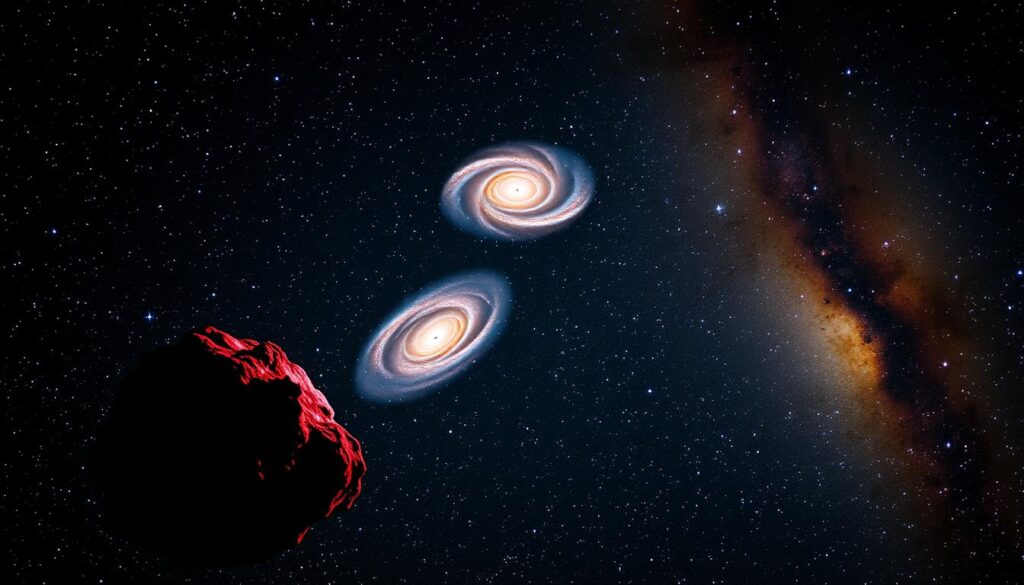
The context in which a deep sky object is presented can also greatly impact the overall impact of the image. For example, framing a galaxy against a rich, star-filled background can add depth and scale. Isolating a nebula against a darker background can highlight its intricate details.
- Consider the rule of thirds for balanced composition.
- Use leading lines to guide the viewer’s eye.
- Pay attention to the context and surroundings of your target.
Choosing the Right Equipment
Astrophotography fans know that the right gear is key for amazing deep sky shots. The quality of your equipment greatly affects your astrophotography results.
Recommended Camera Types
Choosing the right camera is crucial for deep sky astrophotography. DSLR cameras are great for beginners because they’re affordable and versatile. They let you take high-resolution photos and work with many lenses and accessories. Mirrorless cameras are also good, offering fast shooting and better battery life.
Look at the camera’s sensor size, resolution, and noise level when picking one. A full-frame sensor is better for low light, and higher resolution means more detail in your photos.
Ideal Telescopes for Deep Sky Imaging
The telescope is the heart of your deep sky setup. Refractor telescopes give clear images and less chromatic aberration. Reflector telescopes have a big aperture at a lower price, perfect for seeing faint objects.
When picking a telescope, think about its aperture size, focal length, and mount stability. A bigger aperture lets in more light, and a strong mount tracks objects smoothly.
Essential Accessories to Consider
Along with a camera and telescope, you’ll need some key accessories. A sturdy tripod and mount keep your gear stable and track objects well. A focuser ensures precise focus, and filters improve image quality by cutting down light pollution or boosting specific wavelengths.
Other must-haves include a remote shutter release or autotimer to reduce camera shake, and a star tracker or planetary software for finding and tracking objects.
By picking the right equipment and accessories, you can greatly enhance your deep sky astrophotography. Whether you’re new or experienced, knowing your gear is essential for capturing the night sky’s beauty.
Preparing for Your Deep Sky Session
Getting ready for a deep sky astrophotography session is key. You must think about the location, timing, and your equipment setup. These steps can greatly affect your image quality.
Selecting the Best Location
Choosing a spot with little light pollution is vital. Dark sky locations are perfect for capturing detailed night sky images. An astrophotographer says traveling to these areas helps avoid city light pollution, making images better.
When picking a spot, keep these in mind:
- How close it is to cities and light pollution
- How easy it is to get to and how safe it is
- The weather and what it’s forecasted to be
Timing and Astrological Conditions
The timing of your session is as important as the location. Astronomical twilight is the best time for deep sky shots, as the sky is dark enough. Also, check the lunar calendar to avoid nights with a full moon, as it can ruin your photos.
Important timing tips include:
- Plan your session during astronomical twilight
- Steer clear of nights with a full moon
- Make sure the weather will be clear
Setting Up Your Equipment
After picking your spot and timing, it’s time to set up. Make sure your telescope or camera lens is aligned and focused. Also, check that your tracking mount works right to follow the Earth’s rotation.
Key equipment to have includes:
- A strong tripod for stability
- A camera or DSLR that can handle manual settings
- A remote shutter release or timer
Composition Techniques for Deep Sky Photography
Capturing the beauty of the night sky is more than just having a good camera. It takes an eye for composition. As you dive into deep sky photography, learning and using composition techniques can make your images go from simple snaps to stunning views of the cosmos.
Rule of Thirds in Astrophotography
The rule of thirds is a basic technique. It divides your image into thirds both ways, making nine parts. Putting interesting things on these lines or at their points makes your photos more balanced and engaging. In deep sky photography, this means placing a bright star or a galaxy at these points, not in the center.
For instance, when shooting the Milky Way, put its brightest part at an intersection. This makes your photo more dynamic. It also guides the viewer’s eye to the most interesting part.
Leading Lines and Depth
Leading lines are a powerful tool that add depth and interest to your photos. They are elements in your scene that lead the viewer’s eye to the main subject. In astrophotography, these lines can be roads, shorelines, or mountain ranges that lead to the sky.
To use leading lines well, include foreground elements in your photo. For example, a winding road under a starry sky can draw the viewer into the scene. This creates a compelling story in your image.
Showcasing Cosmic Context
Showing the cosmic context of your subject adds depth to your photos. It’s not just about capturing the object, like a nebula or galaxy. It’s also about its surroundings. Including nearby stars, other celestial objects, or terrestrial features gives a broader context. This enriches the viewer’s understanding and appreciation of the image.
For example, when shooting the Orion Nebula, include surrounding stars and constellations. This gives a sense of its place in the celestial landscape. Such an approach can turn a simple deep sky image into a rich, contextualized photo that tells a story.
By using these composition techniques, you can greatly improve the quality and appeal of your deep sky photos. Whether you’re new or experienced, mastering composition is crucial for capturing the beauty and wonder of the night sky.
Utilizing Focal Length and Field of View
To take amazing deep sky photos, you must understand focal length and field of view. These two key elements greatly affect your photos’ quality and how they look.
Understanding Focal Length
The focal length of your telescope shows how much you can zoom in. A longer focal length means you can see more details, but it also makes things look smaller. A shorter focal length lets you see more of the sky at once.
Think about what you want to photograph. For big nebulae, a shorter focal length works best.
Calculating Your Field of View
Knowing your field of view is key to get the right shot. You can use online tools or software to figure it out. Just enter your telescope’s focal length and your camera’s size.
| Telescope | Focal Length (mm) | Field of View (degrees) |
|---|---|---|
| Askar SQA55 | 264 | 2.5 |
| Celestron Nexstar | 390 | 1.8 |
| Meade Instruments LX850 | 342 | 2.2 |
By mastering focal length and field of view, you can improve your deep sky photos. This way, you’ll get more stunning images.
Capturing the Perfect Shot
To get the perfect shot in deep sky astrophotography, you need both technical skills and creativity. Focus on several key aspects of your photography technique.
Focus Techniques for Clear Images
Getting precise focus is key for clear images. Use live view to zoom in on a bright star and adjust focus manually. Another method is focus peaking, which shows sharp focus areas.
Always check your focus, as temperature changes can affect it. By combining these techniques, your images will be sharp and clear.
Exposure Settings to Consider
Exposure settings are vital for the perfect shot. Balance ISO, shutter speed, and aperture for the best effect. Start with a low ISO (800-1600) and a moderate shutter speed (1-3 minutes).
- Adjust your ISO based on the brightness of your target object.
- Try different shutter speeds for the detail you want.
- Use a wider aperture for more light, but watch for distortions.
Taking Multiple Shots for Best Results
Taking multiple shots is crucial in deep sky astrophotography. This method, called image stacking, combines images to reduce noise and improve detail.
- Take several shots of the same target with the same settings.
- Align and stack the images using software for a single, high-quality image.
- Adjust the final image for better contrast and color balance.
By following these tips and practicing, you can capture stunning deep sky images. These images will show the universe’s beauty.
Post-Processing Techniques for Stunning Images
Post-processing is a crucial step in creating stunning images. It involves using software options and Photoshop techniques to enhance and refine your photos. By applying these techniques, you can take your images to the next level and achieve professional-grade results.
One of the key aspects of post-processing is color grading. Color grading allows you to adjust the colors in your images to create a specific mood or atmosphere. Whether you want to enhance the natural colors or add a unique touch, color grading can help you achieve the desired look.
Another important technique is exposure adjustment. Exposure refers to the brightness or darkness of an image. By adjusting the exposure, you can balance the light and shadows, creating a more visually appealing image. This technique is essential for capturing the right mood and atmosphere in your photos.
Contrast is another crucial element in post-processing. Contrast refers to the difference in brightness between different areas of an image. By adjusting the contrast, you can create depth and dimension in your photos, making them more engaging and visually appealing.
Sharpening is a technique used to enhance the details in an image. By sharpening your photos, you can bring out the textures, patterns, and fine details, resulting in a more crisp and clear image. Sharpening is essential for capturing the essence of your subject and creating visually stunning photos.
Lastly, noise reduction is an important technique in post-processing. Noise refers to the random, grainy patterns that can appear in low-light images. By reducing noise, you can improve the overall quality of your photos and create a cleaner, more professional look.
By mastering these post-processing techniques, you can take your images to new heights and achieve stunning results. Whether you’re a professional photographer or a hobbyist, post-processing is an essential skill to develop in order to enhance your photos and showcase your creativity.
Software Options for Post-Processing
When it comes to post-processing, there are several software options available. Some popular choices include Adobe Lightroom, Adobe Photoshop, and Skylum Luminar. Each software offers a range of tools and features that can help you enhance and refine your photos.
Adobe Lightroom is a powerful photo editing software that offers advanced tools for color grading, exposure adjustment, contrast, sharpening, and noise reduction. It is widely used by professional photographers and offers a user-friendly interface.
Adobe Photoshop is another popular choice for post-processing. It offers a wide range of tools and features, including advanced color grading, exposure adjustment, contrast, sharpening, and noise reduction. Photoshop is known for its versatility and ability to create stunning images.
Skylum Luminar is a user-friendly photo editing software that offers a range of tools and features for post-processing. It includes advanced color grading, exposure adjustment, contrast, sharpening, and noise reduction tools, making it a great choice for both beginners and professionals.
These software options provide you with the tools and features you need to enhance and refine your photos. Whether you’re a beginner or a seasoned photographer, exploring these software options can help you take your post-processing skills to the next level.
Common Framing Mistakes to Avoid
To capture the beauty of the night sky, it’s key to avoid common framing errors in deep sky astrophotography. Getting your framing right can greatly improve your image quality.
One big mistake is over-cropping, which can cut out important details. To avoid this, use the rule of thirds when framing. This means dividing your image into thirds both ways, placing key elements on those lines.
Tips to Prevent Over-cropping
To prevent over-cropping, plan carefully and pay attention to detail during capture. Here are some tips to help:
- Use the rule of thirds to balance your composition.
- Consider leading lines and other composition techniques to guide the viewer’s eye.
- Leave some margin around your subject to allow for flexibility during post-processing.
Ignoring the Background and Context
Another big mistake is ignoring the background and context of your image. The background can add depth and context to your deep sky object, making it more interesting and informative.
When framing your shot, think about the surrounding environment and how it relates to your subject. This might include other celestial objects, nebulosity, or even the Milky Way. By including these elements, you can create a more engaging and contextual image.
For example, when capturing an image of a distant galaxy, consider including nearby stars or other deep sky objects to provide scale and context. This approach can help tell a more compelling story with your image.
Final Thoughts on Deep Sky Framing
Exploring deep sky astrophotography is exciting. Remember, practice and patience are crucial for amazing photos. Deep sky framing is an art that needs focus and a desire to learn.
Practicing the Craft
Starting out can feel daunting, but don’t be afraid to try. “Everyone should try deep-sky astrophotography, and it’s not as complicated as you think.” With each try, you’ll get better and find your own style.
Continuing Education
To improve, check out online forums, tutorials, and workshops. These resources share tips from pros. They keep you updated on the latest in Deep Sky Framing.