
If you love astronomy, you know photographing Mars from Earth is a rare chance. The Red Planet’s opposition happens every 26 months. This is the best time to take its picture.
On January 16, 2025, Mars will be at its closest point to Earth. This makes it the perfect time to observe and photograph. Looking through the eyepiece is an unforgettable experience. It gives a unique view of the planet’s surface.
To capture great images of Mars, you need the right equipment and techniques. In this article, we’ll show you how to take high-quality photos of Mars. We’ll cover the best time to photograph and share tips for stunning photos.
What is Mars Opposition?
Mars opposition happens when Earth is between the Sun and Mars. This makes Mars shine brightly and appear close to Earth. It’s a great time for looking at Mars and taking photos.
During this event, Mars is fully lit by the Sun. This means we can see it in the night sky for a long time.
The Astronomical Significance
Mars opposition is special because of its unique alignment. It offers unparalleled views of the Red Planet. When Earth is between the Sun and Mars, we can see Mars up close.
This is the best time to see Mars’ surface. We can see its ice caps, valleys, and volcanoes clearly. It’s a chance to learn more about Mars.
During opposition, Mars looks bigger and brighter. This makes it easier to study with telescopes. We can learn more about Mars’ geology, atmosphere, and how it moves.
Historical Importance of Mars Opposition
Mars opposition has always been important. Ancient people saw it as a special event in the sky. They linked it to myths and astrology.
Today, Mars opposition still excites astronomers and the public. It’s a rare chance to see Mars in all its beauty.
Knowing Mars opposition’s history makes it even more special. Whether you’re an expert or just starting, don’t miss this event.
When Does Mars Reach Opposition?
For those eager to capture Mars at its closest, understanding the opposition dates is essential. Mars reaches opposition approximately every 26 months. This is due to the unique orbital patterns of Earth and Mars.
The next significant opposition is on January 16, 2025. During this time, Mars will be at its closest approach to Earth. This event is a highlight for astronomers and photography enthusiasts. It offers a rare opportunity to observe the planet in detail.
Upcoming Opposition Dates
To plan your Mars observation and photography sessions effectively, it’s crucial to know the upcoming opposition dates. Here is a table outlining the next few opposition dates:
| Date of Opposition | Closest Approach | Distance (AU) |
|---|---|---|
| January 16, 2025 | January 16, 2025 | 0.64 |
| March 15, 2027 | March 17, 2027 | 0.66 |
| May 21, 2029 | May 22, 2029 | 0.68 |
Factors Affecting Visibility
While opposition dates are crucial, the visibility of Mars is also affected by several factors. These include atmospheric conditions and light pollution. Understanding these factors can significantly enhance your observation and photography experience.
Atmospheric conditions, such as clarity and turbulence, play a significant role in determining the quality of your observations. Light pollution can also hinder your ability to capture clear images of Mars. It’s advisable to observe Mars from locations with minimal light pollution and during periods of stable atmospheric conditions.
By considering these factors and planning, you can maximize your chances of capturing high-quality images of Mars during opposition.
Equipment You Need to Capture Mars
To capture Mars in the night sky, you need the right equipment. The right gear can greatly improve your photos.
Telescopes: Choosing the Right One
Choosing the right telescope is key. A good refractor or reflector telescope is essential. It gives you the magnification and clarity you need.
A longer-focal-length refractor can show more details. This includes cloud structures or the polar caps.
Key Considerations for Telescopes:
- Aperture size: A larger aperture lets in more light, making images clearer.
- Focal length: A longer focal length means more detailed observations.
- Mount stability: A stable mount is crucial for smooth tracking and less vibration.
| Telescope Type | Aperture Size | Focal Length |
|---|---|---|
| Refractor | 80-120 mm | 600-1000 mm |
| Reflector | 150-300 mm | 1000-2000 mm |
Cameras and Accessories
You’ll also need a camera and accessories for high-quality images. A Barlow lens can increase the focal length. This lets you see more details.
Essential Cameras and Accessories:
- Camera: A DSLR or a dedicated astronomy camera is best.
- Barlow lens: Increases focal length for detailed images.
- Filters: Enhance specific features or reduce light pollution.
Additional Gear for Photography
More gear can make your Mars photography better. A sturdy tripod, remote shutter release, and image processing software are great additions.
Additional Gear:
- Tripod: Keeps your telescope and camera stable.
- Remote shutter release: Prevents camera shake during exposure.
- Image processing software: Refines your captured images.
Preparing for Your Observation
To get the best shots of Mars, you need to plan carefully. Think about where you’ll be, the weather, and your gear. These details are key to capturing top-notch images.
Finding the Right Location
For clear Mars photos, pick a spot with little light pollution. Dark skies help with contrast and detail. If dark spots are far, find a place away from city lights. For more tips, check this resource.
Checking the Weather Conditions
Clear skies are a must for great views. Look at the forecast before the opposition. Stay away from nights with lots of clouds or high humidity to avoid blurry photos.
Setting Up Your Equipment
Get your gear ready before you start. Use a red flashlight to keep your eyes dark-adapted. Make sure your telescope is aligned and your camera is secure.
| Equipment | Purpose | Tips |
|---|---|---|
| Telescope | To magnify Mars for clearer observation | Ensure proper alignment and focus |
| Camera | To capture images of Mars | Use a camera with manual settings for better control |
| Red Flashlight | To preserve night vision | Use it to read charts and adjust equipment without disrupting night vision |
Techniques for Capturing Mars
To get the best shots of Mars during opposition, you need to understand key techniques. Capturing high-quality images of Mars requires the right equipment and knowledge.
Understanding Exposure Settings
Exposure settings are crucial when capturing images of Mars. You must adjust your camera settings to avoid overexposure or underexposure. A planetary camera or a DSLR camera with a telephoto lens can help you get the right exposure.
- Start with a low ISO to minimize noise.
- Use a fast shutter speed to freeze the motion of Mars.
- Adjust your exposure compensation to balance the brightness.
Tips for Focusing Your Telescope
Focusing your telescope is critical to capturing a sharp image of Mars. Here are some tips to help you achieve a sharp focus:
- Use a Barlow lens to increase the focal length and magnify the image.
- Adjust your telescope’s focus knob slowly to achieve a sharp image.
- Use the live view or video mode on your camera to help you focus.
Utilizing Filters to Enhance Images
Filters can enhance the contrast and detail in your images of Mars. Using a red or orange filter can help to:
- Reduce atmospheric distortion.
- Enhance the visibility of Martian features.
- Improve the overall contrast of the image.
By mastering these techniques, you can capture high-quality images of Mars during opposition. Practice makes perfect, so be sure to experiment with different settings and techniques to find what works best for you.
Taking Great Photos of Mars
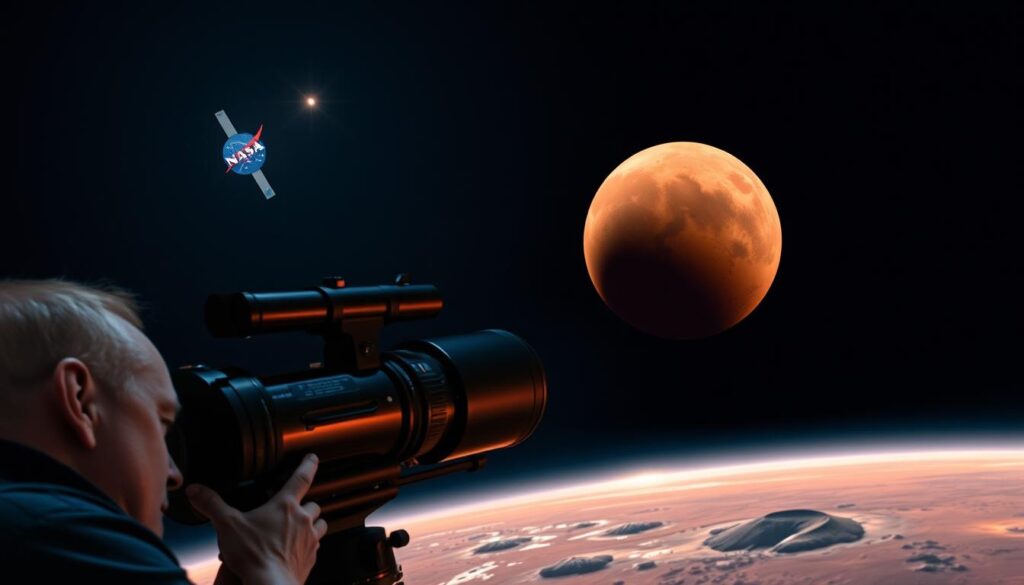
Photographing Mars is more than just aiming a camera at the sky. It requires careful planning and skill. To capture Mars’ details during opposition, you need to use various techniques.
Composition Techniques for Astrophotography
In astrophotography, composition is key, just like in any photography. When shooting Mars, try the rule of thirds to place the planet off-center. This makes your photo more interesting. You can also add depth with leading lines or foreground elements.
Try different framing methods to improve your photos. Use a wide-angle lens to show Mars with its surroundings. Or, a narrow-angle lens for more detail on the planet.
Best Practices for Night Photography
Night photography needs special techniques to avoid camera shake and noise. A sturdy tripod is crucial for steady shots during long exposures. Use a remote shutter release or self-timer to avoid shake.
Adjust your camera settings for night shots. Choose a low ISO to reduce noise. Set your exposure based on Mars’ brightness and the sky.
Stacking Images for Better Clarity
Image stacking can make your Mars photos clearer and more detailed. By stacking multiple images, you can reduce atmospheric distortion. This improves your photos’ quality.
To stack images, use software like AutoStakkert or RegiStax. These tools align and combine your photos. They help you get a sharper, more detailed Mars image.
By using composition, night photography tips, and image stacking, you can greatly enhance your Mars photos. This way, you can capture the planet’s beauty during opposition.
Analyzing Your Mars Images
To analyze your Mars images, you need the right software and techniques. Capturing Mars during opposition is just the start. You must also analyze and process your photos carefully.
You’ll need specialized software for image processing. AutoStakkert! and RegiStax are top choices for astronomers. These tools align and stack frames, reducing noise and enhancing clarity.
Software for Image Processing
There are many software options for image processing, both free and paid. Beginners should try AutoStakkert! for its easy-to-use interface and strong stacking features. Advanced users might prefer RegiStax for its extra features and flexibility.
- AutoStakkert!: Great for beginners, it stacks images well and improves clarity.
- RegiStax: Offers advanced features for detailed image processing.
- Adobe Photoshop: A powerful tool for further editing and enhancing Mars images.
Enhancing Detail and Color
To enhance detail and color in your Mars images, adjust software parameters. You can tweak contrast, brightness, and color balance to highlight the planet’s features. For more tips, visit Televue Optics.
By learning image processing techniques and using the right software, you can greatly improve your Mars photos. This makes your captures more vivid and detailed.
Common Challenges in Mars Photography
Capturing Mars at its best comes with challenges like atmospheric distortion. When you’re trying to capture Mars during opposition, you face significant hurdles. These can affect the quality of your images.
Dealing with Atmospheric Distortion
Atmospheric distortion is a big challenge in Mars photography. The Earth’s atmosphere can distort and blur Mars’ image. This makes it hard to capture clear details.
To reduce this effect, using a telescope with a longer focal length helps. It can lessen the impact of atmospheric distortion on your images.
Try observing Mars when it’s at its highest point in the sky. This reduces the atmosphere you’re looking through. Using short exposure photography can also freeze atmospheric distortion. This results in sharper images.
Avoiding Light Pollution
Light pollution is another big challenge in capturing Mars. Artificial lighting from cities and towns scatters light into the atmosphere. This makes it harder to observe faint objects like Mars.
To avoid light pollution, find a dark location for your observation. Look for places far from urban areas with minimal artificial lighting. By choosing a location with dark skies, you can improve your Mars images’ quality. Using a light pollution filter can also help. It allows you to capture clearer and more detailed images of Mars.
Engaging with the Astronomy Community
The astronomy community is full of knowledge for those who want to photograph Mars. By connecting with others, you can learn new tips and techniques. This will help improve your Mars photography skills.
You can join local astronomy clubs or online forums to connect. These places let you learn from experts and share your own stories.
Joining Local Astronomy Clubs
Local astronomy clubs are great for meeting others who share your interest. They often have viewing nights and workshops. These events can teach you a lot about taking pictures of Mars from Earth.
- Network with experienced astronomers and photographers
- Participate in viewing nights and workshops
- Access club resources and libraries
Participating in Online Forums
Online forums for astronomy and photography are perfect for sharing your work. You can get feedback and learn from others. It’s a great place to talk about techniques, ask questions, and keep up with Mars photography news.
| Platform | Description | Benefits |
|---|---|---|
| Reddit (r/Astronomy) | A community-driven forum for astronomy enthusiasts | Share your work, get feedback, and learn from others |
| Astronomy Forum | A dedicated forum for discussing various astronomy topics | Discuss techniques, ask questions, and stay updated |
| 500px | A photography community with a strong focus on astronomy | Share your photos, receive feedback, and connect with other photographers |
Getting involved with the astronomy community can really boost your skills. Whether it’s through local clubs or online forums, connecting with others is key. It’s a valuable step in your journey to photograph Mars.
Sharing Your Mars Photography
You’ve captured the stunning details of Mars; now, let’s explore how to share your work with the astronomy community. Sharing your Mars photography can be a great way to connect with other enthusiasts, gain feedback, and showcase your skills.
Platforms to Showcase Your Work
There are several platforms where you can share your Mars photography. Social media sites like Instagram and Flickr are popular choices among astronomy enthusiasts. You can also join online forums and discussion groups dedicated to astronomy to share your work and connect with others.
- Instagram: Share your photos and use relevant hashtags to reach a wider audience.
- Flickr: Create albums and share your photos with the Flickr astronomy community.
- Online forums: Participate in discussions and share your photos on platforms like Reddit’s r/Astronomy.
Building an Online Portfolio
Building an online portfolio can help you establish a presence in the astronomy community. You can create a website or blog to showcase your best work, share your experiences, and provide tips and tutorials on capturing Mars in the night sky.
| Platform | Benefits | Tips |
|---|---|---|
| Large community, easy sharing | Use relevant hashtags, post regularly | |
| Flickr | Dedicated astronomy community, high-quality images | Create albums, engage with other users |
| Personal Website/Blog | Full control over content, can share detailed tutorials | Regularly update content, optimize for SEO |
By sharing your Mars photography and building an online presence, you can connect with other enthusiasts, gain feedback, and improve your skills in capturing the beauty of Mars opposition visibility.
Continuing Your Astronomy Journey
As you keep exploring the night sky, capturing Mars during opposition is just the start. You now have skills in Mars opposition photography tips. You can focus on other celestial events like meteor showers and planetary alignments.
Upcoming Celestial Events to Watch
Tools like Stellarium help you plan your observations and track celestial events. This free software simulates the night sky on your computer. It helps you find the best viewing times.
By using these tools, you can grow your knowledge and get better at astrophotography.
Resources for Further Learning
Online forums and astronomy clubs are full of knowledge and learning opportunities. By joining these communities, you can learn from experts. You’ll get new insights and stay current with astronomy news.
These resources can help you improve your skills in capturing Mars during opposition. Or, you can explore new areas of astronomy.