
Capturing the beauty of the night sky is a fascinating endeavor. It requires technical skills, patience, and practice. Astrophotography is about taking images of stars, planets, and other celestial objects. It’s a complex form of photography because of the distance and lighting challenges.
To start, you need to understand the basics of capturing the stars. Experts say to keep things simple when you’re just beginning. You can learn about the equipment and techniques needed for stunning photos. For more information, check out a beginner’s guide to shooting the stars. It offers valuable tips and insights.
Understanding Astrophotography
Astrophotography is all about capturing the stars and other celestial bodies. It’s a mix of art and science. You’ll learn about the gear and techniques needed to take amazing photos.
Definition and Overview
Astrophotography is the art of taking pictures of the sky and its wonders. You’ll need special tools like tripods, cameras, and wide-angle lenses. Each piece of equipment plays a key role in capturing the night sky’s beauty.
It’s not just about pointing a camera at the sky. You must understand light pollution, weather, and the timing of events. Mastering these will help you improve your astrophotography skills.
Brief History of Astrophotography
Astrophotography has a long history, starting with the early days of photography. Telescopes allowed for detailed images of the sky. Technology has kept improving, making it possible to capture incredible images.
From black and white to digital photos, astrophotography has changed a lot. Today, with advanced tools and software, photographers can show the universe’s beauty in stunning images.
The Science Behind Astrophotography
Understanding astrophotography is key to capturing the night sky’s beauty. It’s not just about pointing a camera at the stars. You need to know how light travels and how to capture it well.
How Light Travels Through Space
Light from stars travels long distances to reach our cameras. It can be affected by the Earth’s atmosphere, light pollution, and how far away the object is. Knowing these factors helps you take better astrophotography pictures.
Light pollution can make it hard to get clear images. So, it’s best to take pictures in dark places. The light’s intensity and color also matter. Different stars and objects give off light at different wavelengths. The atmosphere can change these wavelengths, affecting your photos.
The Role of Exposure and Sensitivity
Exposure and sensitivity are crucial in astrophotography. Your camera’s ability to capture light in the dark depends on its sensor and your settings. A long exposure lets more light in, which is needed for faint stars or galaxies.
The best camera for astrophotography has high sensitivity and low noise. It should work well in the dark. Look for cameras with full-frame sensors or those made for low-light photography. Knowing how to adjust ISO, aperture, and shutter speed is also important.
- Use a tripod to keep your camera steady, avoiding blur.
- Choose a camera with manual controls for better exposure settings.
- Use a remote shutter release or timer to avoid camera shake.
Mastering astrophotography’s science improves your skills. It’s about understanding light, exposure, and sensitivity. Whether you’re new or experienced, knowing these principles helps you take amazing night sky photos.
Essential Equipment for Astrophotography
Getting the right gear is key for astrophotography. You’ll need a few important items to capture the night sky. Knowing how to use each piece will improve your astrophotography skills.
Cameras: DSLRs, Mirrorless, and More
There are many cameras for astrophotography. DSLRs and mirrorless cameras are top picks. They offer manual controls and lens changes.
DSLRs have been favorites for years, known for their quality and lens variety. Mirrorless cameras are more compact and travel-friendly, without the mirror and prism system.
Look for a camera that lets you control focus manually and performs well in low light. Full-frame sensors are great for low light, but crop sensor cameras can also deliver excellent results with the right lens.
Lenses: Choosing the Right One
The lens you pick greatly affects your astrophotography. A wide-angle lens is best for showing the vast night sky. Choose lenses with a low f-stop number (like f/2.8 or lower) to let in more light. Some prefer prime lenses for their sharpness and ability to gather light.
Tripods and Mounts: Stability Matters
A strong tripod is vital for astrophotography. It prevents camera shake and blurry photos. For long shots, a tripod that tracks celestial movements smoothly is essential.
Make sure your tripod is on a stable surface. Use a remote shutter release or self-timer to avoid vibrations. This ensures sharp images, even during long exposures.
Preparing for Your Astrophotography Session
To capture the stars in all their glory, preparation is key. You need the right equipment and to know the best times and locations. This will help you capture the celestial beauty.
Identifying the Best Locations
Choosing the right location is crucial for high-quality astrophotos. Avoid areas with light pollution as it can ruin your images. Instead, go for dark skies, like national parks or remote areas away from cities.
When looking for a location, think about how easy it is to get to and if it’s safe at night. It’s also good to visit during the day to see what’s around and what you might want in the foreground.
Timing Your Shots: Lunar and Solar Events
The timing of your astrophotography session is very important. Lunar events, such as a new moon, are ideal for capturing the Milky Way. This is because there’s no moonlight, so the stars shine brighter.
Solar events, like solar eclipses, offer unique chances for rare and spectacular images. But, you need to plan carefully because the time to capture them is short.
| Event | Best Time | Tips |
|---|---|---|
| Milky Way | New Moon | Use a wide-angle lens and focus on the stars. |
| Solar Eclipse | During an eclipse | Use solar viewing glasses or a solar filter. |
| Lunar Eclipse | During an eclipse | Capture the moon’s color changes. |
By planning your astrophotography session well, you can improve your photos. Choose the right location and time your shots for lunar and solar events. This will make your astrophotography much better.
Techniques for Effective Astrophotography
Stunning astrophotography starts with the right techniques. You need to know how to capture the night sky’s beauty. We’ll look at camera settings and focusing methods in this section.
Long Exposure Settings
Long exposure settings are key in astrophotography. They let more light into the camera by keeping the shutter open longer. Long exposure settings are crucial for capturing the faint light of distant stars. But, you must balance the exposure to avoid overexposure and star trailing.
The right exposure time depends on your equipment and the scene. For deep-sky objects like nebulae, a longer exposure might be needed. But, a shorter exposure is better for the moon.
| Object | Recommended Exposure Time | Notes |
|---|---|---|
| Deep-Sky Objects (e.g., Nebulae) | 10-30 minutes | Use a tracking mount to avoid star trailing |
| Moon | 1/100th to 1/200th of a second | Use a shorter exposure to avoid overexposure |
| Stars | 20-30 seconds | Use a wider aperture to capture more stars |
Focusing in Low Light
Focusing in low light is a challenge in astrophotography. Manual focusing is often necessary since autofocus struggles in darkness. Use live view or focus assist features to help with sharp focus.
To focus well, target a bright star or use focus peaking if your camera has it. Taking multiple test shots can also help ensure sharp focus.
Mastering long exposure settings and focusing techniques can greatly improve your astrophotography. Using the right astrophotography software can also enhance your images during post-processing.
Post-Processing Your Astrophotos
Post-processing is key in astrophotography. It turns raw images into stunning visuals. Here, you fine-tune your captures, tweaking settings to boost quality and beauty.
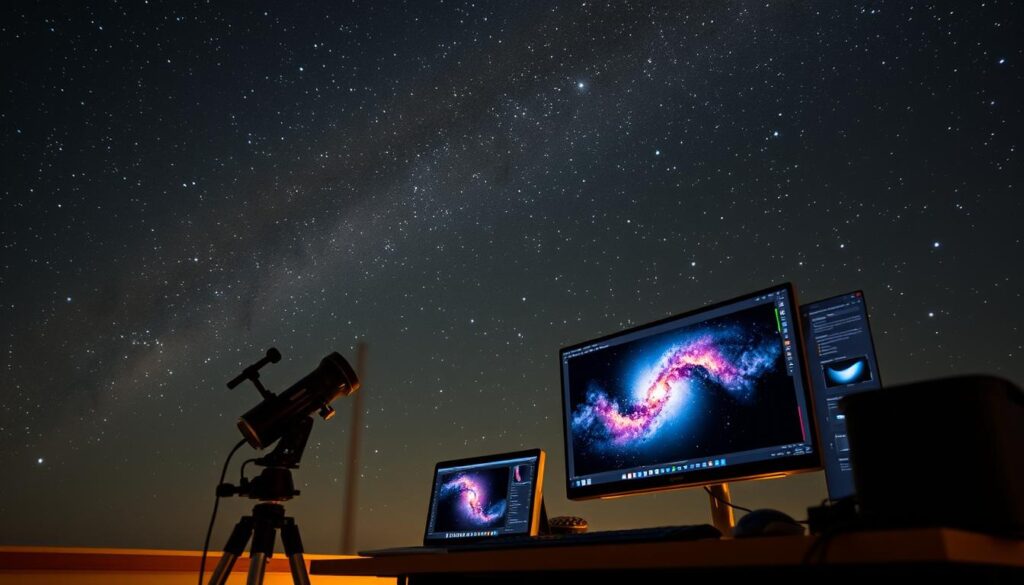
Editing Software Options
Choosing the right software is the first step in editing astrophotos. Adobe Photoshop and Lightroom are top choices. They help with exposure, contrast, and noise reduction. Adobe Photoshop is known for its detailed editing tools. Lightroom, on the other hand, is loved for its easy-to-use interface and great organization tools.
StarStax and PixInsight are also favorites among astrophotographers. They offer special features like star stacking and advanced noise reduction.
Basic Editing Techniques for Beginners
For beginners, starting with simple techniques is best. First, tweak the exposure and contrast to brighten your images. Reducing noise is also crucial for clearer photos. Use software tools for this.
Playing with highlights is another useful trick. It helps reveal more in the bright parts of your image, adding depth.
- Adjust exposure and contrast
- Reduce noise using software tools
- Experiment with highlights to reveal details
Common Challenges in Astrophotography
Capturing stunning astrophotography images requires overcoming common obstacles. Light pollution and atmospheric conditions are major hurdles. They can greatly affect your photo’s quality.
Dealing with Light Pollution
Light pollution is a big challenge for astrophotographers. Artificial light from cities can drown out the natural light from stars. This makes stars appear dim or invisible in your photos.
To tackle this, find locations with little light pollution. Dark-sky preserves and remote areas are perfect for capturing the night sky.
Managing Atmospheric Conditions
Atmospheric conditions like moon phase, cloud cover, and air quality also impact your photos. A full moon can make it hard to see faint stars. High cloud cover can block your view.
Understanding and managing these conditions is key. Use apps and websites to track lunar cycles and weather. Adjusting your astrophotography camera settings can also help.
By tackling these challenges, you can improve your astrophotography. Whether it’s finding dark spots or adjusting camera settings, preparation is crucial. It helps capture the night sky’s beauty.
Notable Astrophotographers to Follow
If you love capturing the night sky, following famous astrophotographers can inspire you. The field is full of talented people who share their skills and tips online.
Influential Figures in the Field
Many astrophotographers have changed the game with their amazing photos. Adam Block is famous for his stunning Milky Way shots. Trevor Jones is known for his beautiful star trails. These stars, and others, lead the way in astrophotography.
Online Communities and Resources
Joining online groups is a great way to learn from pros. Sites like 500px and Astrophotography Forum are full of helpful info. You can find tutorials, gear reviews, and even workshops and courses online.
| Resource | Description | URL |
|---|---|---|
| 500px | A community-driven platform with a wealth of astrophotography content. | https://500px.com |
| Astrophotography Forum | A dedicated forum for discussing all aspects of astrophotography. | https://www.astrophotographyforum.net |
| Astronomy Apps | Various apps that help plan astrophotography sessions by checking weather, moon phases, and star positions. | https://www.astronomyapps.com |
By following these famous astrophotographers and joining online groups, you can improve your skills. You’ll also keep up with the newest methods and tools.
Astrophotography vs. Traditional Photography
Astrophotography is different from traditional photography. It deals with the night sky, needing special skills and tools. Traditional photography captures everyday moments, while astrophotography explores the vast universe.
Key Differences in Approach
Astrophotography has a unique approach. It involves taking pictures in very low light, needing longer exposures and special gear. The subjects are also different, focusing on stars, planets, and celestial events.
The equipment used in astrophotography is more advanced. It includes telescopes, mounts, and cameras designed for low-light conditions. The right tools are essential for capturing the night sky’s beauty.
Why Astrophotography is Unique
Astrophotography is special because of its challenges. Capturing distant celestial objects is complex due to their distance and light. It reveals the night sky’s beauty, showing details unseen by the naked eye.
It also connects us to the universe in a deep way. By capturing stars and galaxies, astrophotographers share their awe with others. This inspires a greater appreciation for the cosmos.
Future Trends in Astrophotography
The world of astrophotography is on the verge of a big change. New tech and a growing community are leading the way. The future of capturing the cosmos looks very promising.
Advances in Camera Technology
New cameras, like the Sony Alpha a7S V, will have even better sensors. This means they’ll work better in low light. Soon, cooled CMOS cameras will be cheaper, making top-notch astrophotography more available to everyone. Learn more about camera tech and astrophotography on astrophotography resources.
The Role of Artificial Intelligence
Artificial intelligence (AI) and machine learning will change astrophotography a lot. They’ll make image processing easier and improve picture quality. AI tools will help you create amazing images with less effort.
The astrophotography world is growing, with more chances to share and work together. The future is exciting, with new tech and methods. You’ll be able to show the universe’s beauty in ways we’ve never seen before.