
Astrophotography has grown more advanced with plate solving software. This tool helps photographers find the exact location of stars in their photos.
It works by matching star patterns in images to a star catalog. This way, astrophotography plate solving gives precise coordinates. It makes the whole process better.
Using plate solving software like ASTAP and PlateSolve2 can greatly improve your astrophotography. These tools are known for their speed and accuracy.
Key Takeaways:
- Plate solving software enhances astrophotography workflow.
- Accurate targeting and tracking of celestial objects is possible.
What is Plate Solving?
Astronomers can now find the exact spot of stars in the sky with great accuracy thanks to plate solving. This method is key in today’s astronomy, helping those with advanced telescopes.
Definition and Overview
Plate solving matches star patterns in images to a star catalog. It finds the exact location of stars, including their RA/Dec coordinates, image size, and view area. This method is much more accurate than old ways, making it very useful for scientists.
How Plate Solving Works
The process uses a plate solving algorithm to compare star patterns in images to a big star catalog. It then figures out the exact location of stars. This helps telescopes find and track stars more easily.
| Key Features | Description | Benefits |
|---|---|---|
| Star Pattern Matching | Matching star patterns in an image to a star catalog | High accuracy in celestial targeting |
| Precise Coordinate Calculation | Calculation of RA/Dec coordinates, image scale, and field of view | Enhanced precision in astronomical observations |
| Compatibility with Various Telescopes | Can be used with different telescope setups | Flexibility and adaptability in astronomical research |
In short, plate solving has changed astronomy by making it easier to find stars. It works with many telescopes and gives exact locations. This makes it a must-have for today’s astronomers.
The Importance of Accurate Targeting
Accurate targeting is key to great astrophotography and astronomy. It helps capture top-notch images and precise measurements of space objects. Getting it right is crucial for quality and reliable data.
For those who love astrophotography, precise targeting is essential. It ensures precise alignment with celestial targets, making images sharper and more detailed. Plate solving techniques help align equipment perfectly, leading to better images.
Benefits for Astrophotography
Accurate targeting brings many benefits to astrophotography:
- Improved image quality: It leads to clearer, more detailed images.
- Enhanced efficiency: It saves time, making sessions more productive.
- Better data collection: It ensures accurate data for scientific research.
| Benefit | Description | Impact on Astrophotography |
|---|---|---|
| Improved Image Quality | Accurate targeting results in sharper images with more detail. | Enhances the overall quality of astrophotography work. |
| Enhanced Efficiency | Reduces the time spent on equipment alignment and image capture. | Allows for more productive astrophotography sessions. |
| Better Data Collection | Ensures that data is collected from the correct celestial objects. | Improves the reliability of scientific research conducted through astrophotography. |
Enhancing Observational Astronomy
In observational astronomy, accurate targeting is vital. It helps make precise measurements and observations of space phenomena. This leads to more accurate data, deepening our understanding of the universe.
A plate solving tutorial offers insights into achieving accurate targeting. By mastering plate solving, astronomers and astrophotographers can improve their work. Whether it’s stunning images or groundbreaking observations, the results are significant.
How to Get Started with Plate Solving
Starting with plate solving is easy. First, pick the right camera and software. You need to know what you need for plate solving and how it fits into your workflow.
Required Equipment and Software
You need the right gear and software for plate solving. A plate solving camera is key. It takes the images for solving. Make sure it works with your telescope and captures clear images with lots of stars.
For software, ASTAP and PlateSolve2 are favorites among astronomers. They look at star patterns in your images to find celestial coordinates. Think about your camera’s compatibility, how easy it is to use, and its accuracy when picking software.
| Equipment/Software | Description | Considerations |
|---|---|---|
| Plate Solving Camera | Captures images for plate solving | Compatibility with telescope, image quality |
| ASTAP | Plate solving software | Ease of use, precision |
| PlateSolve2 | Alternative plate solving software | Compatibility with camera, features |
Initial Setup Steps
After getting your gear and software, set up your system. First, install the software on your computer and follow the instructions.
Then, connect your camera to your telescope and computer. Make sure everything is secure and set up right. Check your manuals for specific setup steps.
Now, start the plate solving workflow. Capture an image, upload it, and analyze the stars to find celestial coordinates. Practice to get better and fine-tune your skills.
Popular Plate Solving Software Options
There are many plate solving software options out there. Each has its own special features and abilities. It’s important to pick the right one based on your astrophotography needs.
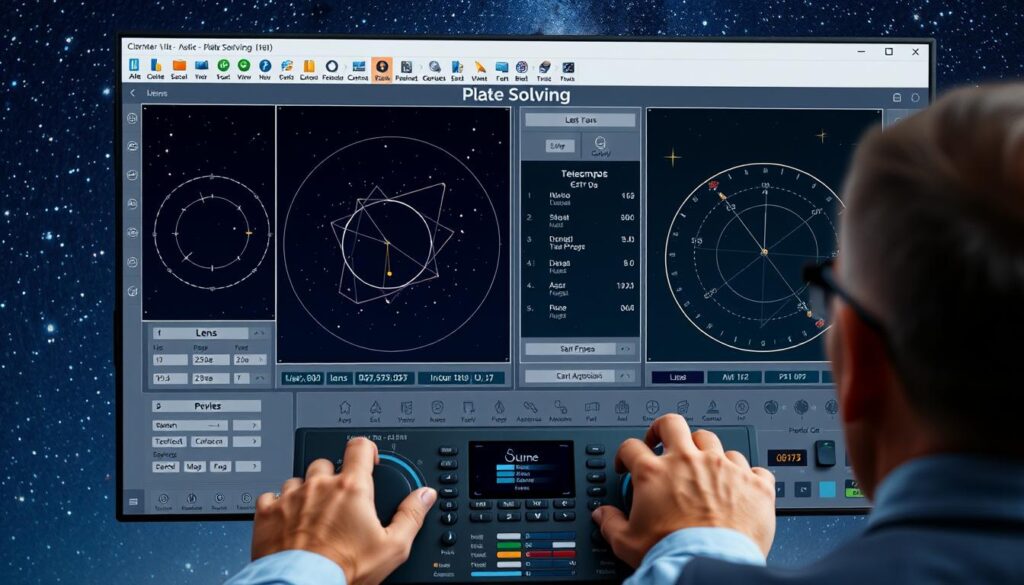
MaximDL
MaximDL is a top choice for astrophotographers. It has advanced plate solving and is easy to use. MaximDL gives you detailed control over solving plates, making it a favorite among pros.
Astrometry.net
Astrometry.net is a web service that solves images without knowing their location. It’s great for beginners and researchers. Astrometry.net makes solving plates easy and effective.
SGP (Sequence Generator Pro)
SGP combines plate solving with other astrophotography tools. It helps you manage your workflow from start to finish. SGP’s plate solving ensures you hit your targets accurately and automates your shots.
Choosing the right plate solving software can greatly improve your astrophotography. It doesn’t matter if you’re new or experienced. Knowing what each software can do is key to getting the best results.
Integrating Plate Solving into Your Workflow
To get the most out of plate solving, you need to make it a part of your astrophotography workflow. This means following a few key steps. These steps help you use the technology to improve your observations and images.
Pre-Observing Preparations
Before you start observing, getting your equipment and software ready is key. Make sure your telescope is aligned right and your plate solving software is set up correctly. Also, check that your camera is calibrated and ready to go.
Some important steps include:
- Aligning your telescope for accurate positioning.
- Setting up your plate solving software with the right settings for your gear.
- Calibrating your camera to get the best image quality.
Adjusting Settings for Optimal Results
Changing settings on your equipment and software can really help with plate solving. You need to adjust things like exposure time, gain, and other settings to get the best image quality.
Here’s a table showing how different settings affect plate solving:
| Setting | Description | Effect on Plate Solving |
|---|---|---|
| Exposure Time | How long the camera is exposed to light | More exposure time can make images better but can overexpose if too much. |
| Gain | How much the camera amplifies the signal | Higher gain can make faint objects clearer but may add noise. |
| Binning | Mixing pixels to increase sensitivity | Binning can make signal-to-noise ratio better but lowers resolution. |
By tweaking these settings and knowing their effects, you can get better plate solving results. Using a plate solving telescope and a smart plate solving algorithm can also make your targeting more accurate.
Adding plate solving to your workflow makes your observing smoother. It also opens up new chances for astrophotography and research. By learning these techniques, you can target more accurately and work more efficiently.
Troubleshooting Common Issues
Plate solving software has many benefits but can also have challenges. When using it for astrophotography, you might face problems. Knowing how to fix these issues is key to getting the best results.
Software Failures
One common problem is software failure. This can happen for many reasons like compatibility issues, wrong settings, or damaged files. To fix software failures, first check for updates or patches for your plate solving software. Keeping your software current can often solve many problems.
If updates don’t help, try reinstalling the software or look for conflicts with other programs. Also, reading the user manual or online forums can offer helpful tips for solving specific issues.
Addressing Image Quality Problems
Image quality issues are another common problem. These can make plate solving less accurate. Poor seeing conditions, wrong exposure, or not enough calibration can cause bad images.
To improve image quality, work on your imaging skills and settings. Make sure your telescope is calibrated right, and your images are well-exposed and focused. Using astrophotography plate solving can also help spot and fix image problems.
By understanding and solving common plate solving software issues, you can avoid problems and get better results in your astrophotography.
Advanced Techniques in Plate Solving
As you explore plate solving, you’ll find advanced methods to boost your workflow and image quality. Learning these techniques is crucial for top-notch astrophotography results.
One key advanced method is using multiple reference images. This method greatly improves your targeting by giving a deeper view of the celestial objects you’re capturing.
Using Multiple Reference Images
Using multiple reference images means taking several shots of the same area and merging them for a better plate solution. It’s very helpful for complex or crowded fields.
Benefits of multiple reference images:
- Improved targeting accuracy
- Enhanced image quality
- Better handling of complex or crowded fields
To use this method, take multiple images of the same area, making sure they’re aligned and calibrated. Then, use plate solving software to merge these images for a more precise solution.
Combining Plate Solving with Other Tools
Another advanced technique is combining plate solving with other tools and software. This integration makes your workflow smoother and more efficient.
Benefits of combining plate solving with other tools:
- Streamlined workflow
- Improved image quality
- Enhanced accuracy and precision
For instance, use plate solving to center your target, then autoguiding to keep precise tracking during exposure. This combination leads to better images and data.
By mastering these advanced plate solving techniques, you can elevate your astrophotography skills. Whether you’re experienced or new, these techniques are vital for success in astronomy.
Best Practices for Astrophotographers
By following best practices, you can make your astrophotography better. This means choosing the right equipment and workflow.
Selecting the Right Cameras and Telescopes
Choosing the right plate solving camera and telescope is key. Your camera needs to catch the faint light from stars. Your telescope should give you clear, detailed images.
Look at the camera’s sensor size, pixel depth, and cooling. For telescopes, consider the aperture size, focal length, and type. A good camera and telescope pair can boost your plate solving workflow.
| Equipment | Key Considerations |
|---|---|
| Camera | Sensor size, pixel depth, cooling system |
| Telescope | Aperture size, focal length, type (refractor/reflector) |
Calibrating Your Setup
Calibrating your setup is crucial for great results. This means calibrating your camera, telescope, and plate solving software. Proper calibration helps your equipment work together well, reducing errors and improving image quality.
To calibrate, align your telescope’s mount and sync it with your camera. Then, set up your plate solving software with your gear. Regular updates and checks keep your setup running smoothly.
By following these tips and improving your skills, you can take amazing pictures of the night sky.
Comparing Plate Solving to Other Targeting Methods
The quest for precision in astrophotography has led to many targeting techniques. Plate solving is one of the most popular. Knowing the strengths and weaknesses of each method helps you pick the right one for your needs.
Traditional Star Hopping
Traditional star hopping uses a telescope’s finder scope or main eyepiece to find objects in the sky. It relies on the observer’s sky knowledge and can take a lot of time. While it connects you deeply to the sky, it’s not as quick as plate solving for hard-to-find or faint objects.
Plate solving software quickly finds stars in an image and tells the telescope where to go. This makes targeting more accurate and quicker.
GoTo Systems
GoTo systems automatically move the telescope to a celestial object using pre-programmed coordinates. They’re fast and convenient but their accuracy depends on the mount’s alignment and the database. Even with a good GoTo system, the actual pointing can still be off due to mechanical issues.
Astrophotography plate solving is more accurate because it looks at the actual star field in the image. This makes it a top choice for precise work.
Plate solving stands out for its accuracy and speed, making it a key tool for astrophotographers. Whether you’re new or experienced, knowing about plate solving can improve your sky observations.
Real-World Applications of Plate Solving
Plate solving is very useful in many ways, changing astronomy a lot. It helps both experts and hobbyists find and study stars and planets easily.
It’s very important in research and collecting data. Astronomers use it to find and study stars and other things in space. This helps us learn more about the universe.
Research and Data Collection
In research, plate solving helps study things like asteroid paths, supernovae, and far-off galaxies. It helps find these objects’ exact locations. This gives us important data for understanding the universe better.
For researchers, learning how to use plate solving is key. A good tutorial can show them how to do it right. This makes collecting data more accurate and quick.
| Research Area | Application of Plate Solving | Benefits |
|---|---|---|
| Asteroid Orbits | Precise tracking and prediction | Enhanced understanding of asteroid trajectories |
| Supernovae Studies | Accurate location and analysis | Better data on supernovae characteristics |
| Distant Galaxies | Detailed observation and study | Increased knowledge of galaxy evolution |
Community Star Parties and Events
Plate solving is also key at community star parties. These events bring together people who love to look at the stars. It helps them find and see stars more easily.
At these events, plate solving helps plan better. It makes the experience better for everyone. It also helps people feel connected as they explore the sky together.
As plate solving gets better, it will help more in research and events. It lets astronomers and fans alike help us learn more about space.
Future of Plate Solving Technology
The future of plate solving technology is changing fast. New software and ways to observe are leading the way. You’ll find new ways to improve your astrophotography skills.
Advancements in Automation
Plate solving technology is getting more automated. This means you can target more efficiently and accurately. The software is getting smarter, helping you take better pictures.
Artificial Intelligence in Astronomy
Artificial intelligence is changing astronomy, including plate solving. AI can process huge amounts of data quickly. This makes plate solving faster and more accurate.
With these advancements, you can expect better results in your astrophotography. Keep up with new software and techniques. You’ll be able to capture amazing images of the sky.