
Are you ready to capture the night sky like never before? 2025 promises to be an exciting year for astronomy and photography. Many celestial wonders are waiting for you to capture.
Recent forecasts say you can expect to see lunar eclipses, planetary alignments, and meteor showers. With the right tips, you can improve your astronomy photography.
This article will guide you through the best celestial events to photograph in 2025. You’ll also get some valuable astronomy photography tips to boost your skills.
Introduction to Celestial Photography
Starting in celestial photography opens a world where patience and skill meet amazing night sky views. It’s a mix of knowing how to use your camera and being creative. This hobby is rewarding for those who are patient and willing to learn.
Celestial photography is more than just taking pictures of the sky. It’s an art that needs the right equipment, timing, and techniques. Whether you want to shoot the Moon, planets, or meteor showers, you need the right tools and knowledge.
What Makes Celestial Events Special?
Celestial events are unique because they show us the vast beauty of the universe. Events like lunar eclipses, planetary alignments, and meteor showers are not only beautiful but also rare opportunities for photographers.
- Lunar eclipses offer a chance to capture the Moon in a unique light.
- Planetary alignments allow photographers to capture multiple planets in a single frame.
- Meteor showers provide a dynamic and fast-paced subject to photograph.
Essential Gear for Photography
To take great celestial photos, you need the right gear. Here are some must-haves:
- A DSLR or mirrorless camera with manual controls.
- A sturdy tripod to stabilize your camera.
- A wide-angle lens to capture expansive sky views.
- Remote shutter release or camera timer to avoid camera shake.
By knowing what makes celestial events special and having the right gear, you’re ready to take amazing night sky photos. Check out a skywatching events calendar to plan your next shoot.
Major Lunar Events to Capture in 2025
2025 is packed with exciting lunar events for astrophotographers. The moon’s phases offer a wide range of photography subjects. From the crescent moon’s soft glow to the full moon’s bright light, there’s something for everyone.
Types of Lunar Events
Lunar events include lunar eclipses, where the Earth blocks the sun’s light, shadowing the moon. In 2025, we’ll see two major eclipses. A total lunar eclipse on March 14 and a partial one on September 7.
The March 14 total lunar eclipse will turn the moon red, known as a “blood moon.” The September 7 partial eclipse will offer a unique moon view.
Optimal Viewing Locations
Where you are affects what you can see. For the March 14 total lunar eclipse, North America, Europe, and parts of Asia are best. Check timing and visibility maps to plan your shoot.
For the September 7 partial eclipse, South America, Africa, and parts of Europe are good spots. Always check the weather and local conditions for the best photos.
Tips for Photographing the Moon
Photographing the moon needs planning and the right gear. Use a telephoto lens for detailed shots. A tripod helps get sharper images, even with long exposures.
- Adjust your camera settings for the lunar phase and environment.
- Try different exposure times for the look you want.
- Bracket your shots for later HDR merging.
By knowing lunar events, where to see them, and how to photograph the moon, you can take amazing pictures. These images will show the moon’s beauty.
Solar Events Worth Your Attention
In 2025, a partial solar eclipse will be seen in many places. It will happen on March 29. You can see it in Europe, parts of Asia, Africa, North America, and the Arctic.
Timing and Path of Solar Eclipses
Knowing when and where to see a solar eclipse is key. The March 29 eclipse will be visible over a large area. This makes it easy for many to capture it.
To get the best shot, find out when and how long the eclipse will last in your area.
| Region | Visibility Timing | Duration |
|---|---|---|
| Europe | Partial Eclipse: 10:00 AM UTC | 2 hours 30 minutes |
| North America | Partial Eclipse: 12:00 PM UTC | 2 hours 45 minutes |
| North of Africa | Partial Eclipse: 11:00 AM UTC | 2 hours 20 minutes |
Preparing for Solar Photography
Photographing solar eclipses needs specialized equipment. You’ll need a camera, tripod, and solar filter. These protect your camera and eyes.
- Use a DSLR or mirrorless camera with manual controls.
- Invest in a good quality solar filter that fits your lens.
- Practice your photography skills beforehand to be prepared.
With the right timing and gear, you can take amazing photos of this rare event.
Meteor Showers: A Photographic Opportunity
The night sky comes alive with meteor showers. They offer a unique chance for photographers to capture stunning visuals. Meteor showers happen when Earth passes through debris left by comets or asteroids. This causes small particles to burn up in the atmosphere, creating bright streaks in the sky.
Key Meteor Showers in 2025
In 2025, several notable meteor showers are expected to peak. This gives photographers a chance to show off their skills. The Quadrantid meteor shower, peaking on January 3-4, is one of the year’s first major events. Later, the Geminid meteor shower, peaking on December 13-14, is known for its high rates of activity and bright meteors.
These events are significant because they offer a high frequency of meteors. This increases the chances of capturing great shots. Knowing the peak times and radiant points of these showers is crucial for successful photography.
Best Practices for Shooting Meteor Showers
To capture meteor showers effectively, you need to employ certain techniques. First, use a wide-angle lens to cover more of the sky. A tripod is essential for stabilizing your camera during long exposures. Set your camera to manual focus and use a remote shutter release or the camera’s timer to avoid camera shake.
- Use a low f-stop value (around f/2.8) to capture as much light as possible.
- Set your camera to a high ISO (1600-3200) to be sensitive to the meteors’ brightness.
- Take multiple shots in succession to increase your chances of capturing a meteor.
Finding the Right Location
Finding a location with minimal light pollution is crucial for capturing the night sky in all its glory. Look for places with dark skies, such as national parks or remote areas. Check the weather forecast to ensure clear skies on the night of the meteor shower.
Arriving at your location early allows you to set up and compose your shot while there’s still light. This preparation is key to capturing the meteor shower at its peak.
Planetary Alignments and Conjunctions
As we explore the celestial events of 2025, we find planetary alignments and conjunctions to be key. These rare events are perfect for astronomers and photographers to capture. They offer a chance to see planets aligning in the sky.
Planetary alignments happen when many planets seem close in the sky. This creates a stunning sight. In 2025, on January 21, six planets will align in the evening sky. This is a rare event and a great chance for photographers to capture something special.
Noteworthy Alignments in 2025
The astronomy calendar for 2025 lists several planetary alignments. These not only look amazing but also offer a chance to take incredible photos.
| Date | Planetary Alignment | Best Viewing Time |
|---|---|---|
| January 21 | Six planets align in the evening sky | Shortly after sunset |
| March 15 | Mars and Jupiter conjunction | Early morning hours |
| August 20 | Venus and Saturn conjunction | Late evening hours |
How to Photograph Planetary Conjunctions
Photographing planetary alignments needs planning and the right gear. Here are some astronomy photography tips to help you:
- Use a tripod to keep your camera steady and avoid shake.
- Find a spot with a clear view of the horizon.
- Use a telephoto lens to get close-up shots of the planets.
- Try different exposure settings to get the best shot.
Catching celestial phenomena like planetary alignments is rewarding. With the right tools and planning, you can make stunning images of the night sky.
The Perseid Meteor Shower: A Must-See
Get ready to see the amazing Perseid meteor shower in 2025. It’s a top event in the sky, perfect for photographers to catch shooting stars.
The Perseid meteor shower peaks on August 12-13, 2025. Mark your calendars for the best view. It’s famous for bright meteors and glowing trails that photographers love to capture.
Timing for Optimal Viewing
To see the Perseid meteor shower at its best, know the timing. The best hours are midnight to dawn, when it’s darkest. Find a spot with little light pollution for a better view.
- Check the weather forecast for clear skies.
- Go to a dark place, away from city lights.
- Wear warm clothes, as you’ll be outside for a while.
Techniques for Capturing the Perseids
To capture the Perseid meteor shower, plan and use the right techniques. Use a wide-angle lens to see more sky. Set your camera to a low f-stop to let in lots of light.
- Use a tripod to keep your camera steady.
- Set your camera to manual focus and focus on infinity.
- Take many shots in a row to catch the meteors.
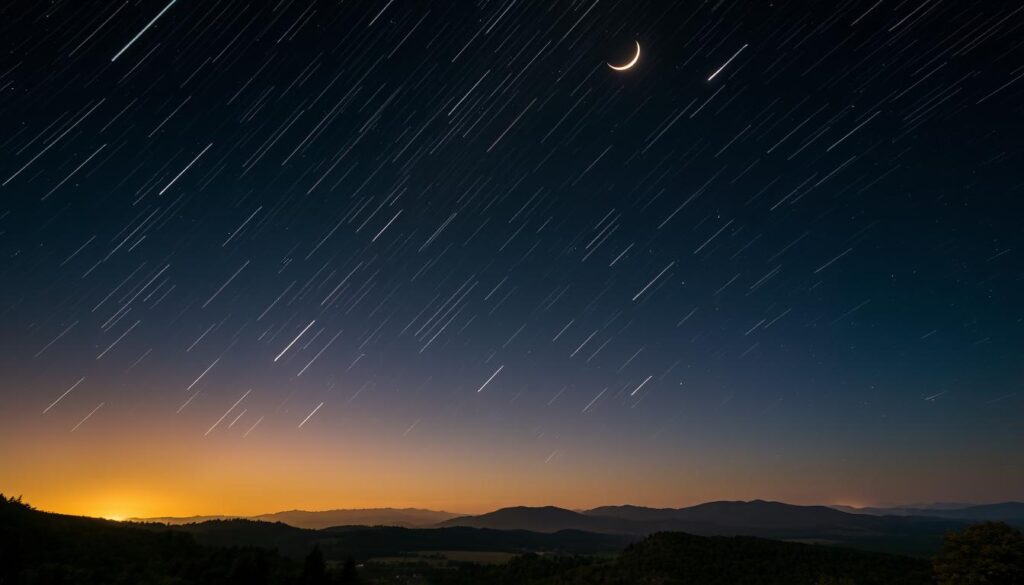
By using these tips, you’ll get amazing photos of the Perseid meteor shower in 2025. Don’t miss this chance to see one of the year’s top sky events.
Exploring the Night Sky with Your Camera
The night sky is full of stars and wonders. It waits for your camera’s lens. Capturing its beauty needs skill and vision.
To start, you need the right astrophotography gear. You’ll need a DSLR or mirrorless camera, a sturdy tripod, and wide-aperture lenses. A remote shutter release or timer helps avoid camera shake.
Star Trails Photography
Star trails photography shows stars moving over time. It creates a mesmerizing light trail. To do this, set your camera for a long exposure, from 30 minutes to hours.
- Use a wide-angle lens to capture more sky.
- Set your camera to manual focus and focus on infinity.
- Use an intervalometer for multiple shots to stack later.
Long Exposure Techniques
Long exposure techniques capture the night sky’s beauty. Longer exposures let more light in, showing faint details.
When using long exposure, keep your camera’s ISO low to minimize noise. Use a tripod to keep the camera stable and sharp.
For great stargazing photos, find places with little light pollution. National parks and remote spots are perfect for a clear night sky.
Eclipses: Total vs. Partial
Eclipses are rare chances to see the sun and moon in unique ways. They are amazing and give photographers a chance to take incredible photos.
Total and Partial Eclipses: There are two main types of eclipses – total and partial. Knowing the difference is key to getting the best photos.
Understanding the Different Types
A total eclipse happens when the moon blocks the sun, showing the sun’s corona. A partial eclipse shows a crescent shape because the moon only covers part of the sun.
Lunar eclipses also vary, with penumbral, partial, and total types. Each offers a unique photo opportunity.
What You Need for Successful Shots
To take great eclipse photos, you need the right gear. A DSLR or mirrorless camera with manual controls is a must. A telescope or telephoto lens helps get closer shots.
You’ll also need a tripod for camera stability and a solar filter to protect your camera from the sun’s light.
With knowledge of eclipse types and the right equipment, you can take photos that amaze everyone.
Comets: A Celestial Photographer’s Dream
Comets are a big deal in 2025, lighting up our skies. They are a mix of mystery and beauty. For photographers, capturing comets is a special task.
Expected Comets in 2025
Comet C/2024 G3 (ATLAS) is set to dazzle in 2025. It’s getting a lot of buzz for its brightness and visibility.
Tips for Photographing Comets
Photographing comets needs skill and creativity. Here are some tips for amazing shots:
- Use the right equipment: A DSLR or mirrorless camera is key. A tripod and wide-angle lens help too.
- Location is key: Find a dark spot with little light pollution. It makes the comet stand out.
- Timing is everything: Take photos when the comet is brightest. This is usually when it’s closest to the Sun.
| Comet | Expected Visibility | Brightness |
|---|---|---|
| C/2024 G3 (ATLAS) | 2025 | High |
| Other Comets | TBD | Variable |
Photographing comets is tough but rewarding. Knowing what to expect and how to prepare can elevate your photos.
The Best Times for Astrophotography
Capturing the beauty of the night sky needs careful planning. Knowing the best times for astrophotography is key. Success depends on the time of year, celestial events, and weather.
Seasonality and Celestial Events
Seasonal celestial events are crucial for astrophotography. Meteor showers happen every year, offering a spectacular show. The Milky Way is visible in summer, perfect for stunning photos.
Planetary alignments, solar eclipses, and lunar eclipses are significant. They offer unique astrophotography opportunities. For example, a total solar eclipse lets you capture the sun’s corona. A lunar eclipse can create striking moon shadow images.
Weather Considerations
Weather is vital for astrophotography. Clear skies are necessary for quality images. Always check the weather forecast before going out.
Be ready for unexpected weather changes. This includes sudden cloud cover or fog.
When planning, consider these weather factors:
- Cloud cover: Avoid nights with heavy cloud cover, as it can obstruct your view of the stars.
- Moon phase: A full moon can be too bright, while a new moon can provide darker skies ideal for capturing faint celestial objects.
- Temperature: Extreme temperatures can affect your equipment, so be sure to dress appropriately and protect your gear.
Understanding the best times and being weather-ready can improve your astrophotography. Whether you’re experienced or new, careful planning and attention to detail are crucial.
Milky Way Photography Opportunities
Ever looked up at the night sky and felt amazed? Capturing the Milky Way is a dream for many. It’s a breathtaking sight that photographers can capture with the right gear and planning. You can take stunning pictures of our galaxy.
When and Where to Capture the Milky Way
The Milky Way’s visibility changes with the seasons and your location. The best times are spring and summer when it’s high in the sky. Dark sky locations with little light pollution are perfect for clear Milky Way shots. Use apps and websites to find the best times and places for your location.
- Check local astronomical events calendars to plan your shoot.
- Use apps like PhotoPills or Stellarium to determine the Milky Way’s position.
- Head to locations known for dark skies, such as national parks or designated dark sky reserves.
Equipment Recommendations
To capture the Milky Way, you need a few key items. A wide-angle lens with a low f-stop value (like f/2.8 or lower) is crucial for light. A sturdy tripod is also key for stable long exposures. Use a remote shutter release or self-timer to avoid camera shake.
For editing, learn Adobe Lightroom or Photoshop. They help improve your Milky Way photos’ details and colors. Stacking multiple shots can also reduce noise and enhance image quality.
Conclusion: Get Ready to Capture 2025’s Wonders
The night sky in 2025 is full of amazing sights to capture. You’ll find everything from lunar events to planetary alignments. This year is perfect for taking stunning photos of the sky.
Practical Tips for Success
To capture these amazing sights, make sure you have the right gear. You’ll need a strong tripod and a camera that can handle manual settings. Learn tips for astronomy photography, like using long exposures and finding the best times for the Milky Way or meteor showers.
With the right equipment and a little practice, you can capture the beauty of the night sky. So, grab your camera, head to your favorite spot, and get ready to capture the wonders of 2025.