
When you’re taking pictures of deep-sky objects (DSOs), knowing the best methods is key. Astronomical filters are crucial in astrophotography techniques. They help make your images better.
Choosing between narrowband and broadband imaging greatly impacts your DSO photos. Narrowband imaging focuses on certain light wavelengths. On the other hand, broadband imaging captures a broader spectrum. Each has its own benefits.
Understanding the differences between these methods helps you make better choices. This way, you can enhance your deep space objects imaging results.
Introduction to DSOs and Imaging Techniques
For those starting in astrophotography, knowing about deep-sky objects and how to capture them is key. Deep-sky objects, or DSOs, include galaxies, nebulae, and star clusters. Each one has its own challenges and opportunities for astronomers and astrophotographers.
What are Deep Sky Objects (DSOs)?
Deep-sky objects are far from Earth and often hard to see. They need special equipment and techniques to observe and capture. There are different types, like galaxies, nebulae, and star clusters.
- Galaxies: Massive, gravitationally bound systems consisting of stars, stellar remnants, interstellar gas, dust, and dark matter.
- Nebulae: Interstellar clouds of dust, hydrogen, helium, and other ionized gases, often the birthplaces of new stars.
- Star Clusters: Groups of stars that are gravitationally bound together, offering insights into stellar evolution and the history of the universe.
To capture images of these objects, you need to understand their characteristics and the challenges of imaging them. You can learn more about techniques and equipment on AstroBackyard. It offers insights into narrowband imaging techniques.
Importance of Imaging Techniques
Imaging techniques are crucial in astrophotography. They help capture high-quality images of deep-sky objects. The choice of technique depends on the object, equipment, and desired outcome. Narrowband and broadband imaging are two main techniques used.
| Imaging Technique | Description | Application |
|---|---|---|
| Narrowband Imaging | Uses specific filters to capture images in narrow wavelength bands, enhancing contrast and detail in certain features like emission nebulae. | Ideal for capturing nebulae and other objects with specific emission lines. |
| Broadcast Imaging | Captures a broader spectrum of light, resulting in more natural color representation of celestial objects. | Suitable for imaging galaxies, star clusters, and other objects where color accuracy is desired. |
Understanding the importance of these techniques and how to use them is key. By choosing the right technique and equipment, you can capture the beauty and complexity of deep-sky objects.
Understanding Narrowband Imaging
Narrowband imaging lets you see deep-sky objects more clearly. It’s great for taking detailed pictures of nebulae and other space bodies. This method uses specific light wavelengths to cut down light pollution and make faint details stand out.
Definition and Principle of Narrowband Imaging
Narrowband imaging uses special filters to catch certain light wavelengths. It focuses on specific emission lines from space objects. These lines show the presence of elements like hydrogen and oxygen, helping to create detailed images.
Narrowband filters are made to grab these specific emission lines. This boosts contrast and lessens light pollution. Narrowband imaging gives a more detailed look at deep-sky objects.
Key Emission Lines in Narrowband Imaging
Important emission lines in narrowband imaging include hydrogen-alpha, oxygen-III, and sulfur-II. Each line corresponds to a different light wavelength. These lines are key for detailed images of nebulae and other space bodies.
- Hydrogen-alpha (Hα) emission lines capture the red glow of nebulae.
- Oxygen-III (OIII) emission lines reveal the faint details of planetary nebulas.
- Sulfur-II (SII) emission lines provide additional contrast and detail in images of deep-sky objects.
Understanding Broadband Imaging
Broadband imaging captures a wide range of colors, showing deep-sky objects more naturally. It’s great for seeing the beauty of celestial bodies.
This method uses a broad spectrum to image deep-sky objects. It brings out more natural colors and details, making it key in astrophotography.
Definition and Principle
Broadband imaging captures a wide range of light. This gives a full view of deep-sky objects, showing their true colors and details.
It involves taking images through different filters. These filters let various wavelengths of light pass through. The combined images show a rich, detailed picture.
Common Filters Used
LRGB filters are often used in broadband imaging. They capture luminance (L), red (R), green (G), and blue (B) channels. These are then mixed to create a full-color image.
- Luminance filters capture the overall brightness of the object.
- Red, Green, and Blue filters capture the color information.
By mixing these channels, astronomers create high-quality images. These images show the detailed beauty of deep-sky objects.
Advantages of Narrowband Imaging
Narrowband imaging has many benefits for capturing deep-sky objects, like nebulae. It focuses on specific light wavelengths. This lets astrophotographers get detailed images that broadband imaging might miss.
Enhanced Contrast for Nebulae is a big plus of narrowband imaging. It isolates light from elements like hydrogen and oxygen. This reveals the fine details in nebulae, which is great for showing their complex structures.
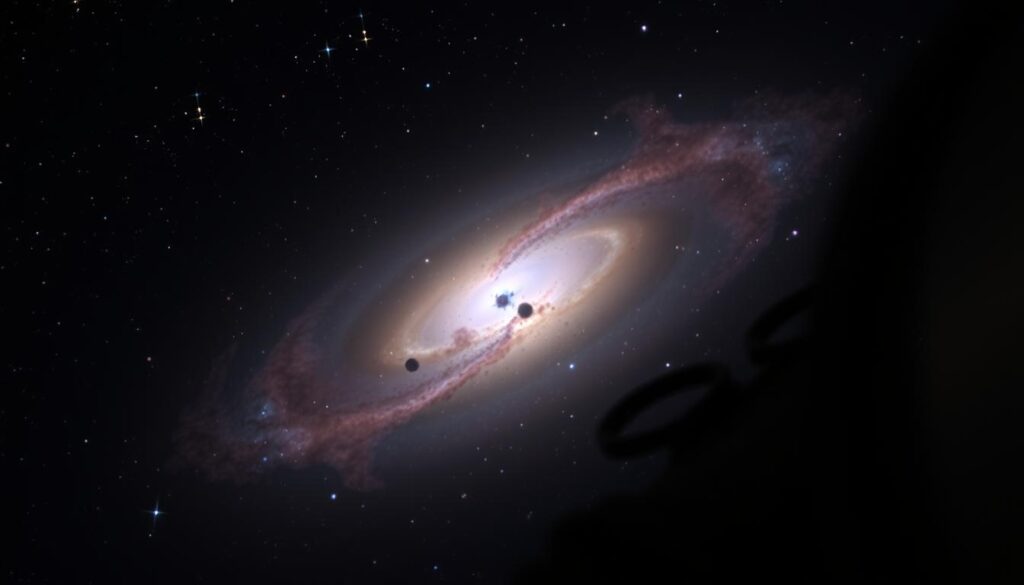
Capturing Intricate Details
Narrowband imaging lets you see small details in nebulae that broadband images can’t. It uses filters for specific emission lines. This boosts contrast between different parts of the nebula, making its structure clearer.
It also helps Reduce Light Pollution Effects. Light pollution from cities can mess up astrophotography. But narrowband filters focus on wavelengths less affected by pollution. This way, you can get clearer images of deep-sky objects, even in less-than-ideal spots.
Mitigating Light Pollution
Narrowband imaging is great for fighting light pollution. It uses filters for specific wavelengths. This reduces the impact of artificial light, making images closer to what you’d see in the dark.
Narrowband imaging is a powerful tool for astrophotographers. It offers better contrast for nebulae and less light pollution. By using its advantages, you can take amazing images of deep-sky objects. These images show their intricate details and structures.
Advantages of Broadband Imaging
Broadband imaging is a key tool in astrophotography. It has many benefits for capturing deep-sky objects (DSOs). One major advantage is its ability to capture a wide range of colors.
Capturing a Wider Spectrum of Colors
Broadband imaging captures a broader range of wavelengths. This results in images with more nuanced and varied color profiles. This is great for DSOs with complex color characteristics, like nebulae.
Key Benefits:
- Captures a wider range of colors
- Reveals subtle color variations in DSOs
- Enhances the overall aesthetic appeal of astrophotography images
Better Detail in High-Contrast Areas
Broadband imaging also shines in capturing detail in high-contrast areas of DSOs. It uses a wider spectrum of light. This helps balance the contrast between bright and dark regions.
| Imaging Technique | Color Capture | High-Contrast Detail |
|---|---|---|
| Broadband Imaging | Wide spectrum of colors | Excellent detail in high-contrast areas |
| Narrowband Imaging | Limited to specific wavelengths | Limited detail in high-contrast areas |
In conclusion, broadband imaging is a big plus for astrophotographers. It’s great for capturing a wide range of colors and revealing better detail in high-contrast areas.
Comparing Signal-to-Noise Ratios
In astrophotography, knowing about the signal-to-noise ratio is key. It helps capture clear images of deep-sky objects. The ratio compares the signal we want to the background noise.
Narrowband and broadband imaging have different ways to capture images. Their signal-to-noise ratios can vary a lot. It’s important to know these differences to choose the right method for your photos.
Factors Affecting Signal-to-Noise Ratio in Narrowband Imaging
In narrowband imaging, several things affect the signal-to-noise ratio. These include the emission lines captured, the quality of the filters, and the light pollution.
- The narrower bandwidth reduces noise from other wavelengths, improving the SNR for specific lines.
- Using high-quality narrowband filters can greatly reduce noise by capturing the exact wavelengths needed.
Factors Affecting Signal-to-Noise Ratio in Broadband Imaging
For broadband imaging, the SNR is influenced by capturing a broader spectrum of light. This includes more noise from light pollution and sky glow.
- The wider bandwidth in broadband imaging can increase noise due to more background light.
- Yet, it can also capture a wider range of colors, adding more detail to the image.
To show the SNR differences between narrowband and broadband imaging, here’s a comparison:
| Imaging Technique | Typical SNR | Noise Factors |
|---|---|---|
| Narrowband Imaging | High | Specific emission lines, filter quality, light pollution |
| Broandband Imaging | Variable | Broader spectrum, light pollution, sky glow |
Knowing how these factors affect the SNR in both methods is vital. It helps choose the best technique for your astrophotography goals.
Choosing the Right Filters
Choosing the right filter is key to capturing great images of deep-sky objects. The type of filter you pick affects the quality and detail of your photos. This is true for both narrowband and broadband imaging.
Understanding Filter Options is crucial. Narrowband filters capture specific wavelengths of light. Broadband filters let more light through, each for different astrophotography needs.
Popular Narrowband Filters
Narrowband filters focus on specific light from deep-sky objects. The top ones are:
- Hydrogen-alpha (H-alpha) filters, which catch the red light from hydrogen gas.
- Oxygen-III (OIII) filters, which catch the green light from oxygen.
- Sulfur-II (SII) filters, which catch the red light from sulfur.
These filters are great for detailed nebula images, even in light-polluted areas.
Popular Broadband Filters
Broadband filters capture a wider range of light. The most used ones are:
- Luminance (L) filters, which capture a broad spectrum of light, making images brighter and more detailed.
- Red (R), Green (G), and Blue (B) filters, used together to create full-color images.
These filters are perfect for capturing a wide range of colors and details in deep-sky objects. They’re great for many astrophotography projects.
Knowing the characteristics and uses of these filters helps you choose the right ones for your astrophotography.
Application in Astrophotography
The world of astrophotography is vast and exciting. Understanding narrowband and broadband imaging is key. These techniques are crucial for capturing deep-sky objects with high quality.
Narrowband imaging is popular for its ability to enhance contrast and reduce light pollution. It focuses on specific wavelengths of light. This allows for capturing the intricate details of nebulae and other deep-sky objects.
Best Practices for Narrowband Imaging
To excel in narrowband imaging, follow these best practices:
- Use specific filters that target key emission lines, such as H-alpha, OIII, and SII.
- Optimize your imaging setup to reduce noise and improve signal-to-noise ratio.
- Capture multiple subs to ensure that you have enough data for processing.
Narrowband imaging is great for capturing nebulae’s faint details. The right filters and techniques create images rich in contrast and detail.
Best Practices for Broadband Imaging
For broadband imaging, focus on capturing a wide spectrum of colors while minimizing noise. Here are some best practices to follow:
- Use a high-quality camera with good sensitivity across the visible spectrum.
- Employ a robust image processing technique to reduce noise and enhance detail.
- Capture a sufficient number of subs to ensure a good signal-to-noise ratio.
By mastering broadband imaging techniques, you can create vibrant and detailed images. This method is perfect for capturing the beauty of galaxies and star clusters.
Case Studies: Successful Imaging of DSOs
Getting great pictures of Deep Sky Objects (DSOs) needs both tech skills and creativity. Astrophotographers use many methods to show the details of these cosmic wonders. We’ll look at examples of narrowband and broadband imaging, showing how they capture amazing DSO photos.
Narrowband Imaging Examples
Narrowband imaging has changed astrophotography, making it possible to get clear DSO pictures. For example, the Orion Nebula is a favorite for narrowband shots. By focusing on specific light wavelengths, like H-alpha, OIII, and SII, photographers can show the nebula’s fine details.
Adam Block is known for his stunning Cygnus Loop photo, taken with narrowband filters. His image shows the remnant’s thin filaments, proving the method’s power.
Broadband Imaging Examples
Broadband imaging catches a broader light range, giving more natural colors. A great example is the Andromeda Galaxy (M31). With broadband filters, photographers can show the galaxy’s arms and core in bright colors.
Don Goldman is famous for his M33 (Triangulum Galaxy) photo, taken with broadband filters. His image highlights the galaxy’s complex shape and colors, proving broadband’s worth for big, spread-out objects.
Both narrowband and broadband imaging have their strengths. The choice depends on the object and the photographer’s goal. By mastering these methods, you can take breathtaking DSO photos that show their beauty and complexity.
Conclusion: Which is Right for You?
Choosing between narrowband and broadband imaging for deep-sky objects (DSOs) depends on your goals and needs. Knowing the pros and cons of each helps you make the best choice. This way, you can take amazing pictures of DSOs.
Narrowband imaging is great for reducing light pollution and improving contrast for nebulae. For example, the Askar Dual Narrowband filter is effective in capturing the Heart Nebula and Jellyfish Nebula. Broadband imaging, on the other hand, captures more colors and details in high-contrast areas.
Key Considerations
When choosing between narrowband and broadband imaging, think about your target objects and light pollution. If you’re focusing on nebulae, narrowband might be better. For galaxies or star clusters, broadband could be more fitting.
Understanding your equipment and the objects you want to photograph is key. By considering the benefits of each method, you can improve your astrophotography.