
Timing is key when capturing the night sky’s beauty. You might wonder why Moonless Nights are best for Deep Sky Imaging. Without moonlight, the sky’s objects shine brighter, perfect for Astrophotography Tips and techniques.
These nights turn the sky into a canvas of stars and galaxies. By learning Night Sky Photography and finding Dark Sky Locations, you can take amazing photos.
To Capture Clear Night Photos, you need the right gear and Stargazing Techniques. Knowing the Night Sky Visibility Guide helps you find the best objects to shoot.
Understanding the Importance of Moon Phases
Moon phases are key to getting great deep sky images. They change how bright the night sky is. This affects how well you can see and capture images of stars and planets.
When the moon is full, it shines brightly. This light scatters in the air, making the sky brighter. It’s harder to see faint stars and galaxies when the moon is full.
How Moonlight Affects Your Images
The moon’s brightness can mess with your deep sky photos. Here’s how:
- The moon’s light makes the sky brighter. This reduces the contrast between stars and the sky.
- Too much light can cause your photos to be overexposed. This loses the details of the stars you’re trying to capture.
- A bright moon also makes it tough to see faint objects like distant galaxies or nebulae.
The Optimal Moon Phases for Imaging
The best time for deep sky imaging is during the new moon phase. The moon is hidden from view, making the sky very dark. This is perfect for capturing clear images of deep-sky objects.
Here’s how to plan your deep sky imaging sessions:
- Look at the lunar calendar to find when the new moon is.
- Plan your shoots around this time for the best results.
- If you can’t avoid other moon phases, use moon filters or other tricks to reduce the moon’s impact.
Best Times of Year for Deep Sky Imaging
Getting ready for your next deep sky imaging adventure? Knowing the best times of the year can really help. The Earth’s path around the Sun and its tilt affect what we can see in the sky.
Seasonal considerations are key. In spring and summer, the Milky Way is out, offering many targets like galaxies and star clusters. Fall and winter bring other wonders, like the Andromeda Galaxy and nebulae.
Seasonal Considerations for Photographs
The seasons change the weather and what we can see in the sky. Summer nights are long and warm, perfect for the Milky Way. Winter brings clearer skies, great for distant galaxies.
Clear skies are crucial for deep sky imaging. Fall is known for clear skies in many parts of the United States, making it a top time for astrophotography.
Targeting Specific Celestial Events
There are special events to aim for in deep sky imaging. Meteor showers, planetary alignments, and lunar eclipses are great subjects.
Planning is key to capture these events. Use calendars and apps to keep track of celestial events. This way, you can get your gear ready and capture the moment.
Understanding the best times for deep sky imaging improves your astrophotography. Whether it’s seasonal objects or specific events, timing is everything for stunning images.
Planning Your Imaging Session
A well-planned imaging session is key to stunning deep sky images. You need the right tools and a clear idea of what you want to capture.
Tools for Tracking Moon Phases
Tracking moon phases is crucial in deep sky imaging. You can use:
- Astronomy apps like SkySafari or Star Walk
- Websites such as NASA’s Moon Phase Page
- Software integrated into your telescope or camera system
These tools help plan your sessions during the best moon phases. This ensures your images aren’t affected by moonlight.
Creating a Checklist for Your Equipment
Before you go, make a checklist of your equipment. This ensures everything works. Your checklist should include:
| Equipment | Status | Notes |
|---|---|---|
| Camera | Ready | Ensure batteries are charged |
| Telescope | Ready | Check for dust and alignment |
| Tripod | Ready | Ensure stability and level |
A detailed checklist helps avoid last-minute problems. This can ruin your session.
Effective planning improves your deep sky images and makes the experience better. With the right tools and equipment, you can capture amazing night sky images.
Choosing the Right Location
For deep sky imaging, picking a spot with little light pollution is key. Light pollution can mess up your images, making it tough to see the details of stars and galaxies.
Light Pollution and Its Impact
Light pollution happens when artificial light scatters in the air, brightening the sky. This makes it hard to get clear shots of deep sky objects. To avoid this, find a spot far from cities and streetlights.
Finding Dark Sky Locations in the U.S.
The U.S. has many dark spots perfect for deep sky photos. Look for national parks and remote places with little light. Use dark sky maps and astronomy sites to find great spots near you.
| Location | State | Dark Sky Rating |
|---|---|---|
| Death Valley National Park | California | 9/10 |
| Big Bend National Park | Texas | 8.5/10 |
| Great Basin National Park | Nevada | 9.5/10 |
Choosing a dark spot can really boost your deep sky photos. Always check local rules and get any needed permits before you go.
Ideal Weather Conditions for Imaging
Capturing stunning deep sky images needs more than just the right gear. Clear skies and stable atmospheric conditions are key for top-notch images.
When planning your deep sky imaging, check the weather forecast. Clear skies are a must for seeing celestial objects. A stable atmosphere also prevents image distortion from air movement.
Several factors make for ideal weather for deep sky imaging. These include low humidity, clear skies, and little atmospheric disturbance. Low humidity helps keep the air dry, which improves image quality by reducing light absorption or scattering.
Another important factor is no moonlight, as we’ve talked about before. But weather is also crucial for a successful imaging session. Keeping an eye on the forecast and being ready for changes can greatly improve your results.
- Clear skies
- Low humidity
- Stable atmospheric conditions
- Minimal light pollution
By understanding and preparing for these weather conditions, you can get the best results from your deep sky imaging.
How Clouds Affect Photography
Weather is key in deep sky imaging, and clouds play a big role. They can greatly affect your photos.
Cloud cover is very important. Thick clouds block your view, making it hard to take pictures. Even thin clouds can scatter light and lower image contrast.
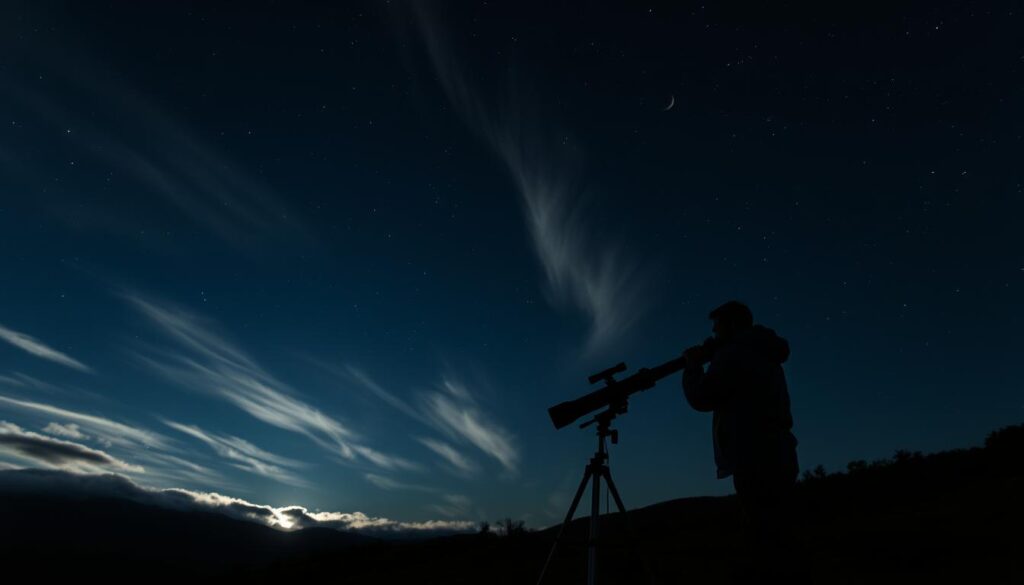
Understanding Atmospheric Stability
Atmospheric stability is also crucial. A stable atmosphere lets light travel straight to your camera, making images sharper.
An unstable atmosphere causes distortions and blur. This is because different air layers have different refractive indices. This problem, called atmospheric seeing, can ruin your images.
| Atmospheric Condition | Impact on Image Quality |
|---|---|
| Stable Atmosphere | Sharper images with less distortion |
| Unstable Atmosphere | Distorted and blurry images due to atmospheric seeing |
| Cloud Cover | Obstructs view, scatters light, and reduces contrast |
To get the best deep sky images, watch the weather. Look for clear skies and stable air. Using tools to track these can really help your photos.
Recommended Equipment for Deep Sky Imaging
The right gear is key for deep sky imaging. It lets you capture amazing celestial images. You’ll need a few essential pieces to get high-quality results.
Cameras and Lenses for the Best Results
There are two main camera types: DSLR and dedicated astronomy cameras. DSLR cameras are great for beginners because they work for both day and night. Dedicated astronomy cameras are better for the night sky, offering better cooling and sensitivity.
Lenses are also very important. A wide-aperture lens lets in more light, which is good for dark scenes. For deep sky shots, a 50-200mm lens is often best. A wider aperture (smaller f-number) means more light, making images brighter.
- DSLR cameras for versatility
- Dedicated astronomy cameras for enhanced sensitivity
- Wide-aperture lenses for better low-light performance
Tripods and Mounts: Stability is Key
A strong tripod is crucial for deep sky imaging. It keeps your camera steady, avoiding blurry images. Choose a tripod that’s sturdy and can hold your camera and lens. Also, think about a tripod with a smooth panhead or a motorized mount for tracking.
Mounts are also vital for tracking celestial objects. An equatorial mount is best. It adjusts for Earth’s rotation, letting you take sharp images for longer times.
- Choose a sturdy tripod for stability
- Consider a tripod with a smooth panhead or motorized mount
- Use an equatorial mount for tracking celestial objects
Techniques for Capturing Deep Sky Objects
To capture the breathtaking beauty of deep-sky objects, you need to master a few key techniques. Deep-sky imaging is not just about pointing a camera at the sky. It’s about understanding and applying the right methods to reveal the hidden wonders of the universe.
One of the fundamental techniques in deep-sky imaging is long exposure photography. This method involves keeping the camera’s shutter open for an extended period. It allows more light to hit the sensor, capturing the faint details of distant celestial objects.
Long Exposure Photography Explained
Long exposure photography is crucial for capturing the intricate details of deep-sky objects. By allowing the camera to gather more light, you can reveal the subtle nuances of nebulae, galaxies, and star clusters.
- Use a sturdy tripod to minimize camera shake and ensure sharp images.
- Choose a location with minimal light pollution to maximize the visibility of deep-sky objects.
- Experiment with different exposure times to find the optimal setting for your target.
Another critical technique is image stacking, which involves combining multiple images of the same object to enhance the overall quality and detail.
Stacking Images for Enhanced Quality
Image stacking is a powerful technique for improving the signal-to-noise ratio in your deep-sky images. By aligning and combining multiple exposures, you can produce a single image that showcases more detail and clarity than any individual exposure.
- Capture multiple images of the same object under consistent conditions.
- Use software to align the images and remove any inconsistencies.
- Combine the aligned images to produce a final stacked image.
By mastering long exposure photography and image stacking, you can significantly enhance your deep-sky imaging capabilities. These techniques, combined with the right equipment and a bit of patience, will help you capture the awe-inspiring beauty of the night sky.
Post-Processing Your Images
Post-processing is key in deep sky imaging. It can greatly improve your photos. This step enhances and refines your images to show the night sky’s beauty.
Choosing the right software is essential for post-processing. There are many options, each with its own strengths. Adobe Photoshop and PixInsight are popular choices. Photoshop is great for general editing, while PixInsight is made for astrophotography.
Software Options for Image Editing
Choosing the right software is crucial for top results. Here are some popular ones:
- Adobe Photoshop: Known for its powerful editing capabilities and wide range of tools.
- PixInsight: A specialized tool for astrophotography that offers advanced processing techniques.
- StarStax: Ideal for stacking images to improve quality and reduce noise.
- Adobe Lightroom: Useful for managing and editing large collections of images.
Techniques for Enhancing Deep Sky Shots
With your software ready, it’s time to apply key techniques. These include:
- Noise Reduction: Using algorithms to minimize the grain and digital noise in your images.
- Color Correction: Adjusting the colors to accurately represent the night sky.
- Image Sharpening: Enhancing the clarity and definition of celestial objects.
- Stacking Images: Combining multiple shots to improve overall quality and detail.
Mastering these techniques and using the right software can greatly enhance your deep sky images. They will become more vibrant and detailed.
Staying Safe While Stargazing
When you go out for deep sky imaging, safety is key. You might be in remote places, far from city lights. These areas can be dark and risky.
To have a good time, you need to be ready. This means having the right safety gear and knowing about dangers like wildlife and tough terrain.
Essential Safety Gear for Night Imaging
Having the right tools is crucial for your safety. Here are some must-haves:
- Reliable flashlights or headlamps to move around in the dark. Use red light to keep your eyes adjusted.
- First aid kits that have everything you need for small injuries.
- Communication devices like phones or radios. They’re important in remote spots.
- Warm and waterproof clothing to keep you safe from the cold and rain.
Avoiding Wildlife and Environmental Hazards
It’s not just about the gear. Paying attention to your surroundings is also important. This means:
- Knowing about local animals and how to stay away from them.
- Understanding the area you’re in and any dangers like steep hills or water.
- Looking at the weather forecast to avoid bad weather.
By being careful and prepared, you can have a safe and fun time with deep sky imaging. The goal is to enjoy the night sky while keeping yourself and others safe.
Engaging with the Astronomy Community
Connecting with the astronomy community can really boost your deep-sky imaging skills. You’ll learn new things, pick up techniques, and keep up with the latest in astrophotography.
Joining local astronomy clubs is a great way to get involved. These clubs have events, viewing nights, and workshops. You’ll meet others who love night sky photography and explore new dark sky locations together.
Joining Local Astronomy Clubs
Local astronomy clubs are full of knowledge and experience. By joining, you can:
- Attend star parties and viewing nights to practice your skills
- Learn from experienced members about the best techniques and equipment
- Share your own experiences and photos, getting feedback from the community
For more info on joining the astronomy community and finding activities that spark curiosity, check out this resource.
Online Forums and Resources for Imaging
Online forums and resources are also key for deep-sky imaging fans. Websites, social media groups, and forums focused on astrophotography are great for sharing your work and learning. You’ll find tutorials, webinars, and photography groups all about deep sky imaging.
By joining both local and online communities, you’ll improve your skills and keep up with new astrophotography tips and best practices. Whether you’re new or experienced, the astronomy community is here to help you capture the night sky’s beauty.
Advanced Techniques for the Experienced Astrophotographer
As you get better at Deep Sky Imaging, it’s key to try new techniques. These can make your Night Sky Photography even better. You’ll need special gear and methods to get more detailed images.
Enhancing Imagery with Filters
Filters are a must in Astrophotography Tips. They cut down light pollution, boost certain wavelengths, and make images clearer. The right filters can show more detail in your Deep Sky Imaging.
Mastering Celestial Motion Tracking
Tracking the sky’s movement is crucial for sharp images. Use advanced Stargazing Techniques and Best Practices. This way, your gear will follow celestial objects well, giving you better images.
Try practicing at Dark Sky Locations for clearer images. These spots have less light pollution. With these techniques and the right gear, you’ll get amazing Deep Sky Imaging results.