
Capturing the beauty of the night sky is easier than ever, thanks to new astrophotography tech. Trevor Jones, a top deep-sky astrophotographer, says wide-field astrophotography shows amazing views of stars, nebulae, and constellations. If you want to learn how to take amazing astrophotography pictures, you’re in the right spot.
This article will show you how to master your DSLR for widefield deep sky imaging in 5 simple steps. You’ll learn from the basics to how to edit your photos. You’ll be able to take stunning pictures of the night sky, showing off amazing details you never saw before.
Understanding Widefield Imaging and Its Benefits
Widefield deep sky imaging lets you see the night sky in a big way. It’s about taking pictures of huge parts of the sky. You can see big nebulae, star clusters, and the Milky Way in all its glory.
What is Widefield Deep Sky Imaging?
Widefield deep sky imaging shows you the vastness of the night sky. It uses a camera with a wide lens to capture big scenes. This is great for shooting large nebulae, star clusters, and the Milky Way.
Advantages of Using a DSLR
DSLR cameras are great for widefield deep sky imaging. They have manual controls for better images in the dark. DSLRs can also use many lenses, perfect for widefield shots.
Being able to change lenses and settings manually is a big plus. DSLRs are also cheaper than special astrophotography gear. This makes them easier for more people to use.
| Advantages | Description |
|---|---|
| Manual Controls | Allows for adjustment of camera settings for better low-light performance |
| Lens Versatility | Can be used with various lenses for different widefield imaging needs |
| Cost-Effective | Generally more affordable than specialized astrophotography equipment |
Ideal Targets for Widefield Imaging
Widefield deep sky imaging is perfect for big objects in the sky. This includes huge nebulae and big star clusters. The Milky Way is also a favorite to capture.
Some great targets are:
- The Milky Way
- Large nebulae (e.g., the North America Nebula)
- Extensive star clusters (e.g., the Pleiades)
Getting these shots takes patience and practice. But the results are amazing. As you get better, you’ll find more cool things to photograph in the sky.
Preparing Your DSLR for Astrophotography
To get great astrophotography shots, you need to know the right camera settings and gear. With the right setup, you can take amazing pictures of the night sky.
Essential Camera Settings for Astrophotography
For top-notch astrophotography, you must understand aperture, ISO, and shutter speed. A wide aperture lets more light in, capturing the night sky’s details. For widefield shots, use a lens with an f-stop of 2.8 or lower.
The ISO setting affects how sensitive your camera is to light. A higher ISO brightens your image but might add noise. Start with ISOs between 800 and 1600. Shutter speed controls how long the camera is exposed to light. For deep sky shots, use exposures from 20 to 30 seconds.
Manual focus is key for astrophotography. Autofocus fails in low light, so use manual focus. Adjust it to make sure your stars are sharp. Use live view to zoom in on a star and fine-tune your focus.
Recommended Lenses for Widefield Imaging
Choosing the right lens is crucial for widefield astrophotography. A wide-angle lens with a low f-stop number lets in more light. Lenses with focal lengths between 10-24mm are great for capturing the whole sky. Try the Canon EF 16-35mm f/2.8L III USM or the Nikon AF-S NIKKOR 14-24mm f/2.8G ED.
Accessory Gear You Might Need
Several accessories can enhance your astrophotography. A sturdy tripod keeps your camera steady during long exposures. A remote shutter release or intervalometer helps avoid camera shake. Some use a star tracker to prevent star trails during long exposures.
Other useful items include a camera battery grip and a lens heating band. These accessories can improve your photos and make shooting more fun.
Choosing the Right Location for Your Shoot
The success of your deep sky photography depends on a location with little light pollution. Light pollution makes it hard to get clear images of deep space. So, finding a dark sky location is key.
Dark Skies Matter
Dark sky locations are vital for astrophotography. They let you capture images with more detail and clarity. Places with little artificial light let you see more stars and deeper into space.
- Less light pollution means better visibility of celestial objects.
- Dark skies enhance the contrast and quality of your astrophotography images.
Finding Your Dark Sky Site
To find a dark sky location, use online resources like light pollution maps. These tools show areas with little light pollution. Planning your shoot during the new moon phase also helps get better images.
- Use online light pollution maps to locate dark areas.
- Plan your shoot around the new moon for darker skies.
- Consider traveling to known dark sky preserves or parks.
Weather Considerations
Weather conditions are also crucial for your astrophotography session. Clear skies are a must. Checking the weather forecast beforehand helps avoid cloudy or rainy conditions.
- Check the weather forecast to ensure clear skies.
- Be prepared for varying temperatures, even in cold climates.
- Consider the moon phase and its impact on your shoot.
By choosing the right location and considering the weather, you can greatly improve your deep sky photography. The right conditions can make a big difference in capturing stunning night sky images.
Setting Up Your Equipment
The right equipment setup is key for widefield astrophotography. Capturing the night sky’s beauty requires a well-configured setup. This means choosing the right tripod and mount, balancing your gear, and ensuring accurate polar alignment.
Tripod and Mount Selection
Choosing the right tripod and mount is crucial. A sturdy tripod gives you the stability you need. A reliable mount lets you track celestial objects smoothly. Make sure your mount can handle your DSLR’s weight and has a good tracking system.
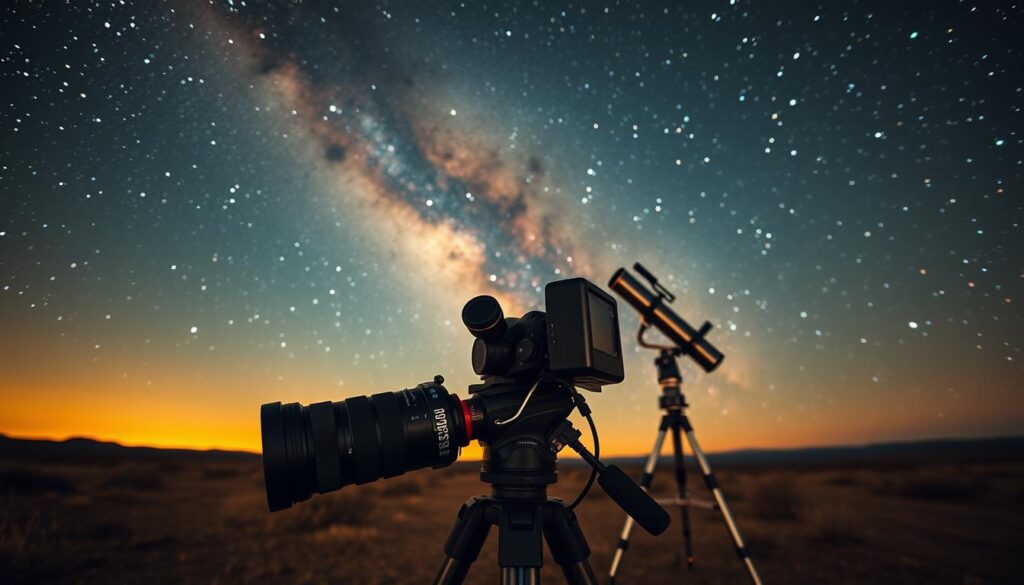
Balancing Your Setup for Stability
Balancing your equipment is vital for stability. Make sure your DSLR is securely attached to the mount. This balance is essential for sharp images, even during long exposures. A balanced setup also helps your mount track smoothly.
Tips for Polar Alignment
Polar alignment is a key step in setting up your gear. It aligns your mount’s polar axis with the Earth’s rotational axis. Use a polar scope or follow a specific procedure for accurate alignment. Proper polar alignment ensures your mount tracks objects accurately, leading to sharper images.
To improve polar alignment, consider using extra tools or software. Some mounts have built-in aids, while others need external tools or apps.
Capturing Your Deep Sky Images
Getting great deep sky photos needs you to know your DSLR camera settings and photography techniques. It’s not just about pointing your camera at the sky. You must plan and execute carefully.
Let’s talk about long exposures, a key part of deep sky imaging. Long exposures help capture more detail but can also cause noise and star trails if not done right.
Best Practices for Taking Long Exposures
When taking long exposures, balance is key. Aim for exposures between 1-3 minutes. This time frame captures enough detail without making image processing too hard.
- Use a sturdy tripod to avoid camera shake.
- Enable long exposure noise reduction in your camera settings.
- Consider using a remote shutter release or the camera’s self-timer.
Using Manual Focus Effectively
Manual focus is vital in deep sky photography. Autofocus often fails in low light. You must focus accurately on the stars.
Here’s how to use manual focus well:
- Set your lens to live view and zoom in on a bright star.
- Adjust the focus until the star appears sharp.
- Take a test shot and check it on your camera’s LCD to ensure focus.
Timing Your Shots
The timing of your shots greatly affects your deep sky photos. You must think about the position of celestial objects and the sky conditions.
For the best results:
- Plan your shoots during the best viewing times for your target objects.
- Check the weather forecast to avoid bad sky conditions.
- Use apps or software to track celestial objects and find the best viewing times.
By learning these techniques, you can greatly improve your deep sky photos. You’ll capture the night sky’s beauty with your DSLR camera.
Post-Processing Your Images
Turning your raw astrophotography into stunning images starts with post-processing. This step is key to enhancing your final image. It brings out details that might be hidden.
Essential Software for Editing
To begin post-processing, you need the right software. DeepSkyStacker, PixInsight, and Photoshop are top choices. DeepSkyStacker is great for stacking images to reduce noise. PixInsight has advanced tools for processing. Photoshop is versatile for final touches.
Beginners can start with free tools like DeepSkyStacker. As you get better, you might want to try PixInsight or Adobe Photoshop.
Basic Editing Techniques to Enhance Your Images
Basic editing can greatly improve your astrophotography. Adjusting brightness and contrast enhances details. Color correction also makes your image more natural.
- Adjusting levels to balance the image
- Using curves to enhance contrast
- Applying noise reduction techniques
For more tips on capturing great images, check our astrophotography tutorial. It offers valuable insights.
Advanced Techniques for Astrophotography
Once you’re good at basic editing, try advanced techniques. Star removal and gradient correction can greatly improve your images. Star removal highlights deep sky objects. Gradient correction removes background gradients from light pollution.
Tools like PixInsight’s DynamicBackgroundExtraction and StarNet are great for these tasks. They help refine your images.
Mastering these techniques can elevate your astrophotography. It reveals the beauty and complexity of the night sky in your images.
Sharing and Showcasing Your Work
Once you’ve taken amazing widefield deep sky images with your DSLR, it’s time to share them. Sharing your astrophotography can help you learn, get feedback, and stay inspired. It’s a great way to improve your skills.
Best Platforms for Astrophotography
There are many places to show off your astrophotography. Social media platforms like Instagram and Facebook are perfect for a big audience. You can also find astrophotography groups on these sites to meet other fans.
- Instagram: Use hashtags like #astrophotography and #widefieldastrophotography to reach more people.
- Facebook: Join groups for astrophotography to share and get feedback.
- Flickr: A site all about photography, including astrophotography.
Tips for Creating an Online Portfolio
Building an online portfolio is a great way to show off your best work. Here are some tips to make it shine:
- Choose your best images to show your talent.
- Tell people about your equipment and how you took the photos.
- Keep adding new images to keep your portfolio fresh.
| Platform | Features | Community |
|---|---|---|
| Visual-centric, hashtags | Large, diverse | |
| Facebook Groups | Discussion forums, feedback | Varied, group-specific |
| Flickr | Photography-focused, detailed descriptions | Photography enthusiasts |
Engaging with the Astrophotography Community
Getting involved in the astrophotography community is very rewarding. By sharing your photos and learning from others, you can get better and stay excited about it.
Join online forums and go to local astronomy events to meet other fans. Don’t hesitate to ask for feedback and give helpful advice to others.
Troubleshooting Common Issues
Every astrophotographer faces challenges, but with the right knowledge, you can overcome them. You can capture stunning images by understanding how to troubleshoot common issues. These include noise in your images, tracking errors, and light pollution.
Addressing Noise in Your Images
Noise is a big problem in astrophotography, mainly when using a DSLR. Software solutions like DeepSkyStacker can help by stacking multiple images. This improves the signal-to-noise ratio. Also, using the right camera settings, like keeping ISO low and using longer exposures, can help reduce noise.
Fixing Tracking Errors
Tracking errors happen when your mount doesn’t follow celestial objects well. This results in blurred or trailed stars. To fix this, make sure your mount is properly polar aligned. Using a polar scope or a software-assisted tool can improve tracking accuracy. Also, check and adjust your mount’s alignment during long imaging sessions.
Dealing with Light Pollution
Light pollution is a big challenge, mainly for those in urban areas. Using light pollution filters can block light from streetlights and other sources. Or, capturing images from dark sky locations can greatly improve your astrophotography quality.
By understanding and addressing these common issues, you can improve your widefield deep sky imaging skills. You can capture more stunning images with your DSLR.
Expanding Your Astrophotography Skills
Getting better at astrophotography is more than just learning the basics. As you grow, you’ll want to try new techniques and tools. This will help you take better pictures and see more in the sky.
Using Filters for Better Images
Filters are a great way to improve your astrophotography. For example, the Optolong L-Pro light pollution filter can make your images clearer. It helps by blocking light pollution and letting the light from stars shine through.
Filters block certain wavelengths of light, like streetlights. But they let the light from stars pass through. This makes your pictures cleaner and more vibrant.
Exploring Other Astrophotography Techniques
There’s more to astrophotography than just widefield deep sky imaging. For instance, planetary imaging lets you take close-up pictures of planets. You’ll need a telescope and a camera adapter for this.
Solar imaging is another exciting area. It involves taking pictures of the sun. You’ll need special solar filters to keep your equipment and eyes safe.
| Technique | Equipment Needed | Skill Level |
|---|---|---|
| Widefield Deep Sky Imaging | DSLR, Wide-Angle Lens, Tripod | Beginner |
| Planetary Imaging | Telescope, Camera Adapter | Intermediate |
| Solar Imaging | Telescope, Solar Filter | Advanced |
Joining Local Astronomy Clubs
Joining local astronomy clubs is a great way to improve. These clubs have people who love astrophotography just like you. They share tips, equipment, and stories.
Club activities, workshops, and viewing sessions are great for learning. You’ll get feedback on your photos and stay motivated to keep getting better.
Equipment Upgrades for Serious Enthusiasts
For serious enthusiasts, upgrading equipment is key to capturing high-quality widefield deep sky images. The right gear makes a big difference in your results.
Upgrading your equipment improves image quality and opens new possibilities. It’s important to understand the options for cameras, mounts, and lenses.
Dedicated Astrophotography Cameras
A dedicated astrophotography camera offers better image quality and more control. These cameras are made for capturing the night sky. They have features like:
- Enhanced sensitivity to low light
- Cooling systems to reduce noise
- Advanced control over exposure settings
When choosing a dedicated astrophotography camera, make sure it fits your existing equipment. Also, check if it has the features you need.
Upgrading Your Mount for Better Tracking
A sturdy and accurate mount is key for widefield deep sky imaging. Upgrading your mount can give you:
| Feature | Benefit |
|---|---|
| Better tracking accuracy | Reduced star trailing and improved image sharpness |
| Enhanced stability | Less vibration and movement during exposures |
| Advanced guiding systems | Improved tracking over long exposure periods |
Investing in a high-quality mount is essential for serious astrophotography enthusiasts.
Investing in High-Quality Lenses
The quality of your lenses affects the sharpness and clarity of your images. High-quality lenses for astrophotography reduce distortion and capture more detail.
Look for lenses with a wide aperture and high-quality glass. Investing in the best lenses you can afford will pay off in the quality of your images.
By upgrading your camera, mount, and lenses, you can improve your widefield deep sky imaging. Each piece of equipment is vital for the quality of your astrophotography. Making informed upgrade decisions is crucial to your success.
Conclusion: Your Journey in Astrophotography
As you keep exploring astrophotography, remember it’s a journey without end. You’ve learned how to take amazing pictures of the night sky with your DSLR camera.
Key Takeaways for Success
Knowing your gear, being patient, and never giving up are key. Keep learning and getting better to reach your goals in astrophotography.
Staying Inspired
It’s important to stay excited about your work. Join the astrophotography community, try new things, and keep practicing to capture the night sky’s beauty.
Final Thoughts
Widefield deep sky imaging gives us a special view of the universe. By using the tips from this article, you’ll make incredible images that show the beauty of astrophotography.