
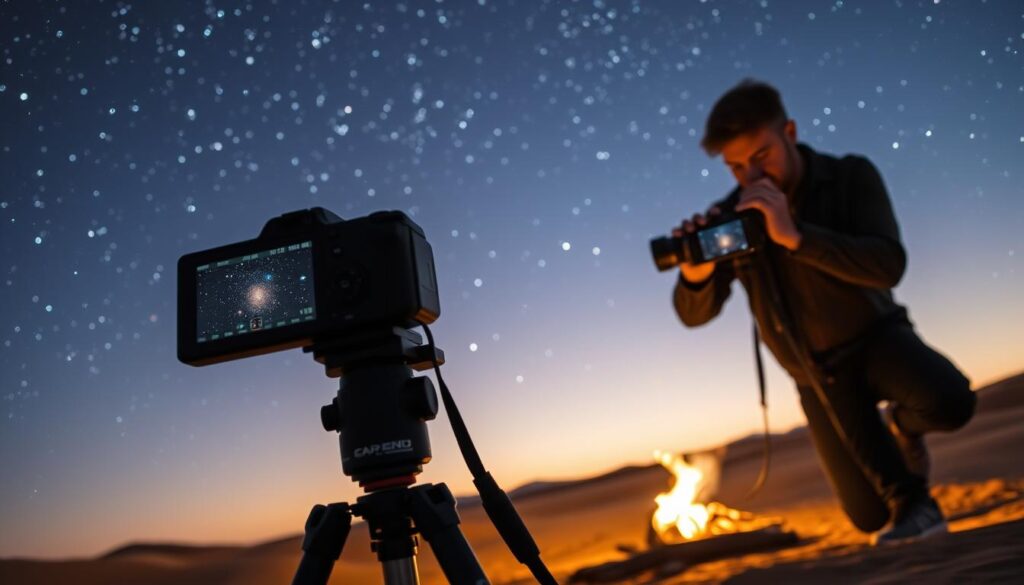
Capturing the night sky in desert environments is truly breathtaking. Deserts have little light pollution, making them perfect for star photography. To start, you need to know the basics of night sky photography.
Benjamin Barakat says dedication and practice can make this passion a full-time job. To excel in desert astrophotography, you must know your equipment and the desert. For more basics, check out a basic astrophotography tutorial. It covers the key equipment and camera settings for amazing photos.
Understanding Astrophotography
Capturing the night sky through astrophotography is a mix of technical skill and creative vision. It’s a hobby that lets you take stunning pictures of stars and celestial bodies. Knowing the basics is key to getting great shots.
What is Astrophotography?
Astrophotography is a special type of photography that focuses on the night sky. It includes stars, planets, and other celestial objects. It takes patience, as you need clear skies and little moonlight for the best shots. Astrophotography tips stress the importance of knowing your gear and the environment.
In desert night photography, the desert’s clear skies are perfect for capturing the Milky Way. The desert’s low light pollution makes it ideal for astrophotography.
The Importance of Composition
Composition is vital in astrophotography, just like in any photography. A well-composed shot can elevate an image from good to great. Include interesting foregrounds, like rocks or trees, to add depth. Try different angles and perspectives for better Milky Way photography.
Knowing composition principles helps create images that capture the viewer’s attention. Use the rule of thirds, leading lines, and framing to enhance your shots.
Equipment for Beginners
For beginners, the right equipment is essential. You’ll need a camera with manual controls, a sturdy tripod, and a wide-angle lens. Astrophotography tips for beginners suggest starting with a camera that shoots in RAW. This gives you more flexibility when editing.
- A DSLR or mirrorless camera with manual controls
- A sturdy tripod for stability
- A wide-angle lens (between 10-24mm) for capturing broad vistas of the sky
- Remote shutter release or camera timer to avoid camera shake
As you get more comfortable, you can explore advanced tools and techniques to improve your astrophotography.
The Unique Characteristics of Desert Environments
The desert is a dream spot for astrophotographers. Its clear skies and lack of light pollution make it perfect for capturing stunning night sky photos. This combination of natural beauty and ideal conditions is unmatched.
The desert’s clear skies are a big plus. Clear skies offer unobstructed views of the stars, creating a breathtaking backdrop for your photos. The dry air means less humidity and cloud cover, allowing for clearer views.
Clarity of the Night Sky
The desert’s dry conditions lead to exceptionally clear skies. With less atmospheric interference, the stars shine brighter. This makes the night sky more vibrant and essential for detailed photos of celestial objects.
Minimal Light Pollution
Deserts are far from cities, so they have minimal light pollution. This darkness lets the night sky shine in all its glory. The stars and constellations stand out against the dark, making it perfect for astrophotography.
Nevada is home to two DarkSky International certified destinations. These include a Dark Sky Sanctuary at Massacre Rim and a Dark Sky Park at Great Basin National Park. These places are ideal for capturing the night sky in its purest form.
Varied Landscape Features
The desert landscape is more than just sand dunes. It has rock formations, mountains, and dry lake beds. These varied landscapes offer many opportunities for creative composition. You can add interesting foreground elements to your astrophotography shots.
| Desert Feature | Astrophotography Opportunity | Example Location |
|---|---|---|
| Sand Dunes | Capture the Milky Way over vast, sweeping dunes | Great Sand Dunes National Park |
| Rock Formations | Use unique rock formations as foreground interest | Monument Valley |
| Mountains | Shoot the night sky over rugged mountain silhouettes | Death Valley National Park |
Preparing for Your Desert Journey
Starting a desert astrophotography adventure needs careful planning. You must prepare for the challenges of desert environments to capture the night sky’s beauty.
First, research your location. Knowing the area’s geography, climate, and photography rules is key. This helps you find the best spots and avoid dangers.
Researching Your Location
Look up the area’s topography, weather, and light pollution. Use apps and forums to find great spots. Dark Sky Parks and protected areas are perfect for Milky Way photos.
Best Seasons for Astrophotography
The desert is great for astrophotography all year, but spring and fall are best. These seasons have better weather and clearer skies. Knowing the best seasons for astrophotography helps plan your trip.
Essential Gear Checklist
Right equipment is crucial for great astrophotography shots. Your essential gear checklist should include:
- A camera with manual controls and good low-light performance
- A sturdy tripod to stabilize your camera
- A variety of lenses, including wide-angle and telephoto lenses
- Remote shutter release or camera timer
- Extra batteries and memory cards
- A star tracker or equatorial mount for long exposure shots
By researching your location, knowing the best seasons, and packing the right gear, you’re ready for your desert astrophotography adventure.
Setting Up Your Shot
Capturing the night sky in the desert needs careful planning. You must know how to set up your camera for amazing night sky photos.
Camera Settings for Night Sky Photography
Getting the right camera settings is key for great night sky photos. Benjamin Barakat, a pro, uses the Sony A7 IV. Here are some settings to consider:
- Aperture: A lower f-stop value (e.g., f/2.8) is ideal for capturing more light.
- Shutter Speed: A slower shutter speed (e.g., 20-30 seconds) can help capture the movement of the stars.
- ISO: A higher ISO (e.g., 1600-3200) is often necessary, but be cautious of noise.
| Setting | Recommended Value | Notes |
|---|---|---|
| Aperture | f/2.8 | Lower values let in more light |
| Shutter Speed | 20-30 seconds | Captures star movement |
| ISO | 1600-3200 | Higher values may introduce noise |
Using Tripods and Stabilizers
A tripod is essential for night sky photography. It stops camera shake and makes sure your photos are sharp. A stabilizer can make your camera even steadier, for smoother shots.
Experimenting with Angles and Perspectives
Don’t be afraid to experiment with different angles and perspectives. Try shooting from low or high spots to add creativity. Adding interesting foregrounds, like rocks or desert plants, can make your photos pop.
Techniques for Capturing the Night Sky
Capturing the night sky is an art that needs both technical skills and creativity. To get amazing astrophotography, you must know the key techniques. These help you show the beauty of the stars.
Night Sky Photography Basics
First, you need to know the basics of night sky photography. This means understanding your camera and lenses well. Also, knowing where you’ll shoot is important.
The Bortle scale, made by John Bortle in 2001, helps measure a location’s darkness. Using a Sky Quality Meter can also check your location’s quality.
Long Exposure Techniques
Long exposure techniques are key for showing the stars’ movement. By setting your camera for a long time, you get stunning images. These images show the Earth’s rotation.
To do this, you need a tripod to keep your camera steady. Try different exposure times to find the best for your shot.
Stacking Images for Clarity
Stacking images makes your astrophotography clearer. By combining shots, you cut down on noise and boost image quality. This method takes patience and practice.
But the results are worth it. Use special software to align and stack your images. This makes your final image detailed and beautiful.
Learning these techniques will help you take amazing night sky photos. Whether you’re experienced or new, the secret is to keep trying and experimenting.
Post-Processing Your Astrophotography Images
After you’ve taken the perfect shot, it’s time to enhance your astrophotography images. This step is key to bringing out the best in your desert night photography.
Software for Enhancement
You’ll need the right software to start. Adobe Lightroom and Photoshop are top choices for editing astrophotography. Experts say starting with white balance and disabling profile corrections in Lightroom can make a big difference.
These tools have many functions. You can adjust exposure and contrast, and even reduce noise and enhance stars.
Basic Editing Techniques
For beginners, learning basic editing is essential. Adjusting the white balance can fix color casts. Tweaking the exposure can reveal more detail in shadows and highlights.
Using the graduated filter or adjustment brush in Lightroom can also enhance specific areas. This is great for the sky or foreground.
Bringing Out the Stars
Enhancing star color and detail is crucial. Adjusting color grading and using the ‘Orton effect’ can add depth to your stars.
Try different techniques and software to get the look you want. This will make your desert night photography truly shine.
Safety Considerations in Desert Environments
Before you head out for desert astrophotography, it’s key to know the risks. The desert’s unique landscape can be challenging, with dangers like wildlife and vast, dry terrains.
Desert Wildlife Awareness
Deserts are home to many animals, some of which can be dangerous. For example, venomous snakes and spiders live in some areas. It’s important to be careful and watch your step when walking. Knowing the wildlife in your area can help you stay safe.
Staying Hydrated and Protected
The desert climate is harsh, with hot days and cold nights. Drinking plenty of water is crucial. Carry enough water and consider drinks with electrolytes to fight dehydration. Also, wear the right clothes and use sunscreen to protect yourself from the sun.
- Carry at least 2 liters of water per person per day.
- Use sunscreen with a high SPF rating.
- Wear lightweight, breathable clothing.
Navigating with GPS and Maps
Desert terrains are vast and can be hard to navigate. Using GPS and maps together can help you stay on track. Make sure your GPS is charged, and bring extra batteries or a power bank. Having a physical map as a backup is also wise.
- Download maps of your area before heading out.
- Notify someone of your itinerary and expected return time.
- Keep your GPS device charged and consider a backup.
Knowing the desert’s challenges and taking precautions can make your desert stargazing trip safe and enjoyable.
Finding Inspiration: Notable Desert Locations
Looking to take amazing Desert Night Sky Photos? Check out the many incredible desert spots. The desert has little light pollution and stunning views, perfect for Astrophotography in Desert Environments.
Some top spots for astrophotography are places with dark skies and cool geological features. These spots let you capture the night sky and add interesting backgrounds to your photos.
Joshua Tree National Park
Joshua Tree National Park is famous for its rocks and dark skies. It’s a top pick for astrophotographers. The park’s remote location and lack of streetlights mean the night sky is super clear.
Death Valley National Park
Death Valley National Park has huge sand dunes and unique rocks. Its dark skies are perfect for Desert Night Sky Photos.
Monument Valley
Monument Valley is known for its famous rock formations. It’s a great place for astrophotography. The valley’s remote spot means the night sky is dark, making for clear star photos.
| Location | Dark Sky Quality | Unique Features |
|---|---|---|
| Joshua Tree National Park | High | Unique rock formations |
| Death Valley National Park | Very High | Sand dunes and geological features |
| Monument Valley | High | Iconic rock formations |
Common Challenges and Solutions
Desert astrophotography is rewarding but comes with unique challenges. You must plan and prepare to capture great images. Knowing how to handle these issues is key.
Dealing with Temperature Fluctuations
Temperatures in the desert can swing wildly, affecting you and your gear. Use insulated camera bags and heating packs for cold. Some use hand warmers or portable heaters to keep their equipment running.
| Challenge | Solution |
|---|---|
| Extreme Cold | Use insulated bags and heating packs |
| Equipment Malfunction | Regularly check and maintain your gear |
Coping with Dust and Sand
Dust and sand are big problems in the desert. Use dust-repelling filters on your lenses. Keep your gear sealed when not in use. Clean your equipment regularly to avoid damage.
Managing Battery Life in Cold Conditions
Cold temperatures can drain batteries fast. Keep your batteries warm by storing them close to your body. Use battery warmers. Carry spare batteries and power banks for recharging.
- Keep spare batteries in a warm place.
- Use power banks to recharge on the go.
- Consider using battery warmers.
Understanding and preparing for these challenges can improve your desert astrophotography. You’ll capture stunning images of the night sky.
Building Your Astrophotography Portfolio
With your camera and creativity, you’re ready to build a stunning astrophotography portfolio. As you capture the desert night sky’s beauty, showcasing your work is key. A well-crafted portfolio highlights your skills and tells your journey as an astrophotographer.
Creating a Personal Website or Blog
Creating a personal website or blog is a great way to share your astrophotography. It lets you display your images, share your experiences, and connect with others. When building your website, consider these elements:
- High-quality image galleries that showcase your best work
- Blog posts that share your experiences and tips on astrophotography
- Contact information and a form for potential clients to reach out
- Social media links to connect with your audience across multiple platforms
For more information on improving your astrophotography skills, consider checking out the AstroMasterclass to learn from experienced professionals.
Sharing on Social Media
Sharing your work on social media is crucial for visibility and attracting followers. Platforms like Instagram, Facebook, and Twitter let you share images, engage with your audience, and stay updated on trends. Use relevant hashtags, post regularly, and interact with other photographers to maximize your reach.
Networking with Other Photographers
Networking with other photographers offers valuable opportunities for collaboration, learning, and growth. Join online forums, attend workshops, and participate in photography events to connect with others. Sharing your experiences and knowledge can also help you learn new techniques and best practices.
| Platform | Benefits | Tips for Engagement |
|---|---|---|
| Personal Website/Blog | Showcases your work, shares your story | Regularly update content, use SEO techniques |
| Social Media | Increases visibility, attracts followers | Use relevant hashtags, post consistently, engage with audience |
| Networking Events | Opportunities for collaboration and learning | Be open to sharing your work, ask questions, follow up with new contacts |
According to the Dark Skies Toolkit, “Astrotourism can play a crucial role in promoting sustainable travel, raising awareness about light pollution, and supporting local economies.” By building a strong portfolio and engaging with the astrophotography community, you can contribute to this movement while advancing your career.
Learning from Expert Astrophotographers
Astrophotography fans can learn a lot from experienced pros. They share tips and tricks that can make your photos better. This helps you grow as a photographer.
Online Resources and Tutorials
The web is full of places to learn astrophotography. Sites like YouTube, forums, and blogs have lots of info. You can find tutorials on Milky Way Photography and more.
- Tutorials on camera settings and tripod usage
- Workshops on image processing software
- Forums for sharing and critiquing photos
Joining Photography Workshops
Workshops let you learn by doing. They cover topics like night sky photography and editing photos. You get hands-on practice and feedback.
| Workshop Type | Focus | Level |
|---|---|---|
| Astrophotography Basics | Understanding camera settings and equipment | Beginner |
| Advanced Techniques | Image stacking and post-processing | Intermediate |
| Specialized Topics | Milky Way and planetary photography | Advanced |
Attending Astrophotography Events
Going to astrophotography events is great for networking and learning. These gatherings have workshops, talks, and photo shows. They show the newest ways to take photos of the sky.
Use online tutorials, workshops, and events to make a learning plan. This plan will help you learn both the technical and creative sides of astrophotography.
Continuing Your Astrophotography Journey
As you finish your desert astrophotography adventure, you’re probably excited to keep capturing the night sky’s beauty. Look for new places to take pictures. Great Basin National Park in Nevada is a great spot, known for its dark skies.
New Horizons in Desert Landscape Photography
Desert Landscape Photography has a lot to offer, from big sand dunes to rocky formations. Try new things like long exposure and image stacking. These techniques can make your Desert Stargazing photos even better.
Techniques for Improvement
To get better at astrophotography, play with different camera settings and techniques. Setting goals for yourself can keep you motivated and focused on your journey.
Future Expeditions
With more experience and practice, you’ll be ready for new adventures. You can capture the night sky in many places. Whether it’s the desert’s clear sky or exploring new areas, your journey is full of possibilities.