
Capturing the night sky is a breathtaking experience. With the right techniques, you can improve your astrophotography skills. To start, you need to know how to use your camera in manual mode.
This lets you control settings like aperture, shutter speed, and ISO. This way, you can take the perfect shot.
Mastering manual mode helps you take amazing photos of stars, planets, and galaxies. We’ll talk about the essential gear and planning for a great astrophotography shoot. You’ll learn about using a tripod and a camera with a wide aperture and focal length.
Understanding Manual Mode in Photography
To take your night sky photography to the next level, understanding manual mode is key. When you’re shooting stars in manual mode, you control your camera’s settings. This lets you create more creative and technically sound photos.
Manual mode lets you adjust your camera for the scene you’re capturing. Unlike automatic modes, you choose the aperture, shutter speed, and ISO. This is based on your vision and the lighting.
What Does Manual Mode Mean?
In manual mode, you set the aperture, shutter speed, and ISO for your photo. This mode is great for night sky photography settings. You need to adjust for the low light to capture the stars and sky well.
With manual mode, you’re not stuck with the camera’s automatic settings. You can open the aperture for more light, slow the shutter speed for star movement, or raise the ISO for better low-light sensitivity.
Benefits of Using Manual Mode
Using manual mode for astrophotography has many benefits. First, it gives you complete control over your camera settings. This lets you capture images that reflect your creative vision. You can adjust for changing light, ensuring your photos are well-exposed and detailed.
Second, manual mode helps you understand your camera better. By manually adjusting settings, you learn how different settings affect your photos. This knowledge is crucial for capturing the perfect night sky shot.
- Gain complete control over camera settings.
- Adjust settings according to changing light conditions.
- Improve your photography skills by understanding the effects of different settings.
By mastering manual mode, you’ll elevate your astrophotography. You’ll capture stunning images of the stars and night sky.
Key Camera Settings You Should Know
To capture stunning night sky images, knowing key camera settings is essential. As an astrophotographer, you must be familiar with the basic settings that can make or break your shot.
Aperture
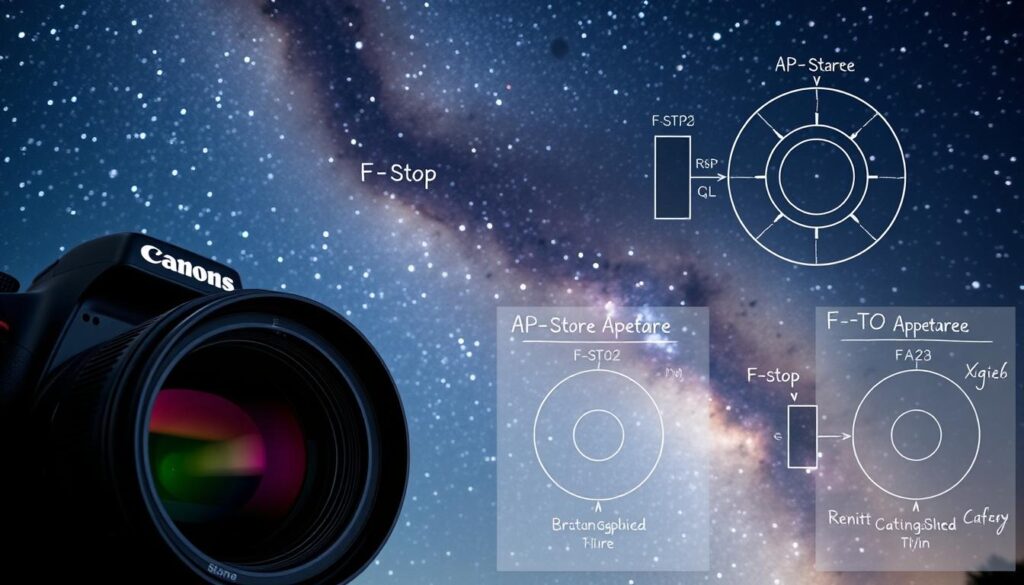
Aperture is the size of your camera lens’s opening. It controls how much light gets in. A wide aperture (small f-stop number) lets in more light, perfect for the night sky. For astrophotography, a lens with an aperture of f/2.8 or wider is best.
Using a wide aperture not only lets in more light. It also creates a pleasing bokeh (background blur) that separates your subject from the night sky.
Shutter Speed
Shutter speed is how long your camera’s shutter is open, in seconds or minutes. For astrophotography, you often need to use long shutter speeds to capture enough light.
A longer shutter speed can capture more stars and details in the night sky. But, it also risks introducing star trails if not managed correctly with the Earth’s rotation.
ISO
ISO settings control your camera’s sensitivity to light. In low-light conditions like astrophotography, a higher ISO can be beneficial. But, it also introduces noise or grain in your images.
Finding the right balance is key. You want to use the lowest ISO necessary to capture the image without excessive noise. Modern cameras have improved ISO performance, but it’s still important to experiment and find what works best for your equipment.
| Camera Setting | Recommended Value for Astrophotography | Effect on Image |
|---|---|---|
| Aperture | f/2.8 or wider | More light, better star visibility |
| Shutter Speed | Long (seconds to minutes) | Captures more stars, potential for star trails |
| ISO | High (but as low as necessary) | Captures image in low light, introduces noise |
Understanding and mastering these camera settings is a crucial step in improving your astrophotography skills. By adjusting aperture, shutter speed, and ISO, you can achieve the desired effects in your photos.
How to Set Up Your Camera for Astrophotography
To improve your night sky photos, knowing how to set up your camera is key. The right camera setup is vital for capturing the night sky’s beauty.
Using a Tripod
A sturdy tripod is essential for astrophotography. It keeps your camera steady for sharper images during long shots. Look for a tripod that’s strong and can hold your camera’s weight.
Key features to look for in a tripod:
- Stability and durability
- Smooth panning and tilting movements
- Compatibility with your camera equipment
Autoguiders vs. Manual Tracking
You have two main choices for tracking celestial objects: autoguiders and manual tracking. Autoguiders use a separate camera and software to guide your mount. Manual tracking means you adjust the mount yourself.
Choosing between autoguiders and manual tracking depends on your gear and what you prefer.
| Feature | Autoguiders | Manual Tracking |
|---|---|---|
| Accuracy | High | Variable, depends on user skill |
| Equipment Cost | Higher | Lower |
| Ease of Use | Easier for long exposures | Requires more user involvement |
Understanding the role of a tripod and the right tracking method can greatly enhance your astrophotography. Try different settings and techniques to see what works best for you.
The Role of Aperture in Astrophotography
In astrophotography, aperture settings are key to clear star photos. Aperture controls how much light enters the lens. It’s vital for capturing the night sky’s beauty.
Learning to adjust aperture can greatly improve your star photos. A wider aperture lets in more light. This is good for seeing faint stars and details in the sky.
Selecting the Right Aperture
Choosing the right aperture depends on what you want in your photos. For a wide view of the stars, use a wide-angle lens with a low f-stop value (like f/2.8). This lets in more light for sharper images.
For focusing on a specific object, like the moon, a narrower aperture (higher f-stop number) is better. It helps avoid overexposure and keeps details sharp.
How Aperture Affects Star Details
The aperture setting affects how much detail you can capture. A wider aperture lets in more light and keeps stars sharp against the dark background.
| Aperture Setting | Effect on Star Photos |
|---|---|
| Wide Aperture (f/2.8) | Captures more light, ideal for broad star fields |
| Narrow Aperture (f/8) | Reduces light, suitable for capturing detailed images of bright celestial objects |
Mastering aperture can greatly enhance your astrophotography skills. It helps capture stunning images of the night sky. Whether you’re new or experienced, knowing how to use aperture is essential for your photos.
Shutter Speed Essentials for Astrophotography
Mastering shutter speed is key for amazing astrophotography shots. You must learn to balance it with other camera settings for the best results.
In night sky photography settings, shutter speed is crucial. A slow shutter can capture more star details. But, it can also cause blur if not managed right.
Finding the Right Balance
Finding the right shutter speed means balancing starlight capture and avoiding blur. For still shots, start with 20-30 seconds.
The 500 Rule helps avoid star trailing. Divide 500 by your lens’s focal length for the max exposure time. For example, with a 24mm lens, your max time is about 20.8 seconds (500 / 24 = 20.8).
Effects of Long Exposures
Long exposures greatly affect your astrophotography. They let in more light, capturing fainter stars and more night sky details.
- Captures more star details
- Increases the overall brightness of the image
- Can introduce star trailing if too long
But, long exposures can also cause unwanted star trailing. Knowing these effects helps you make better choices in your astrophotography tutorial settings.
ISO Settings and Their Impact on Astrophotos
For those starting in astrophotography, learning about ISO settings is crucial. ISO controls how sensitive your camera is to light. This is very important in low-light conditions, like when taking photos of the stars.
Finding the right ISO is a tricky task. A higher ISO makes your camera more sensitive to starlight, helping you capture more detail. But, high ISOs can also add noise, making your photos look grainy.
Choosing ISO for Low-Light Conditions
In astrophotography, you often face very low light levels. A good starting ISO is between 800 to 3200. But, the best ISO depends on your camera and the shoot’s conditions. For beginner astrophotography tips, start with a lower ISO (like 800) and adjust as needed.
Some cameras handle high ISOs better than others. If you’re new, try different ISOs to see how your camera does. For more camera setting tips, check out Adorama’s astrophotography tutorial. It offers detailed advice on getting the most from your camera.
Understanding Noise in Astrophotography
Noise in astrophotography is like digital film grain. It’s more noticeable at high ISOs and can ruin your photos’ quality. Image stacking and post-processing can help reduce noise, making your photos cleaner and more professional.
To reduce noise, use the lowest ISO you can for your shot. Also, try long exposures or wider apertures to help. As you get more experience, you’ll learn how to balance these settings for better astrophotography results.
Exposure Triangle: The Key to Great Shots
Getting the exposure triangle right is crucial for capturing the night sky’s beauty. The exposure triangle includes aperture, shutter speed, and ISO. It helps you control your image’s exposure.
Knowing how to balance these elements is key for amazing shots. Aperture lets more light in, shutter speed controls exposure time, and ISO sets light sensitivity.
Balancing Aperture, Shutter Speed, and ISO
To get stunning astrophotography, balance aperture, shutter speed, and ISO. A wide aperture lets in more light but might need a short shutter speed to avoid star trails. A longer shutter speed captures more detail but can add noise if ISO is too high.
- A wide aperture (f/2.8 or lower) for capturing more light
- A shutter speed that balances exposure and star movement (typically between 20-30 seconds)
- An ISO that minimizes noise while still capturing enough detail (typically between 800-3200)
Practical Examples of the Exposure Triangle
Let’s look at a practical example. Imagine shooting in a dark place with little light pollution. You could set your camera to:
- Aperture: f/2.8
- Shutter Speed: 25 seconds
- ISO: 1600
This setup captures a well-exposed night sky image with little noise. But, if there’s more light pollution, you might need to adjust the exposure triangle.
Mastering the exposure triangle can elevate your astrophotography. You’ll capture stunning night sky images.
Focusing Techniques for Night Skies
To capture the stars’ details, mastering focusing is key for astrophotographers. Focusing on stars in the dark is tough, but the right methods can boost your skills.
Manual vs. Autofocus
Most astrophotographers choose manual focus over autofocus. Autofocus often fails in the dark, leading to blurry images. Manual focus gives you control, letting you fine-tune for sharp star images.
Using your camera’s live view helps with manual focus. Zoom in on a bright star to adjust focus until it’s sharp.
Tips for Accurate Focusing
Here are tips for precise focusing in astrophotography:
- Use live view to zoom in on a bright star and adjust focus manually.
- Take test shots and check them on your camera’s LCD to see if stars are sharp.
- Consider using a focus mask or Bahtinov mask for precise focus.
- Focus on bright stars or planets, as they’re easier to focus than distant, faint stars.
Mastering these focusing techniques will help you capture amazing night sky images. For more beginner astrophotography tips and tutorials, keep exploring our resources to improve your skills.
Composition Tips for Astrophotography
Astrophotography is more than just pointing your camera at the stars. It’s about making a beautiful image through careful composition. When you’re out shooting the night sky, think about what will make your photo pop.
One key part of composition is using leading lines and foreground interest. Leading lines help guide the viewer’s eye, while foreground interest adds depth. For instance, a road, shoreline, or mountain range can lead the eye to the stars.
Leading Lines and Foreground Interest
To use leading lines well, look for landscape features that draw the eye to the night sky. This could be a path, river, or any continuous line. Foreground interest, on the other hand, involves adding objects or features in the front to add depth and scale.
- Find potential leading lines in your scene, like roads or shorelines.
- Add interesting foreground elements, such as rocks or trees.
- Try different angles to find the best composition.
The Rule of Thirds in Star Photography
The rule of thirds is another great technique. It divides your image into thirds both ways, creating nine parts. Placing important elements on these lines or at their intersections makes your composition more balanced and interesting.
- Imagine your image divided into thirds both ways.
- Put the horizon or interesting foreground elements on these lines.
- Place the stars or other key elements at the intersections for a dynamic look.
For more tips on stunning astrophotography, see our guide on astrophotography for beginners. It has essential techniques for better night sky photos.
Best Practices for Night Photography
Starting your astrophotography journey? Knowing the best practices for night photography is key. It’s not just about pointing your camera at the sky. You aim to capture the stars, the Milky Way, or even shooting stars in manual mode. Being well-prepared is crucial.
Checking Weather Conditions
First, check the weather before your night shoot. Clear skies are vital for capturing the stars. Use Clear Dark Sky or The Photographer’s Ephemeris to see weather and moon phases. Stay away from nights with a full moon to avoid moonlight interference.
Preparing Your Gear for a Night Shoot
Getting your gear ready is as important as checking the weather. For beginner astrophotography tips, make sure your camera works well. Carry extra batteries, as cold can drain them fast. A strong tripod is key to avoid camera shake during long exposures.
Use a remote shutter release or self-timer to reduce shake. Also, have a red light torch to preserve your night vision. Dress warmly and bring a chair or blanket for comfort. Learn your camera’s manual mode for the best shooting stars in manual mode results.
By following these tips, you’ll get better at night photography. Remember, practice is key. Don’t worry about initial results. Keep trying different settings and techniques until you get what you want.
Post-Processing Techniques for Astrophotos
After taking amazing astrophotos, the next step is post-processing. This stage is crucial for your image’s quality. You can improve details and lower noise with the right tools and methods.
Editing Software Options
Adobe Lightroom and Photoshop are top choices for editing astrophotos. They let you tweak exposure, contrast, and color balance. Tools like StarStax and Sequator are also great for advanced editing.
Enhancing Details and Reducing Noise
To boost details, use ‘Sharpen’ or ‘Local Contrast’ tools. But be careful not to overdo it, as it can make noise worse. For noise reduction, try ‘Noise Reduction’ in Lightroom or ‘Reduce Noise’ in Photoshop. Finding the right balance is essential for top-notch astrophotos.
By using these post-processing techniques, you can greatly enhance your astrophotography. You’ll get better results in night sky photography settings.