
Astrophotography lets you capture the night sky’s beauty. It uses long exposure techniques to show the drama of stars and planets.
With the right astrophotography tips, you can improve your skills. This article will teach you how to master long exposure techniques. You’ll learn to take amazing astrophotography pictures.
By the end, you’ll know how to create stunning images. These will show the night sky’s beauty in a new way.
Understanding Long Exposure in Astrophotography
Long exposure in astrophotography lets you make amazing images. These images show the movement of stars and planets. They turn the night sky into beautiful, dream-like scenes.
The Basics of Long Exposure
Long exposure photography means keeping the camera’s shutter open for a long time. This lets more light reach the sensor. It’s key for seeing the faint light of stars and galaxies. Knowing the basics of long exposure is crucial for astrophotographers.
To capture the night sky’s beauty, you need to adjust your camera settings. This lets you see the details of celestial objects. Your images will be full of beauty and detail.
Importance of Exposure Time
Exposure time is very important in long exposure photography. Longer exposures mean more light and more detail. But, they also risk noise and star trails.
| Exposure Time | Effect on Image |
|---|---|
| Short Exposure (10-30 seconds) | Captures sharp images of stars without trails |
| Medium Exposure (1-5 minutes) | Reveals more detail in the night sky, with some star movement |
| Long Exposure (10+ minutes) | Creates pronounced star trails, ideal for star trail photography |
How Long Exposure Enhances Detail
Long exposure makes your astrophotography images more detailed. This technique is great for showing the beauty of nebulae and distant galaxies. These are often hard to see with the naked eye.
By getting good at long exposure, you can make images that are not just beautiful but also full of detail. These images give us a closer look at the wonders of the universe.
Essential Equipment for Long Exposures
To capture stunning long exposure astrophotography images, you need the right equipment. The quality of your gear can significantly impact the outcome of your photos. It’s essential to choose the best tools for the job.
Camera and Lens Requirements
For astrophotography, a camera that performs well in low light is crucial. Look for a camera with high ISO capabilities and minimal noise at high settings. A full-frame sensor is ideal, but crop sensors can also produce excellent results.
When it comes to lenses, a wide-aperture lens (like f/2.8 or wider) is recommended. This gathers as much light as possible. A focal length between 10-24mm is ideal for capturing broad vistas of the night sky.
Tripods: Stability Matters
A sturdy tripod is vital for long exposure photography. Any movement can cause blurry images. Look for a tripod that is sturdy and can support the weight of your camera and lens.
Some tripods come with features like built-in levels and adjustable legs. These can be very helpful. Consider a tripod with a smooth panhead or a motorized mount for tracking celestial objects.
Filters for Astrophotography
Filters can enhance your astrophotography by reducing light pollution or enhancing specific wavelengths of light. Light pollution filters can help block out unwanted light from cities and towns. Narrowband filters can isolate specific emissions from nebulae.
| Filter Type | Purpose | Best For |
|---|---|---|
| Light Pollution Filter | Reduces light pollution | Urban astrophotography |
| Narrowband Filter | Isolates specific wavelengths | Nebulae and emission nebulae |
| UV/IR Cut Filter | Blocks unwanted UV and IR light | General astrophotography |
By choosing the right equipment and understanding how to use it, you can significantly improve your astrophotography results. Experiment with different settings and techniques to find what works best for you.
Preparing Your Gear for a Shoot
Getting your equipment ready is key to taking amazing long exposure shots of the night sky. Whether you’re capturing the Milky Way or trying out new ideas, having everything set up is crucial.
Checking Camera Settings
Before you go, make sure your camera settings are right for astrophotography. Start by setting your camera to manual mode. This lets you control exposure time, aperture, and ISO. For the Milky Way, start with an ISO of 3200, an aperture of f/2.8, and an exposure time of 20 seconds. But, these settings might change based on the scene’s brightness and the effect you want.
Key Camera Settings to Check:
- Mode: Manual
- ISO: 1600-6400
- Aperture: f/2.8 or wider
- Exposure Time: 10-30 seconds
- White Balance: Daylight or Auto
Cleaning Your Lens and Sensor
A clean lens and sensor are essential for sharp, clear images. Dust and smudges can ruin your photos. Use a microfiber cloth to clean your lens gently. For deeper cleaning, use a lens cleaning solution. For the sensor, use a specialized kit to avoid damage.
Tips for Cleaning:
- Use a blower to remove loose dust.
- Gently wipe the lens with a microfiber cloth.
- For stubborn spots, use a cleaning solution designed for lenses.
Battery Life and Storage
Long exposure shoots can drain your camera’s battery fast. Make sure you have fully charged batteries and carry spares. Keep your camera close to your body to keep it warm and save battery. For storage, use memory cards with enough capacity and keep them in your camera bag.
| Accessory | Tips for Use | Importance Level |
|---|---|---|
| Fully Charged Batteries | Carry spares, keep warm | High |
| Memory Cards | Use high-capacity cards, format regularly | High |
| Lens Cleaning Kit | Use microfiber cloths, cleaning solution | Medium |
| Sensor Cleaning Kit | Use with caution, follow instructions | Medium |
By carefully preparing your gear, you’ll be ready to capture stunning astrophotography images. These tips are great for both seasoned photographers and beginners. They’ll help you achieve amazing long exposure ideas and memorable Milky Way shots.
Ideal Locations for Astrophotography
Astrophotography is more than just the right gear; it needs a good spot with little light pollution. The place you choose can really affect your night sky and star trail photos.
Dark Sky Locations
Dark sky spots are perfect for astrophotography because they show the night sky best. These places are usually far from cities, which means less light pollution.
Benefits of Dark Sky Locations:
- Less light pollution for clearer images
- More stars and celestial objects to see
- Better contrast between the sky and stars
Avoiding Light Pollution
Light pollution is a big problem for astrophotographers. To get around it, find places far from cities. National parks, remote areas, and dark sky reserves are great options.
Tips for Avoiding Light Pollution:
- Do your research on dark sky spots before you go
- Use light pollution maps to find the best places
- Shoot during the new moon for darker skies
Finding the Perfect Composition
Good composition is crucial for amazing astrophotography shots. Look for interesting foregrounds like landscapes, trees, or monuments to add depth.
Composition Tips:
| Element | Description | Benefit |
|---|---|---|
| Landscape | Use natural or man-made features | Adds depth and context |
| Leading Lines | Paths, shorelines, or lines to guide the eye | Improves composition and guides the viewer |
| Foreground Interest | Include objects or features in the foreground | Makes the image more engaging |
Calculating Exposure Times
To capture the night sky, knowing how to calculate exposure times is key. It’s vital for getting the right look in your astrophotography, whether it’s the Milky Way or star trails.
The 500 Rule Explained
The 500 rule helps prevent star trails in your photos. It’s simple: divide 500 by your lens’s focal length to find the max exposure time in seconds. For instance, with a 24mm lens, your max time is 500 / 24 = 20.83 seconds. This rule keeps your images free of unwanted star trails.
Using Apps for Accurate Timing
While the 500 rule is a good start, apps can make your timing even better. Tools like PhotoPills and Star Walk help plan your shots. They predict the best times for celestial events and set your camera’s exposure right.
| App Name | Platform | Features |
|---|---|---|
| PhotoPills | iOS, Android | Exposure planning, moon phase tracking, augmented reality view |
| Star Walk | iOS, Android | Stellar map, planet and star identification, event notifications |
| Camera Bag | iOS | Long exposure simulations, exposure calculators |
Using the 500 rule and these apps together will help you get the best astrophotography shots. Remember, it takes practice to get it right. So, don’t worry if it takes a few tries.
Focusing Techniques for Long Exposures
Focusing is key in long exposure astrophotography. It helps capture the fine details of stars and planets. Getting a sharp focus is crucial for quality images.
Choosing between manual and auto focus is important. Auto focus might not work well in the dark. So, manual focus is better for its accuracy.
Manual vs. Auto Focus
Manual focus gives you full control over your shots. It ensures your images are sharp. Use the camera’s live view to fine-tune the focus until stars or planets are clear.
Focusing on Stars and Planets
Focusing on stars is easier with live view. Zoom in on a bright star and adjust the focus. But, planets are harder to focus because they are small and dim. A high-quality lens and a sturdy tripod help a lot.
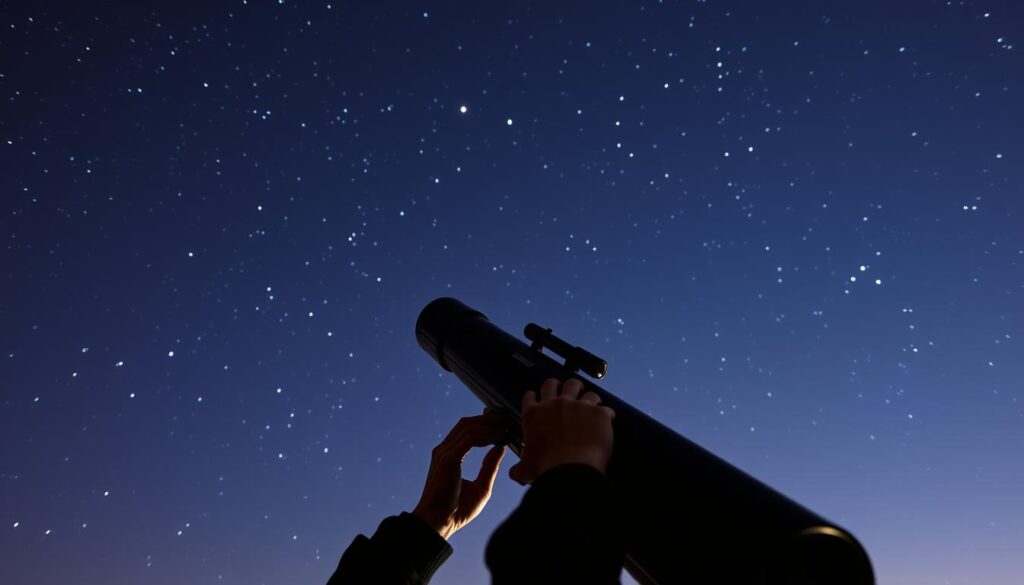
Using Live View for Precision
The live view feature is great for precise focus. Zoom in on a star or planet and adjust the focus until it’s sharp. This method works well in dark conditions where auto focus fails.
Mastering these focusing techniques can greatly improve your astrophotography. The right camera settings for astrophotography and best equipment for astrophotography are also key for amazing night sky shots.
Experimenting with Exposure Settings
Playing with exposure settings can take your astrophotography to new heights. By tweaking ISO, aperture, and exposure bracketing, you can get images that are both technically good and creatively stunning.
ISO Settings for Low Light
In low light, ISO settings are key. A higher ISO can capture dark scenes, but it can also add noise. Begin with an ISO between 800 to 1600 and adjust as needed.
Remember, different cameras handle high ISOs differently. Knowing your camera’s limits is crucial.
Aperture Recommendations
The aperture controls how much light gets in. A wider aperture (smaller f-stop number) lets in more light, which is great for astrophotography. But, it also affects the depth of field, so focus must be precise.
Start with an aperture of f/2.8 or lower if possible. This balance helps capture enough light while keeping the image sharp.
Bracketing Exposures for Best Results
Bracketing involves taking multiple shots at different exposures. This method allows for merging images later using HDR software, creating a single, detailed image.
Bracketing is great for scenes with lots of contrast, like a bright moon against dark shadows. By trying different brackets, you can get a more balanced image.
Also, try creative long exposure ideas like light painting. It uses a light source to illuminate parts of the scene, creating cool effects.
Post-Processing Your Long Exposure Images
Long exposure astrophotography doesn’t stop when you take the photo. It continues with post-processing to show your photos’ full potential. The right techniques can greatly improve your final image’s quality.
Software Options for Astrophotography
The software you pick for post-processing is key. Adobe Photoshop and Lightroom are top choices. They offer many tools for editing and enhancing your photos.
- Adobe Photoshop: Ideal for detailed editing and manipulation.
- Lightroom: Great for managing and making initial adjustments to your photos.
- StarStax: Specialized software for creating star trails.
Techniques for Noise Reduction
Noise reduction is crucial in post-processing long exposure images. Long exposure shots often have noise, which can lower image quality. Here are some techniques:
- Use noise reduction tools in your software.
- Apply dark frame subtraction to remove noise.
- Take multiple shots and stack them to reduce noise.
Enhancing Contrast and Color
Improving contrast and color in your astrophotography images can highlight details. Adjusting the histogram and using curves can help achieve this.
By using these post-processing techniques, you can greatly improve your long exposure astrophotography images. They will look more captivating and professional.
Common Challenges and How to Overcome Them
Astrophotography, with its long exposures, comes with unique challenges. You need patience, practice, and the right techniques to succeed. Whether you’re capturing the Milky Way or star trails, knowing these challenges is key to improving your astrophotography.
Dealing with Star Trails
Star trail photography is breathtaking but requires skill. To create stunning trails, follow these steps:
- Take multiple shots over time and stack them to create the trail effect.
- Use a camera setting for long exposure without overheating, which can introduce noise.
- Post-process your images to make the trails stand out against the night sky.
Tip: A camera with good low-light performance and a sturdy tripod can greatly enhance your star trail photography.
Managing Noise in Long Exposures
Noise is a big issue in long exposure astrophotography. To manage it:
- Use the lowest ISO needed for your shot.
- Employ dark frame subtraction, taking a dark frame to subtract from your image, reducing noise.
- Use camera features or software to reduce noise in post-processing.
| Technique | Description | Benefit |
|---|---|---|
| Dark Frame Subtraction | Takes a dark frame to subtract noise from the actual image. | Reduces thermal noise. |
| Low ISO | Uses the lowest ISO necessary for the shot. | Minimizes digital noise. |
| Noise Reduction Software | Uses software to reduce noise in post-processing. | Enhances image clarity. |
Weather Considerations
Weather greatly affects your astrophotography session. Always check forecasts and be ready for changes.
Consider these weather factors:
- Cloud Cover: Clear skies are best, but partial clouds can create interesting effects.
- Moon Phase: A new moon phase is ideal for deep-sky objects without lunar interference.
- Temperature: Extreme temperatures can impact your equipment’s performance and battery life.
By understanding and preparing for these challenges, you can improve your long exposure astrophotography skills. This way, you can capture stunning images of the night sky.
Safety Tips During Astrophotography Sessions
When you go out for astrophotography, safety is key. It makes sure you have a good time and get great photos. Knowing your surroundings and being careful are important.
Nighttime Shooting Precautions
Shooting at night can be tough. Here are some tips to help:
- Use a red light flashlight to keep your night vision. White light can mess with your dark sight.
- Bring extra batteries for your camera and other gear. Cold weather can drain batteries fast.
- Wear warm and layered clothing to stay cozy during long shoots.
Staying Aware of Your Surroundings
When you’re in remote places, knowing your area is crucial. Here’s how to stay safe:
- Let someone know where you are and when you’ll be back. This helps if you’re in trouble.
- Bring a personal safety device, like a whistle or bear spray, based on where you are.
- Keep your phone charged and with you. It’s for emergencies.
Gear Security in Isolated Areas
Keeping your gear safe is very important in remote spots. Here’s how to protect it:
- Keep your gear close and watch your surroundings to avoid theft.
- Use a camera lock or other security to keep thieves away.
- Consider investing in gear insurance to cover loss or damage.
By following these safety tips, you can have a great time with astrophotography. Always put your safety first and be ready for anything.
The Joy of Sharing Your Work
Sharing your astrophotography can be very rewarding. It lets you connect with others who love the night sky as much as you do. By showing your work in a way that grabs attention, you can make others excited about astrophotography too.
Selecting Online Platforms
You can share your Long Exposure Techniques for Astrophotography on many online platforms. Websites like Stephen Milner’s blog are great for sharing your work. They offer tips and insights into astrophotography.
Creating a Portfolio
Having a portfolio of your best shots is key. It attracts people who share your interests and might even become clients. Put your images together in a way that shows off your skills in astrophotography.
Community Engagement
Getting involved in the astrophotography community is important. It keeps you up-to-date with new trends and techniques. Join online forums, go to workshops, and work with other photographers. This way, you can always get better and share your love for Long Exposure Techniques for Astrophotography.