
You are about to explore one of the most breathtaking sights in the night sky: the Andromeda Galaxy. It’s a majestic spiral galaxy that has captivated astronomers and astrophotographers alike.
Located approximately 2.5 million light-years away, M31 is the largest member of the Local Group of galaxies. This group includes the Milky Way and several smaller galaxies.
Capturing the beauty of M31 requires a deep understanding of its structure. It also needs the right techniques to photograph it effectively. As you explore astrophotography, you’ll learn the secrets to taking stunning images of this celestial wonder.
Understanding the Andromeda Galaxy (M31)
The Andromeda Galaxy, also known as M31, is a fascinating celestial object. It has captivated astronomers and stargazers alike. As you explore astrophotography, knowing this galaxy is key to capturing its beauty and significance.
What Is the Andromeda Galaxy?
The Andromeda Galaxy is a massive spiral galaxy. It has over 1 trillion stars, stellar remnants, and more. It’s the largest member of the Local Group of galaxies, which includes the Milky Way and others.
For those into astrophotography, knowing M31’s structure is vital. Its spiral arms are filled with star clusters, nebulae, and black holes.
Basic Facts and Features
Here are some key facts about the Andromeda Galaxy:
- It is approaching the Milky Way at a speed of about 250,000 miles per hour.
- It is expected to collide with the Milky Way in approximately 4.5 billion years.
- The galaxy is visible to the naked eye on a clear, dark night as a faint, fuzzy patch in the constellation Andromeda.
- M31 is a popular target for astrophotographers due to its proximity to Earth and its striking appearance.
For more detailed information on the Andromeda Galaxy, you can visit NASA’s Hubble Space Telescope page on, which provides insights into its composition and significance.
The Significance of M31
Studying the Andromeda Galaxy is significant for several reasons:
- It provides insights into the structure and evolution of spiral galaxies.
- It serves as a benchmark for understanding other galaxies in the universe.
- The impending collision with the Milky Way offers a unique opportunity to study galactic interactions and mergers.
By understanding M31, you can gain a deeper appreciation for the universe’s complexities. This will also improve your astrophotography skills.
The Importance of Astrophotography
Astrophotography is more than just taking pretty pictures of the night sky. It’s a key tool for understanding the universe. By combining technical skills with an artistic eye, we can study celestial objects in detail. This helps us learn about their composition, behavior, and evolution.
Why Capture Celestial Objects?
Capturing celestial objects through astrophotography has many uses. It helps astronomers and enthusiasts document celestial events and track changes in celestial bodies. It also shares the beauty of the universe with more people.
For example, photographing the Andromeda Galaxy (M31) gives us valuable data. It helps us understand its structure and how it interacts with other galaxies. It also inspires research into the mysteries of the cosmos.
Astrophotography is also important for science. By analyzing images, scientists can learn about the composition of celestial objects. They can measure their distances and understand their dynamics. This knowledge is key for advancing our understanding of the universe and planning future space missions.
Tools of the Trade
The tools used in astrophotography have changed a lot over time. At first, astrophotography used film cameras, which had big limitations. Digital cameras have changed the game, offering better sensitivity and flexibility.
Today, astrophotographers use telescopes, mounts, cameras, and software for image processing. The right equipment depends on the project’s goals. For example, capturing the Andromeda Galaxy needs a good telescope and camera for long exposures.
- Telescopes: For collecting and focusing light
- Mounts: For stabilizing the telescope
- Camera: For capturing images
- Software: For processing and enhancing images
The Evolution of Astrophotography
Astrophotography has evolved a lot since it started. From film to digital, technology has opened up new possibilities. Better cameras, telescopes, and software have let us capture more detail than ever before.
The growing interest in astronomy and space exploration has also driven astrophotography forward. As more people get involved, there’s a need for better equipment and techniques. This drives innovation in the field.
Preparing for Your Imaging Session
A well-planned imaging session can make all the difference in your astrophotography results. To capture the Andromeda Galaxy effectively, you need to consider several factors before you start.
Choosing the Right Location
Finding a location with minimal light pollution is crucial for capturing clear images of the Andromeda Galaxy. Dark skies allow for better contrast and more detailed astrophotography. Consider using resources like astroexploring.com to find dark sky locations near you.
Planning Your Timing
The timing of your imaging session is critical. The Andromeda Galaxy is best observed when it’s high in the sky. Check astronomical calendars to plan your session during the optimal viewing time. Timing varies by location and season, so be sure to adjust.
Importing Local Weather Conditions
Clear skies are essential for astrophotography. Check local weather forecasts to ensure you’re planning your session during a clear period. Websites and apps dedicated to astronomy often provide detailed weather forecasts tailored to your location’s stargazing conditions.
| Weather Condition | Ideal for Astrophotography | Notes |
|---|---|---|
| Clear Skies | Yes | Best condition for capturing the Andromeda Galaxy. |
| Partial Clouds | Sometimes | May cause issues with image quality; consider postponing. |
| Heavy Clouds | No | Not suitable for astrophotography; wait for clearer skies. |
By carefully choosing your location, planning your timing, and checking the weather, you set yourself up for success in capturing stunning images of the Andromeda Galaxy. Remember, preparation is key to achieving the best results in astrophotography.
Essential Equipment for Imaging M31
To capture the Andromeda Galaxy’s beauty, you need the right gear. You’ll need telescopes, cameras, and accessories for top-notch images.
Telescope Options for Viewing M31
Choosing the right telescope is key for M31 images. Refractor and reflector telescopes both work well. Refractors give sharp images with little upkeep. Reflectors are cheaper and gather more light, perfect for distant objects like M31.
Aperture size matters a lot. A bigger aperture lets in more light, making images brighter and clearer. For M31, aim for a telescope with at least 80mm aperture.
Camera Choices for Astrophotography
Choosing the right camera is vital. DSLR cameras are popular for their quality and control. They let you adjust settings for the faint Andromeda Galaxy. Mirrorless cameras are also good, known for their size and features.
Look for a camera that’s good in low light. Cameras with cooled sensors reduce noise, making images cleaner. Being able to shoot in RAW is also key for better image data.
Recommended Accessories
Many accessories can improve your astrophotography. A sturdy tripod keeps your images stable. An equatorial mount helps track objects, allowing for longer exposures.
Adapters and filters are also important. Adapters connect your camera to the telescope. Filters can highlight the galaxy’s core or nebulosity. Light pollution filters help reduce city light effects.
Choosing the right equipment makes a big difference. Whether you’re new or experienced, the right tools will help you capture the Andromeda Galaxy’s beauty.
Setting Up Your Equipment
Before you start imaging the Andromeda Galaxy, make sure your equipment is ready. Calibrate your telescope and camera well for the best images.
Mount Calibration
Getting your mount to track celestial objects smoothly is key. Start by polar aligning it to the celestial pole. Adjust the mount’s altitude and azimuth to match your location’s latitude and the celestial pole’s direction.
Polar Alignment Steps:
- Use a polar scope or a polar alignment app to help you align the mount.
- Adjust the mount’s altitude to match your latitude.
- Rotate the mount to align with the celestial pole.
After polar alignment, do a star alignment to improve the mount’s tracking.
Focusing Your Telescope
Getting your telescope to focus precisely is vital for sharp Andromeda Galaxy images. Use the live view or focus aid on your camera to tweak the focus.
Tips for Focusing:
- Use a bright star to focus your telescope.
- Adjust the focus knob slowly to achieve sharp focus.
- Use the camera’s live view to check the focus quality.
Choosing the Right Filters
Filters can make your images better by reducing light pollution, improving contrast, or highlighting specific features of the Andromeda Galaxy.
| Filter Type | Purpose | Benefits |
|---|---|---|
| Light Pollution Filter | Reduces light pollution | Enhances image quality in urban areas |
| Color Filter | Improves contrast | Highlights specific features of M31 |
| Narrowband Filter | Captures specific wavelengths | Reveals detailed structures in the galaxy |
Choosing the right filter depends on your goals and where you’re imaging.
Capturing Your Images
Photographing the Andromeda Galaxy needs patience, the right gear, and knowing long exposure photography. You must learn the best ways to take long exposures, stack images well, and deal with any problems that come up.
Best Practices for Long Exposure Photography
Long exposure is key to seeing the Andromeda Galaxy’s details. To get the best shots, do the following:
- Use a sturdy tripod to avoid camera shake and get sharp photos.
- Use a remote shutter release or timer to prevent camera vibrations.
- Set your camera for low noise and high sensitivity.
Camera settings are very important for long exposure. Set your camera to manual mode, use the lowest ISO, and a wide aperture to let in more light.
Recommendations for Stacking Images
Stacking images can make your astrophotography better by reducing noise and adding details. To stack images well:
- Capture many frames of the Andromeda Galaxy under the same conditions.
- Use software like Adobe Photoshop or StarStax to align and stack your images.
- Adjust the stacking settings to improve the final image quality.
Image stacking software makes the process easier, but knowing the basics helps you get better results.
Tips for Overcoming Common Challenges
Astrophotography faces challenges like light pollution, equipment failures, and atmospheric issues. To beat these challenges:
| Challenge | Solution |
|---|---|
| Light Pollution | Use narrowband filters to isolate specific wavelengths. |
| Equipment Malfunctions | Regularly maintain your equipment and have backup parts ready. |
| Atmospheric Interference | Image during optimal atmospheric conditions, such as clear skies. |
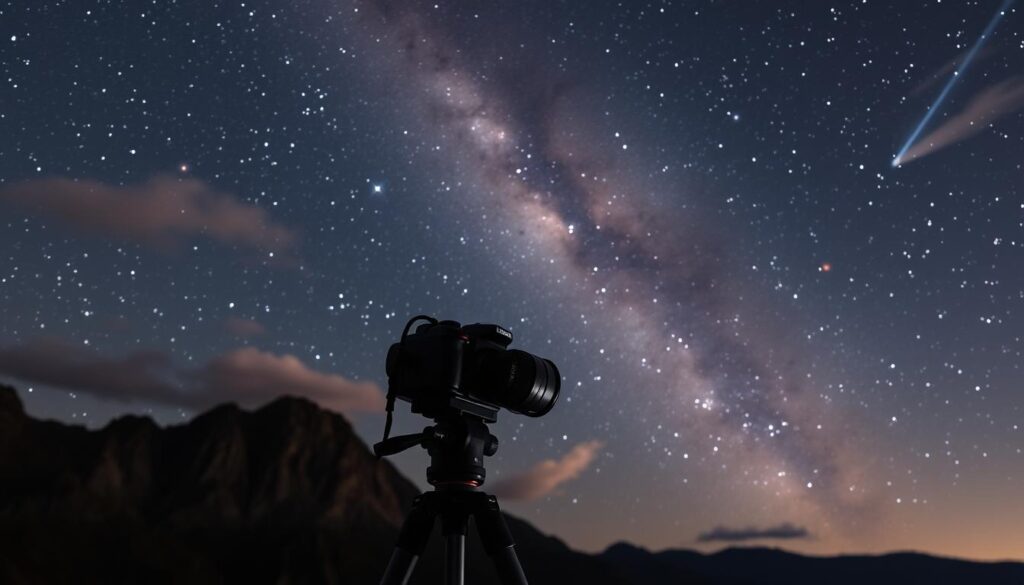
Knowing these challenges and having plans can help you get better photos of the Andromeda Galaxy.
Post-Processing Your Images
Post-processing brings your astrophotography images to life. It reveals the true beauty of M31. This stage is key for improving your images’ quality, making them more appealing and detailed.
Software Options for Editing
Choosing the right software for editing is the first step. Popular choices include Adobe Photoshop, PixInsight, and StarStax. Each offers unique features for astrophotography.
- Adobe Photoshop: Known for its versatility and advanced editing features.
- PixInsight: Specialized software for astrophotography, offering advanced processing techniques.
- StarStax: Ideal for stacking images, enhancing details, and reducing noise.
Basic Editing Techniques
Basic editing involves adjusting brightness, contrast, and color balance. These changes can make the Andromeda Galaxy more visible.
| Technique | Description | Effect on Image |
|---|---|---|
| Brightness Adjustment | Adjusting the overall brightness of the image. | Enhances visibility of faint details. |
| Contrast Adjustment | Adjusting the contrast between different parts of the image. | Makes the galaxy stand out more. |
| Color Balance | Adjusting the color tones to natural hues. | Provides a more realistic representation. |
Advanced Processing Techniques
Advanced techniques include layering images, removing noise, and applying filters. These methods can show the Andromeda Galaxy’s intricate details.
By mastering post-processing, you can turn your astrophotography into stunning images. These images capture the beauty and essence of the Andromeda Galaxy.
Sharing and Analyzing Your Work
The world is eager to see your Andromeda Galaxy astrophotography. Let’s explore how to share it effectively. Sharing your work not only showcases your skills but also contributes to the astronomy community’s knowledge and appreciation of celestial bodies like M31. By doing so, you can gain valuable feedback and insights from others.
You can share your Andromeda Galaxy images on various digital platforms. Social media platforms like Instagram and Facebook are popular choices, allowing you to reach a broad audience. You can also use specialized platforms like Flickr or 500px, which cater to photography enthusiasts. Consider sharing your work on astronomy-focused forums or websites too.
- Broaden your audience reach
- Engage with like-minded individuals
- Gain feedback and insights from the community
- Contribute to the astronomy community’s knowledge base
Engaging with the astronomy community can be incredibly rewarding. Join online forums, attend star parties, or participate in local astronomy clubs to connect with others who share your passion. These interactions can lead to valuable learning opportunities and help you stay updated on the latest astronomical events.
Getting feedback on your astrophotography work is crucial for improvement. By sharing your images and engaging with the community, you can receive constructive criticism and insights from experienced astronomers and photographers. This feedback can help you refine your techniques and capture even better images in the future.
The Science Behind M31
The Andromeda Galaxy, also known as M31, is a wonder of the universe. It gives us clues about the universe’s shape and growth. Being the closest big galaxy to the Milky Way, M31 is very interesting to scientists.
Its closeness lets astronomers study how galaxies move and change. This makes M31 perfect for learning about galaxy growth.
Structure and Composition
M31 is a spiral galaxy with arms full of stars, gas, and dust. It has a central bulge and a halo of stars around it. Studies show M31 has a lot of dark matter, which is key to its gravity.
The galaxy has many different stars, showing its long history. This history helps us understand how M31 has changed over time.
The Milky Way’s Future with M31
M31 and the Milky Way will collide in about 4.5 billion years. This will change both galaxies a lot. The collision will affect the structure and makeup of the new galaxy.
Even though stars won’t crash into each other, the gravity will be strong. This will create new stars and maybe even new planets.
Ongoing Research and Discoveries
Scientists are still learning about M31. They use many methods, like looking at different wavelengths, to study it. They also use advanced telescopes and imaging for M31 imaging tips.
For those wanting to photograph Andromeda Galaxy, knowing about M31’s science helps. It lets photographers plan better shots to show its beauty.
M31 and its Role in Popular Culture
The Andromeda Galaxy has a big impact on art, literature, and music. It’s a cultural icon that has inspired many works. Explore how this galaxy has captured human imagination and creativity.
Literary and Artistic Depictions
Many authors and artists have been inspired by the Andromeda Galaxy. In books, it often stands for the unknown or is a setting for science fiction. It’s mentioned in stories about space travel and searching for alien life.
In art, its spiral shape has inspired many. You can see its beauty in paintings and digital art. Science fiction novels often use it as a setting or reference. Artists have also been inspired, capturing its beauty in various forms.
| Medium | Examples | Notable Works |
|---|---|---|
| Literature | Science fiction novels | Works by authors like Isaac Asimov |
| Art | Paintings, digital art | Visual representations by space art enthusiasts |
| Film | Science fiction movies | Movies like “Contact” (1997) |
Movies Featuring the Andromeda Galaxy
The Andromeda Galaxy has been in many films. It’s often a symbol of space’s vastness or a destination for humans. Its role in movies can range from realistic to fictional.
“Contact” (1997) is a great example. It uses the Andromeda Galaxy in its story. Such movies entertain and inspire people to learn about the galaxy.
Influence on Music and Popular Media
The Andromeda Galaxy also influences music and popular media. You might hear about it in songs or see it in music videos. Its mystique is used in ads and media to show grandeur or futurism.
Some artists use the galaxy in their lyrics. They talk about distance, dreams, or our place in the universe. The galaxy’s image is also used in campaigns to show innovation or exploration.
Planning Future Observations
Planning your next astrophotography session is key, and the Andromeda Galaxy is a great target. To get the most out of your gear and skills, keep up with upcoming astronomical events. This will help you image M31 to its fullest potential.
Upcoming Events for Observing M31
The best times to see the Andromeda Galaxy are in autumn and early winter. Autumn and early winter are ideal seasons for viewing M31 in the Northern Hemisphere. Also, remember that a new moon phase offers the darkest skies, perfect for deep-space shots like M31.
How to Stay Updated on Astronomical Events
There are many ways to stay in the loop about astronomical events. You can sign up for astronomy newsletters or use astronomy apps for up-to-date info. Also, joining online forums or social media groups focused on astrophotography can keep you informed about the best viewing times.
- Subscribe to astronomy newsletters
- Follow astronomy apps for real-time updates
- Join online forums and social media groups for astrophotographers
Collaborating with Others in the Field
Working with other astrophotographers and astronomers can really boost your skills. Sharing knowledge and techniques can teach you new ways to capture the Andromeda Galaxy. Look into joining local astronomy clubs or online communities to meet others with similar interests.
Best camera settings for Andromeda Galaxy shots often include a low ISO and long exposure. Trying different settings and learning from others can improve your technique for capturing M31 in the night sky.
Considerations for Advanced Imaging Techniques
As you get better at capturing the Andromeda Galaxy, try out advanced imaging techniques. These methods give you a closer look at the galaxy’s structure and what it’s made of.
Narrowband Imaging
Narrowband imaging uses special filters to catch specific light wavelengths. It’s great for showing the galaxy’s gas and dust details.
Multi-Wavelength Astronomy
Multi-wavelength astronomy takes pictures in different light ranges, from visible to infrared. It shows the galaxy’s star formation and gas spread.
Using these advanced techniques, you can make your Andromeda Galaxy photos more detailed and informative.