
For capturing detailed images of the planets, the right telescope is key. You need one that offers high-resolution views of the solar system’s planets. The Celestron NexStar 8SE is a top choice for this.
This telescope is special because of its 8-inch aperture and Starbright XLT coatings. These features improve the quality of your images. Whether you’re experienced or new to astrophotography, the right telescope is crucial.
When looking for a Telescope for Astrophotography, think about what matters most. A strong mount and top-notch optics are important. They can greatly improve your imaging experience.
Understanding the Basics of Planetary Imaging
Planetary imaging is more than just looking at planets through a telescope. It’s about knowing your gear and techniques. Learning the basics is key to taking amazing pictures of the sky.
What is Planetary Imaging?
Planetary imaging is a way to take detailed photos of planets and other objects in our solar system. You use a telescope with a camera to capture these images. The quality of your photos depends on your telescope, its size, and how steady the mount is.
Key Features to Look for in a Telescope
Choosing the right telescope for planetary imaging is important. The aperture size matters a lot because it affects how much detail you can see. A bigger aperture means clearer images. Also, the quality of the optics is crucial for sharp images. Lastly, the type of mount is important for keeping the camera steady.
- Aperture size for resolution
- Optics quality for image clarity
- Mount type for stability and tracking
Importance of Mount Stability
A stable mount is key for clear images. A shaky mount can ruin your photos. There are two main types of mounts: altazimuth and equatorial. Equatorial mounts are better for tracking objects as they move.
Knowing these basics will help you pick the right telescope and gear. This will improve your ability to take beautiful pictures of the planets.
Types of Telescopes for Planetary Photography
For those into planetary photography, knowing the different telescopes is key. The right one can greatly improve your photos.
Refractor Telescopes
Refractor telescopes give sharp, clear views, perfect for planets. They use a lens to focus light, offering detailed images. They also keep their image quality over time, unlike some others.
Key Features:
- High-contrast images
- Minimal maintenance
- Less susceptible to mirror flop
Reflector Telescopes
Reflector telescopes are cheaper but offer big apertures. They’re great for detailed planet shots without spending a lot. They use a mirror to gather and focus light, capturing more detail.
Advantages:
- Cost-effective for larger apertures
- High light-gathering capability
- Suitable for deep-space observation
Catadioptric Telescopes
Catadioptric telescopes mix refractor and reflector benefits. They’re compact and versatile, perfect for planetary photos. They use lenses and mirrors to correct optical issues, giving clear images.
Key Benefits:
- Compact and portable design
- High image quality with minimal distortion
- Versatile for various astronomical applications
To understand the differences, here’s a comparison table:
| Telescope Type | Image Quality | Cost | Portability |
|---|---|---|---|
| Refractor | High Contrast | Generally Higher | Moderate |
| Reflector | High Resolution | Cost-Effective for Larger Apertures | Bulkier |
| Catadioptric | High Quality with Minimal Distortion | Varies | Compact and Portable |
For more info on choosing the best telescope for planetary imaging, check out this resource.
Top Brands for Planetary Imaging Telescopes
To get amazing planetary images, you need a telescope with great optics and features. Top brands offer telescopes made for planetary imaging. Each brand has its own strengths and features.
Celestron
Celestron is known for its innovative telescopes and high-quality optics. Their NexStar series has SkyAlign technology and StarBright XLT coatings. It’s perfect for planetary imaging.
Celestron’s Key Features:
- Advanced computerized mounts for precise tracking
- High-quality optics for clear, sharp images
- Innovative designs for ease of use
Meade Instruments
Meade Instruments is a well-known brand for telescopes good for planetary imaging. Their LX series has advanced optics and strong mounts. It’s great for detailed planetary images.
Meade’s Key Features:
- Advanced optics for high-resolution imaging
- Robust mounts for stable tracking
- Enhanced features for improved image quality
Sky-Watcher
Sky-Watcher is known for its high-quality telescopes with excellent optics. Their telescopes are perfect for clear, sharp images. They’re great for planetary imaging.
Sky-Watcher’s Key Features:
- High-quality optics for detailed imaging
- Durable construction for long-lasting performance
- Range of models to suit different needs and budgets
Here’s a comparison of the three brands:
| Brand | Model | Optics Quality | Mount Stability |
|---|---|---|---|
| Celestron | NexStar 8SE | High | Excellent |
| Meade Instruments | LX600 ACF | High | Excellent |
| Sky-Watcher | Heritage 130P | High | Good |
When picking a telescope for planetary imaging, look at the brand’s reputation and the optics quality. Also, consider the features that improve image quality. Choosing a top brand ensures you get a quality telescope for stunning planetary images.
Recommended Telescopes for Beginners
Starting with planetary photography? You’ll need a telescope that’s easy to use and gives great images. It’s key to pick one that’s good, affordable, and simple to use.
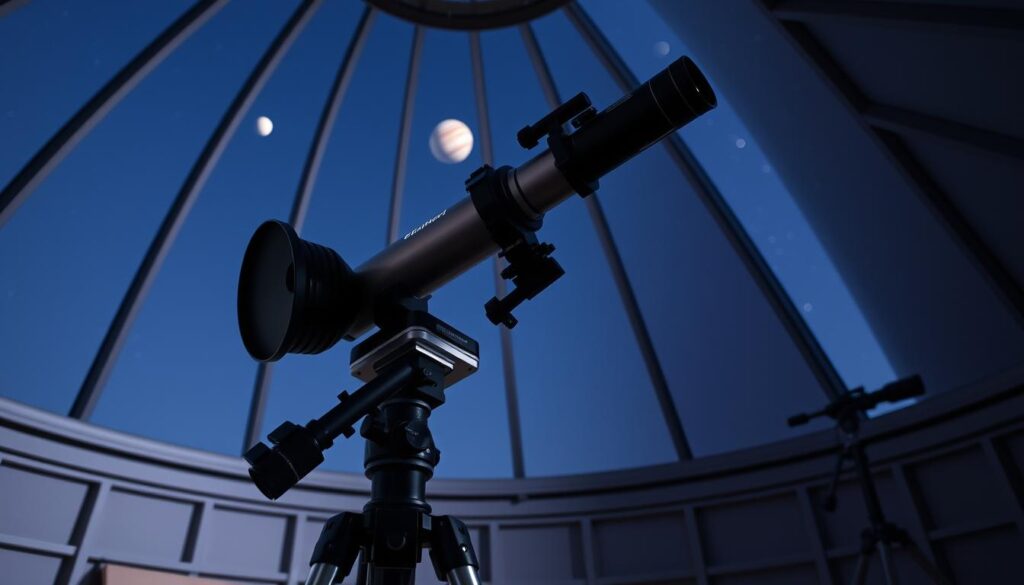
Celestron AstroMaster 70AZ
The Celestron AstroMaster 70AZ is perfect for beginners. It has a 70mm aperture and a strong altazimuth mount. This makes it easy to move around the sky. It’s a refractor telescope great for seeing planets clearly.
Meade Infinity 102
The Meade Infinity 102 is also great for newbies. It has a 102mm aperture, which means it can capture more light. This results in better images. Plus, its altazimuth mount is easy to use.
Sky-Watcher Heritage 130P
The Sky-Watcher Heritage 130P is a reflector telescope with a big 130mm aperture. It’s great for getting detailed images of planets. Its design is compact and simple, perfect for beginners who want quality without hassle.
These telescopes are top picks for beginners in planetary imaging. They offer a great mix of quality, ease of use, and price. They’re ideal for capturing stunning images of the planets.
Advanced Telescopes for Serious Astrophotographers
If you’re serious about astrophotography, you need a telescope that captures high-resolution images of planets. Advanced telescopes meet these high standards. They offer superior optics, strong build, and new features.
Celestron EdgeHD Series
The Celestron EdgeHD Series is known for its exceptional optical quality and advanced features. These telescopes are perfect for serious astrophotographers. They provide high-resolution images without extra correction lenses.
- EdgeHD optics for improved image quality
- Advanced coma correction for wider fields
- Robust construction for stability
Meade LX600 ACF
The Meade LX600 ACF telescopes are made for high-performance astrophotography. Their Advanced Coma-Free (ACF) optics give sharp, clear images everywhere in the field.
- Advanced Coma-Free optics for superior image quality
- Precision tracking for accurate imaging
- High-quality construction for durability
Orion 10″ f/3.9 Imaging Newtonian
The Orion 10″ f/3.9 Imaging Newtonian is a high-speed telescope for astrophotography. Its fast f/3.9 focal ratio means shorter exposure times. It’s great for capturing images of planets.
- Fast f/3.9 focal ratio for shorter exposures
- Newtonian design for clear, detailed images
- Robust construction for stable performance
Essential Accessories for Planetary Imaging
Along with a top-notch Planetary Imaging Telescope, you’ll need some key accessories for better astrophotography. A good telescope is important, but the right extras can make your planetary photos even better.
Barlow Lenses
A Barlow lens is key for planetary shots. It boosts your telescope’s magnification, letting you see more details on planets. With double or triple magnification, you can spot finer features on planetary surfaces.
Camera Adapters
Camera adapters are vital for linking your camera to your telescope. They let you take pictures through the telescope. There are adapters for DSLR cameras and special astronomy cameras, fitting different telescopes.
Filters and Other Tools
Filters are crucial for better planetary images. They cut down glare and boost contrast. Color filters highlight certain details, while neutral density filters soften bright spots. Tools like autoguiders and adaptive optics also help, correcting for tracking errors and atmospheric distortions.
Adding these essential accessories to your setup will greatly enhance your planetary images. You’ll be able to capture stunning details of the planets.
Tips for Successful Planetary Imaging
To get the best from your telescope for astrophotography, follow some key tips. High-quality planetary images require the right setup, shooting conditions, and post-processing. These steps are essential.
Best Practices for Equipment Setup
Setting up your telescope right is key for planetary imaging. Make sure it’s stable and level. Any shakes or misalignments can ruin your images. Use a strong mount and think about adding a barlow lens for more magnification.
- Align your telescope properly to avoid image distortion.
- Use a remote shutter release or timer to minimize camera shake.
- Ensure your camera is compatible with your telescope.
Ideal Shooting Conditions
The quality of your images depends a lot on the shooting conditions. Aim for clear, stable skies. Avoid nights with strong winds or big temperature changes, as they can mess up your images.
- Check the weather forecast to choose the best night for imaging.
- Image planets when they are at their highest point in the sky.
- Use software to help you determine the best times for imaging based on your location.
Post-Processing Techniques
Post-processing is vital in planetary imaging. It’s about making your images better by enhancing details. Use tools like Adobe Photoshop or astrophotography software to tweak brightness, contrast, and color.
- Stack multiple images to improve image quality.
- Adjust the wavelet filters to enhance details.
- Use histogram adjustments to optimize the image.
By following these tips and practicing, you can get better at planetary imaging. You’ll be able to take amazing pictures with your best telescopes for astrophotography.
Common Challenges in Planetary Imaging
Capturing high-resolution images of planets is not easy. It comes with several obstacles. Knowing these challenges is key to getting great results.
Dealing with Atmospheric Disturbances
Atmospheric disturbances are a big problem in planetary imaging. They can blur and distort your images. To fight this, you can:
- Use a telescope with top-notch optics.
- Apply image processing software to fix distortions.
- Take many images and pick the sharpest ones.
Managing Focus and Stability
Keeping your images sharp requires managing focus and stability. A stable mount is crucial. It keeps your telescope steady for precise focusing. You can:
- Choose a strong and reliable telescope mount.
- Use a Barlow lens to boost magnification.
- Use a remote shutter release or timer to avoid camera shake.
Lighting Issues
Lighting problems, like glare and overexposure, can be tough. To tackle these, you can:
- Apply filters to cut down glare and boost contrast.
- Adjust your camera’s exposure settings for better image capture.
- Use a camera adapter for proper alignment and less light loss.
By tackling these common challenges, you can greatly enhance your planetary images’ quality.
Conclusion: Choosing the Right Telescope for You
Finding the perfect telescope for planetary imaging can seem hard. But, by thinking about what you need and how much you can spend, you can choose well. Whether you’re new to astronomy or have been at it for years, there’s a Top Telescopes for Planetary Imaging out there for you.
Assessing Your Requirements
To pick the Best Telescopes for Planetary Photography, think about what you want to see. Consider the objects you’re interested in, how much detail you want, and what gear you already have.
Budgeting for Your Telescope
Telescope for Planetary Observation vary in price. Knowing your budget helps you focus. Remember, the cost of the telescope isn’t the only thing to consider. Think about the accessories you might need too.
Final Recommendations
With your needs, budget, and this guide, you can find the ideal Telescope for Planetary Observation. Look for Top Telescopes for Planetary Imaging that match your needs, offer great features, and fit your budget.