
Capturing the vastness of the night sky needs a special camera. It must handle the challenges of deep space photography well. You want a camera that takes high-quality images with little noise and lots of detail.
For deep sky astrophotography, some features are key. These include a high ISO range, a full-frame sensor, and image stabilization.
Top cameras like the Canon EOS R6, Nikon D780, and Fujifilm X-T5 are great for low-light shots. For more info on cameras for astrophotography, check out this guide on Canon cameras for astrophotography. These cameras have the features you need to capture the night sky’s beauty.
Understanding Deep Sky Astrophotography
Deep sky astrophotography is about taking pictures of stars, galaxies, and nebulae. It needs both astronomy and photography skills. It’s not just about taking photos; it’s about showing the details of the universe that we can’t see with our eyes. To get great pictures, you need the right tools and knowledge.
What is Deep Sky Astrophotography?
Deep sky astrophotography is a special kind of photography. It focuses on capturing images of far-off objects like galaxies and nebulae. It’s different from other types of photography because it takes a lot of time to get the right shot. The aim is to create images that are not only beautiful but also show the science behind the stars.
You must know the basics of astronomy to do this. This includes understanding how stars and planets move and when to take pictures. Knowing this helps you plan your shoots and get ready for the challenges of deep sky photography.
Importance of Camera Quality
The quality of your camera is very important in deep sky astrophotography. A good camera should be sensitive, have low noise, and handle long exposures well. The type and size of the sensor are key to how well a camera works in the dark. Cameras with full-frame sensors usually do better than those with crop sensors because they are bigger and more sensitive.
When picking a camera for deep sky photography, look at its ISO range and how it cools the sensor. Cameras made for astrophotography often have cooled sensors and special noise reduction tools. These features help capture the faint details of distant stars and galaxies.
Key Features to Look for in Astrophotography Cameras
To capture stunning images of celestial objects, you need a camera that excels in several critical areas. The right camera can make a significant difference in the quality of your deep sky astrophotography.
Sensor Type and Size
The type and size of the camera’s sensor are key. A full-frame sensor is often preferred. It’s larger and more sensitive, capturing more light and detail in low light.
Full-frame sensors also reduce noise better at high ISOs. This makes them perfect for capturing faint celestial objects.
A larger sensor can capture more light and provide better image quality. But, remember to consider the camera’s design and how the sensor works with other features like lens quality and image stabilization.
ISO Range and Sensitivity
The ISO range and sensitivity of a camera are vital for astrophotography. A camera with a high ISO range (up to 51200 or higher) is great for capturing distant celestial objects without too much noise. Good low-light performance is also key for capturing detailed images of faint objects.
When choosing a camera for astrophotography, look for models with good ISO performance and minimal noise at higher ISO settings. This ensures your images are clear and detailed, even of faint celestial bodies.
In summary, when selecting a camera for deep sky astrophotography, consider the sensor type and size, as well as the ISO range and sensitivity. By choosing a camera that excels in these areas, you can significantly enhance the quality of your astrophotography.
Top DSLR Cameras for Deep Sky Astrophotography in 2025
The world of deep sky astrophotography is getting better thanks to new DSLR tech. In 2025, two cameras are leading the pack: the Canon EOS Ra and the Nikon D780.
Canon EOS Ra
The Canon EOS Ra is a special version of the EOS R, made just for astrophotography. It has a 30.3-megapixel full-frame CMOS sensor and a modified IR filter. This filter helps capture light from nebulae better.
- High ISO range: Great for shooting in low light.
- Dual Pixel AF: Makes focusing on stars easier.
- Vari-angle touchscreen LCD: Helps with framing and focusing, even in tough conditions.
Nikon D780
The Nikon D780 is also a top choice for deep sky astrophotography. It has a 24.5-megapixel full-frame sensor and is excellent in low light. This is thanks to its high ISO range and advanced noise reduction.
- Fast autofocus: Uses Nikon’s advanced system for quick focusing.
- Weather sealing: Keeps the camera safe from the weather, letting you shoot in many conditions.
- 4K video capability: Shows the D780’s versatility, even though it’s mainly for stills.
Both cameras are great for deep sky astrophotography. They have features that meet the needs of astrophotographers. Your choice will depend on what you want to capture and your current lenses.
Best Mirrorless Cameras for Astrophotography
The best mirrorless cameras for astrophotography have the latest tech and great low-light performance. You need a camera that captures the night sky well, with clear images and little noise.
The Sony Alpha a7 III and the Fujifilm X-T4 are top choices. They stand out for their features in astrophotography.
Sony Alpha a7 III
The Sony Alpha a7 III has a full-frame sensor for better light capture and less noise in the dark. It also has a wide ISO range (100-51200, expandable to 50-204800), making it great for the night sky.
This camera’s image stabilization reduces camera shake and blur. Its weather-sealing also protects it from the elements, making it perfect for outdoor shoots.
Fujifilm X-T4
The Fujifilm X-T4 has an APS-C sensor but still takes excellent photos. It’s fast and good for capturing fast events like meteor showers.
It also has in-body image stabilization. This helps keep the camera steady for sharper photos, even with unstabilized lenses.
| Camera Model | Sensor Type | ISO Range | Image Stabilization |
|---|---|---|---|
| Sony Alpha a7 III | Full Frame | 100-51200 | Yes |
| Fujifilm X-T4 | APS-C | 160-51200 | Yes (In-body) |
For more info on mirrorless cameras for astrophotography, check out this article. It reviews some of the best models.
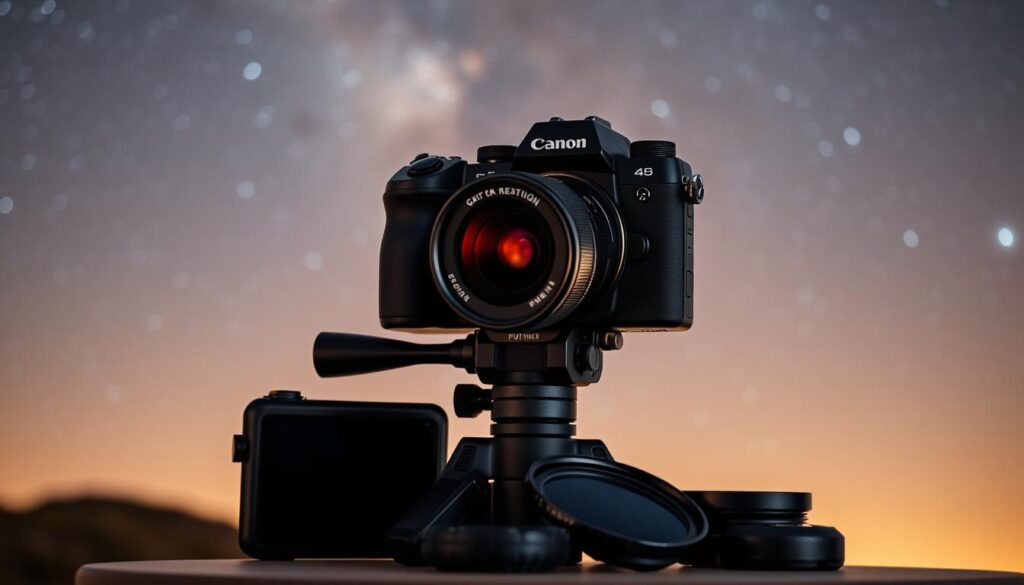
Budget-Friendly Options for Aspiring Astrophotographers
Aspiring astrophotographers don’t need to spend a lot to take amazing pictures of the sky. New technology has made entry-level cameras very good. They have features that were once only found in expensive cameras.
Best Entry-Level DSLRs
Entry-level DSLRs are great for beginners because they’re affordable and packed with features. The Canon EOS Rebel T7 has an APS-C sensor and can handle high ISOs. It’s easy to use and works with many lenses.
The Nikon D3500 also stands out. It takes great pictures and has a guide mode for learning photography basics, including astrophotography.
Affordable Mirrorless Choices
Mirrorless cameras are popular for their small size and advanced features. The Sony Alpha a6100 is a top pick in the affordable mirrorless range. It has a 24.2MP APS-C sensor and fast autofocus. Its small size and lens compatibility make it perfect for night sky shots.
The Fujifilm X-T100 is another mirrorless camera worth considering. It has a vari-angle touchscreen LCD and improved autofocus. This makes it versatile for different astrophotography needs.
When deciding between DSLR and mirrorless, think about lens options, camera size, and your main astrophotography goals. Both types have great budget-friendly options for starting deep sky astrophotography.
High-End Cameras for Professional Astrophotography
For those who want the best in astrophotography, high-end cameras are the way to go. They offer top-notch image quality, advanced features, and strong performance. These cameras are made to capture the night sky’s details with precision and clarity.
The Canon EOS-1D X Mark III is a top pick for astrophotography. It has a full-frame sensor, a wide ISO range, and advanced image stabilization. These features make it perfect for capturing deep sky objects with great detail.
Canon EOS-1D X Mark III
The Canon EOS-1D X Mark III is known for its amazing low-light performance and weather-sealing. It’s great for tough astrophotography conditions. Its full-frame sensor gives high-resolution images with little noise, even at high ISOs.
- Full-Frame Sensor: Provides excellent low-light sensitivity and detailed images.
- Advanced Image Stabilization: Reduces camera shake and blur, crucial for long-exposure shots.
- Weather Sealing: Protects the camera from dust and moisture, ensuring reliability in various environments.
Panasonic Lumix S1R
The Panasonic Lumix S1R is also a top choice for astrophotography. It has a high-resolution full-frame sensor and advanced image stabilization. This makes it great for capturing stunning deep sky images.
- High-Resolution Sensor: Offers detailed images with exceptional clarity.
- Image Stabilization: Enhances the camera’s ability to capture sharp images during long exposures.
- Durable Construction: Built to withstand the rigors of frequent use in challenging conditions.
Both the Canon EOS-1D X Mark III and Panasonic Lumix S1R are at the forefront of astrophotography technology. They give professionals the tools to capture breathtaking images of the cosmos.
Accessories to Enhance Your Astrophotography Experience
For amazing deep sky photos, you need the right accessories. A great camera is key, but it’s not everything. Other tools can greatly improve your astrophotography.
Tripods and Mounts
A strong tripod and mount are crucial. They keep your camera steady for smooth tracking of stars. A good mount also helps track objects without blurring due to Earth’s rotation.
Choose a tripod that’s sturdy and can hold your camera and lens. For mounts, look for ones that track smoothly and support your gear’s weight.
| Tripod/Mount Feature | Importance | Benefit |
|---|---|---|
| Stability | High | Reduces camera shake and blur |
| Smooth Tracking | High | Allows for longer exposure without star trailing |
| Weight Capacity | High | Ensures the mount can handle your equipment |
Lenses Suitable for Deep Sky
Wide-aperture lenses (like f/2.8 or wider) are best for deep sky shots. They let in more light, helping you see fainter stars.
Some top lenses for deep sky astrophotography include:
- Lenses with focal lengths between 14-24mm for wide-field shots
- Lenses with a wide aperture to capture more light
- Lenses with low distortion to maintain image quality across the frame
Investing in the right gear like tripods, mounts, and lenses can greatly improve your astrophotography. You’ll get stunning images of the night sky.
Software and Post-Processing for Astrophotography
Post-processing is key in astrophotography. It lets you improve and fine-tune your deep sky images. The right software can greatly enhance your final image’s quality.
Best Software Options
Many software options are available for astrophotography post-processing. Adobe Lightroom and Photoshop stand out for their powerful tools. These include noise reduction, color grading, and image sharpening.
StarStax, PixInsight, and Adobe Camera Raw are also notable. They offer advanced features for astrophotography.
Tips for Effective Processing
Effective post-processing involves several key techniques. Using layers and masks lets you make precise adjustments. Curves help you get the right contrast and color balance.
Noise reduction is also crucial. Techniques like luminance noise reduction can reduce grain. This makes your images smoother and more detailed.
- Use layers and masks to make targeted adjustments.
- Adjust curves to achieve the desired contrast and color balance.
- Apply luminance noise reduction to minimize grain.
Conclusion: Choosing the Right Camera for You
Choosing the right camera for deep sky astrophotography is key. Your choice depends on your experience, budget, and what you like. This guide for 2025 shows many cameras for different needs.
Assessing Your Astrophotography Needs
Beginners can start with entry-level DSLRs or mirrorless cameras. They offer great value and don’t cost too much. For the best deep sky astrophotography, consider the Canon EOS Ra or Sony Alpha a7 III.
Cameras for Different Experience Levels
Professionals need high-end cameras with advanced features. The Canon EOS-1D X Mark III or Panasonic Lumix S1R are good choices. Think about your needs and budget to find the best camera for capturing the night sky’s beauty.